Mikhail Menshikov Afternoon
9 July 2026
Organiser: Nicholas Georgiou (Durham)
Venue: University of Durham, MCS2068
An afternoon of talks to remember Mikhail Menshikov, who passed away, aged 78, on 1 May 2026 after a short illness.
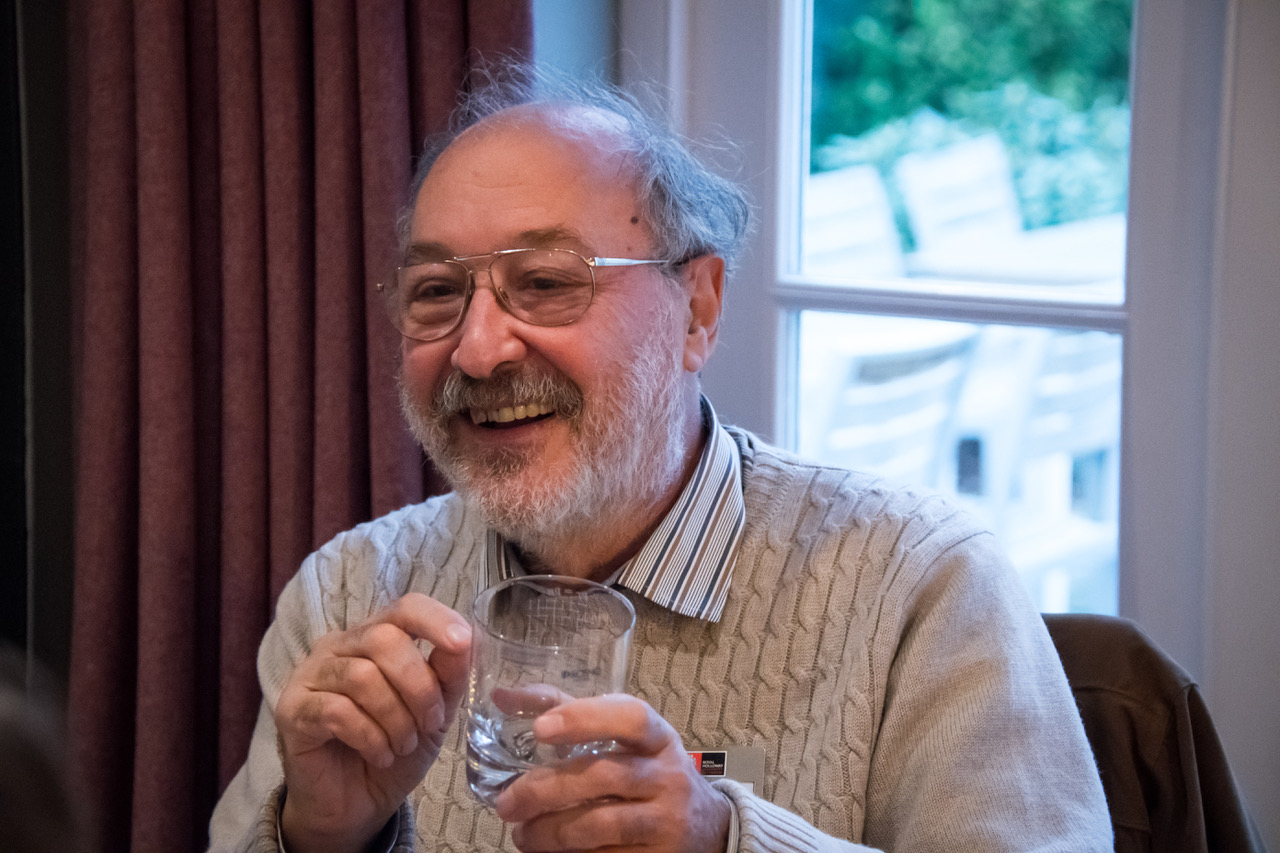
Misha was educated at Moscow State University where he also worked for many years. Following a period at the University of Sao Paulo, he came to Durham as Professor of Mathematics in September 2000. He was an expert in probability theory with nearly 100 publications and world leading results in percolation theory and random walks. Misha supported the development of other colleagues and contributed significantly to the Probability group. He was a successful PhD supervisor with most of his ten students following an academic career. Misha partially retired in 2021 but continued his research and teaching, including as module leader for Discrete Mathematics which is taken by most year 1 Mathematics students.
Programme
14:00-14:25
Nicholas Georgiou
(Durham University)
This question was a favourite of Mikhail's - he had an excellent probabilistic intuition for problems like this type - and he used to like teasing other probabilists with it. (Many, being aware of Pólya's recurrence classification for simple random walks, would suppose the answer to be yes.)
I'll present some examples, essentially due to Mikhail, which show that for non-homogeneous random walks the answer is rather subtle, as there are walks exhibiting either possible behaviour (recurrence or transience) in all dimensions at least 2.
14:30-14:55
Conrado Da Costa
(Universidade de São Paulo)
This talk is a personal and mathematical tribute to Mikhail Menshikov. We will recall some of his trajectory from the Moscow school of probability, shaped in the circle of Vadim Malyshev, to his years in Brazil and later in the United Kingdom.
On the mathematical side, the talk will focus on Menshikov’s contribution to the study of random walks in the quarter plane and in related constrained domains. I will describe how, for Malyshev's group, this subject was led to approaches based on complex analysis, boundary value problems, and algebraic ideas. Next, we will see how Menshikov instead adopted a distinct probabilistic viewpoint, based on Foster–Lyapunov functions and semimartingale methods, a red thread in Menshikov's research trajectory that later became central to his work on non-homogeneous random walks and phase transitions between recurrence and transience. The aim is to remember not only his results, but also his mathematical style, his personality, the memories, and legacy he left through collaborators, students, and friends.
On the mathematical side, the talk will focus on Menshikov’s contribution to the study of random walks in the quarter plane and in related constrained domains. I will describe how, for Malyshev's group, this subject was led to approaches based on complex analysis, boundary value problems, and algebraic ideas. Next, we will see how Menshikov instead adopted a distinct probabilistic viewpoint, based on Foster–Lyapunov functions and semimartingale methods, a red thread in Menshikov's research trajectory that later became central to his work on non-homogeneous random walks and phase transitions between recurrence and transience. The aim is to remember not only his results, but also his mathematical style, his personality, the memories, and legacy he left through collaborators, students, and friends.
15:00-15:25
Andrew Wade
(Durham University)
I will give a brief introduction to one of Mikhail Menshikov's most famous results, in percolation theory.
15:30-15:55
Vadim Shcherbakov
(Royal Holloway University of London)
This brief tribute is a personal recollection of Mikhail Menshikov, both as an outstanding mathematician and as a remarkable human being.
Followed by
Drinks reception in MCS on 2nd floor outside the Maths office.