Description
To describe the dynamics of atom size objects, one must use the theory of Quantum Mechanics as Newtonian dynamics cease to be applicable. Instead of having a precise speed and position dynamical objects are described by a wave function, called a probability density function, used to compute the probability for the object to be in a specific position or state.One consequence is that in a potential well, particles such as electrons can only be in a discrete set of states with restricted energy values. One of the problem consists in determining these energy values as well as the corresponding wave function.
This can be done for simple,1 dimensional, systems as well as 2 or 3 dimensional ones. Some standard system can be solve analytically but more complex ones must be solved numerically.
The aim of the project is to initiate you to the fundamental properties of quantum mechanics and to solve some concrete problems mostly numerically in python. You will be asked to read some chapter of the Griffiths book as well as some pdf documents covering more specific topics and numerical methods. No previous knowledge of Quantum Mechanics is required.
The project is mostly computational and so will involve an extensive amount of programming in python.
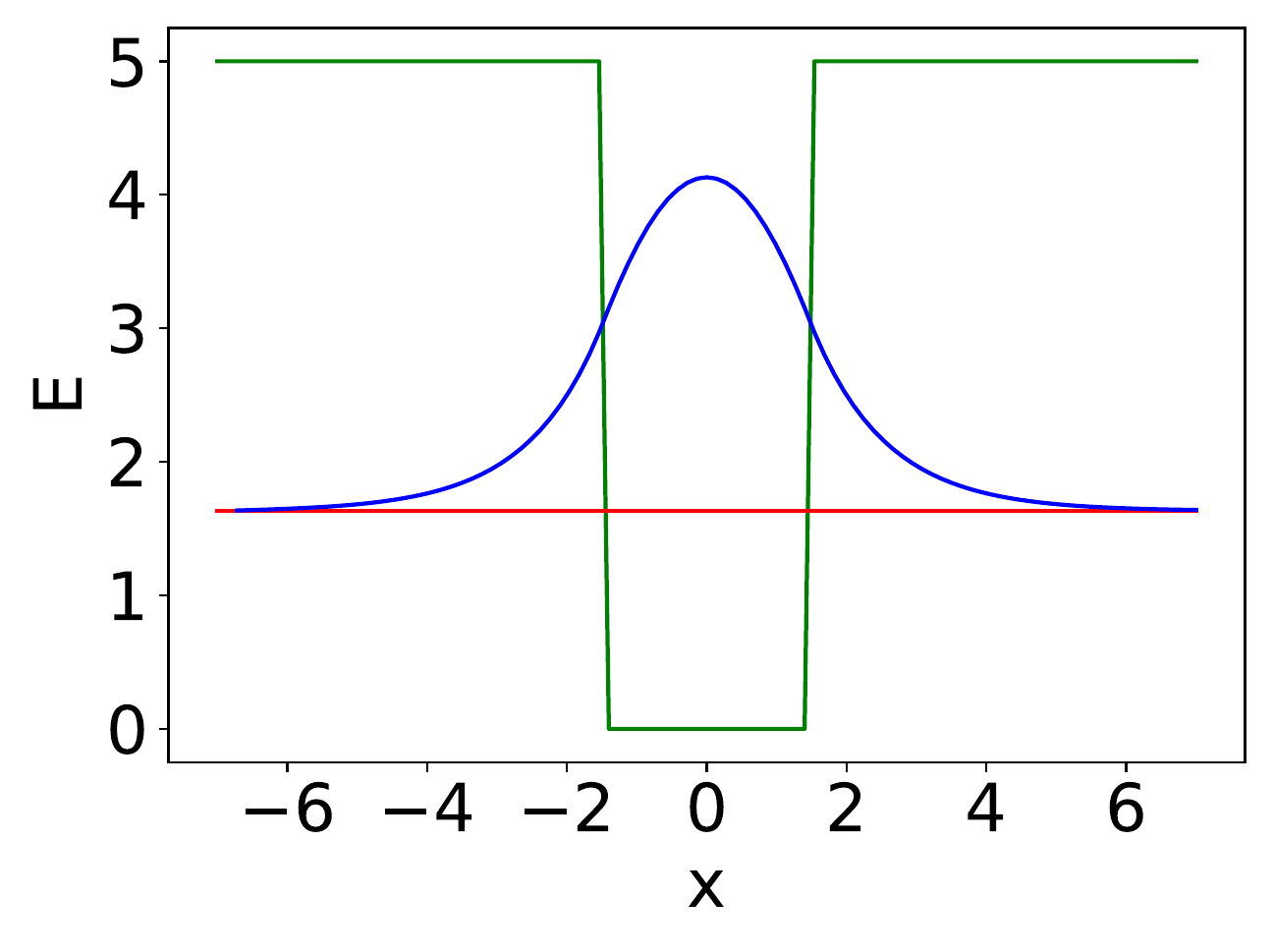
An electron in a square potential well
Group project
The group project will revolve around learning basic concepts and results in the field of convex analysis. By the end of the group project we would have learned- The fundamental principle of quantum mechanics
- Some advanced python skills such as numpy and classes.
- Solve the statics Schroedinger equation for simple square potentials.
- Solve the statics Schroedinger equation numerically.
- Solve the time dependant Schroedinger equation numerically.
- Write python programs to graphically display the probability density function and
generate figures such as
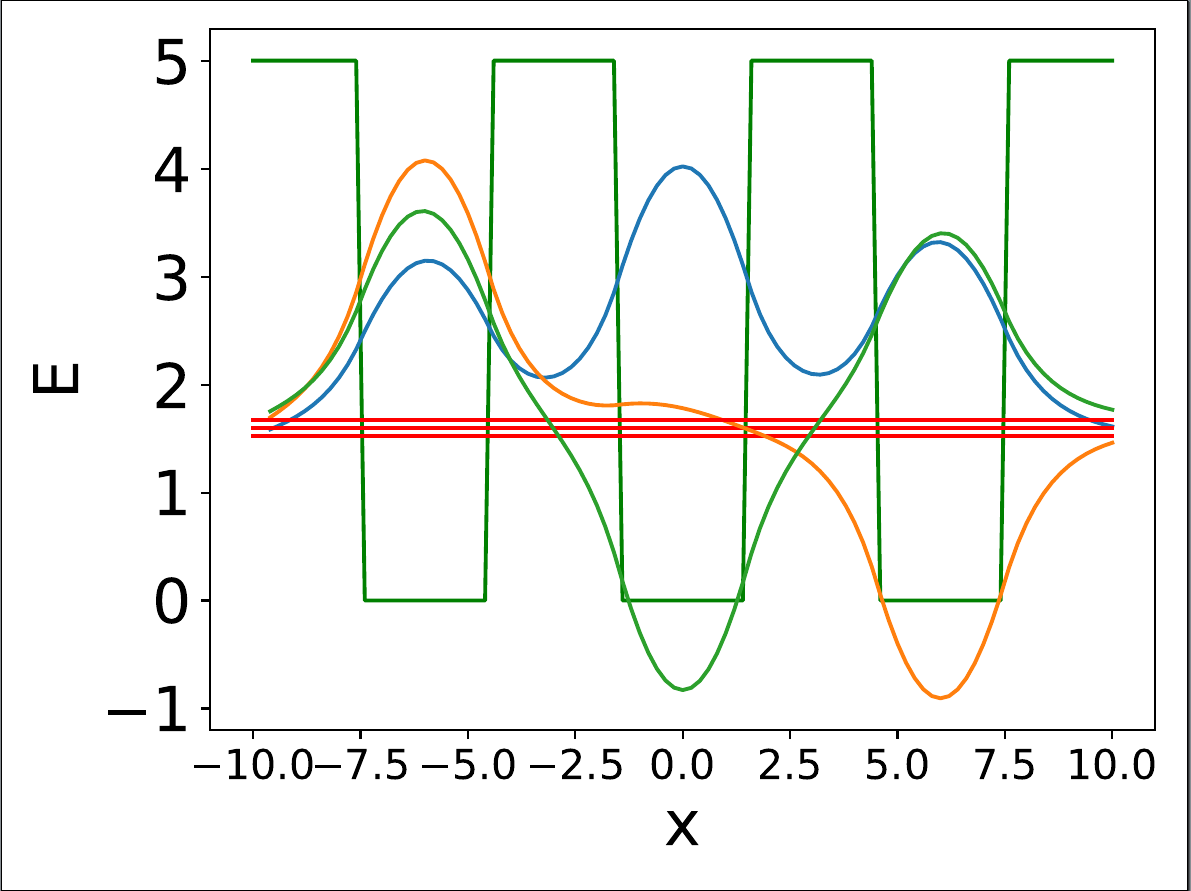
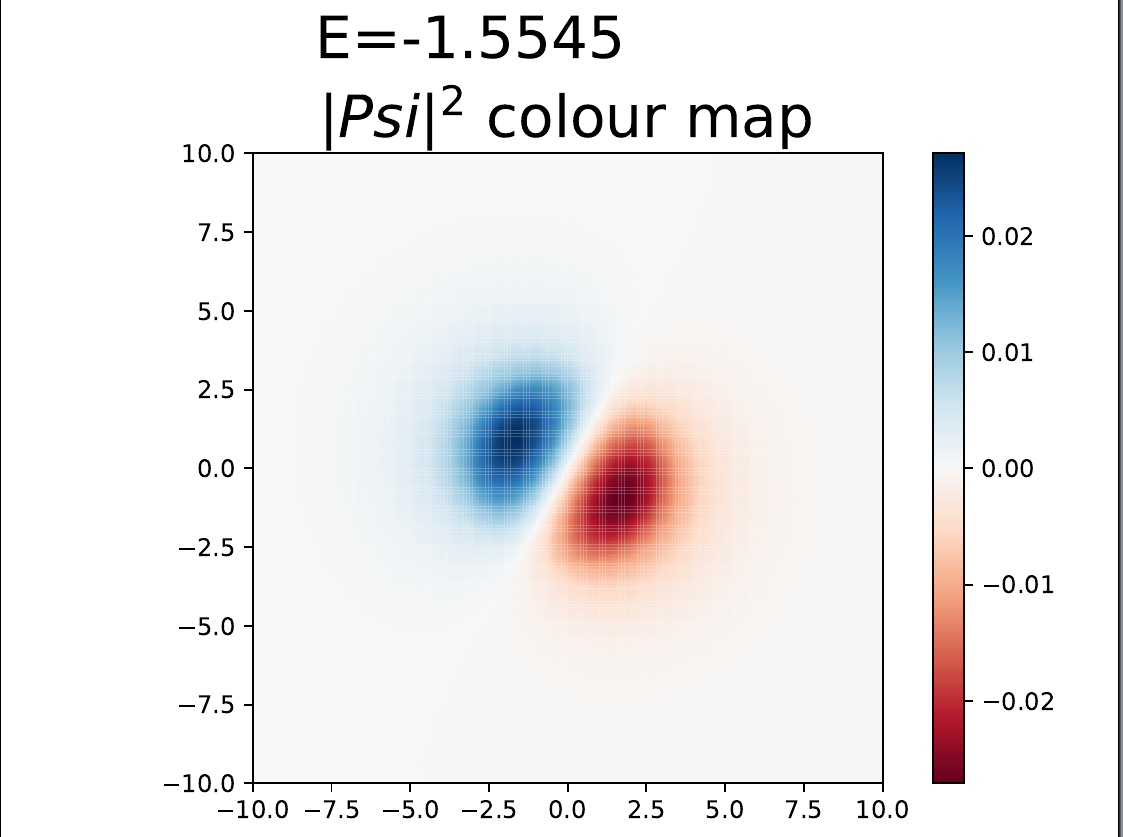
Electron in a triple potential well and in a 2d quare well
Mode of Operation and Evidence of Learning for the group project
The project will revolve around learning through reading as well as modifying and extending some provided python programs. Students will demonstrate their understanding by solving related relevant problems, exploring examples and theoretical applications of the covered material, as well as clearly communicating the findings both orally and in writing.Individual project
The individual project will build on the knowledge we have gained in the group project and will explore additional advanced topics. Examples of topics that could be investigated are:- Study numerically the scattering of a wave packet on a potential well or a potential barrier.
- Solve the Schroedinger equation numerically, in 2 dimensions, for an electron gravitating around 2 atom nucleus.
- Study numerically the formation of electron conducting bands in metals.
- Solve numerically the nonlinear Schroedinger equation.
- Study some interference patterns numerically
Prerequisites
- Programming and Dynamics (MATH1041)
Resources
- Introduction to quantum mechanics David Griffiths.
- Several pdf documents and sample python programs.