Description
The Cantor set is a fundamental object in topology which appears naturally throughout mathematics, from measure theory to logic to functional analysis. Compact, uncountable, perfect (i.e. no isolated points), and totally disconnected, it is—up to homeomorphism—the unique metrisable space with these properties. Because of this uniqueness, the study of the Cantor set is essentially the study of its self-homeomorphisms φ: X → X.
What do these homeomorphisms look like? How can they be classified, and what structure do they carry? These questions turn out to be incredibly rich. A central concept in addressing these questions is the use of Bratteli diagrams.
In brief, a Bratteli diagram is an infinite graph B = (V, E) where the vertex set V = ⋃i≥0Vi (with V0 a singleton) and the edge set E = ⋃i≥0Ei are partitioned into disjoint finite subsets Vi and Ei such that:
- each edge in Ei starts at vertex in Vi and ends at some vertex in Vi+1;
- each vertex in Vi is connected (through some e ∈ Ei) to a vertex in Vi+1 and vice versa.
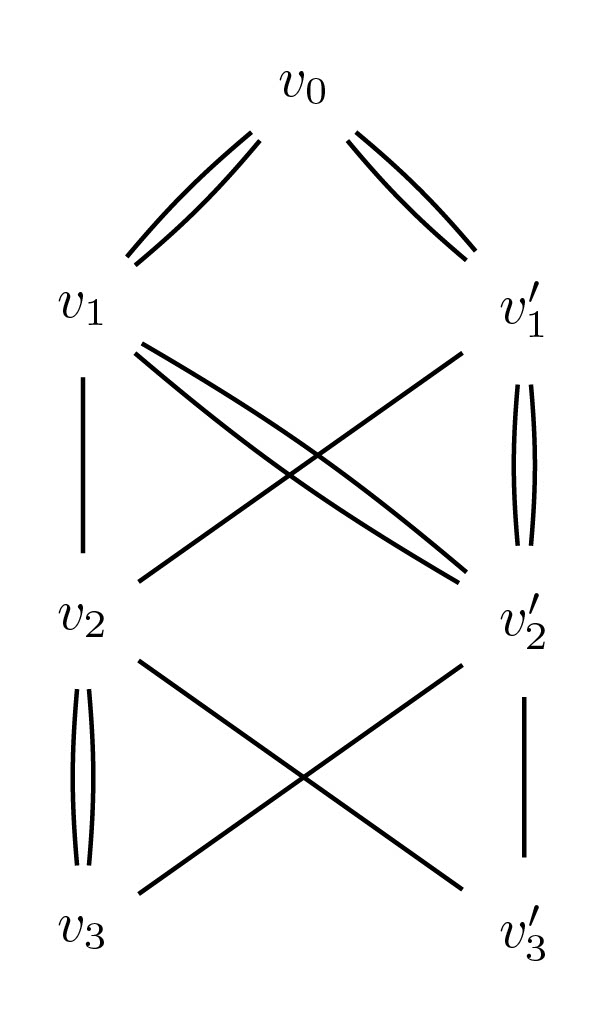
Under mild assumptions, the space of infinite paths through such a diagram admits a natural topology, rendering it homeomorphic to the Cantor set. Equipping the diagram with a suitable ordering induces a successor map on this path space—a homeomorphism of the Cantor set. One major theorem of the project that you may aim at is the converse: every homeomorphism of the Cantor set arises in this way.
Otherwise, some possible directions for the project include (but are not limited to) the following:
- Symbolic Coding and Subshifts: homeomorphisms given by shifting infinite sequences of symbols subject to certain (combinatorial) constraints;
- Invariant Measures: probability distributions that remain unchanged under the action of a homeomorphism;
- K-Theory: constructing algebraic invariants to classify and distinguish homeomorphisms;
- Topological Full Groups: massive groups of local symmetries generated by a homeomorphism;
- Topological Conjugacy: studying conditions that imply that two distinct homeomorphisms are topologically identical.