Project III 2026-2027
Beams, Barriers, and Backpropagation
Description
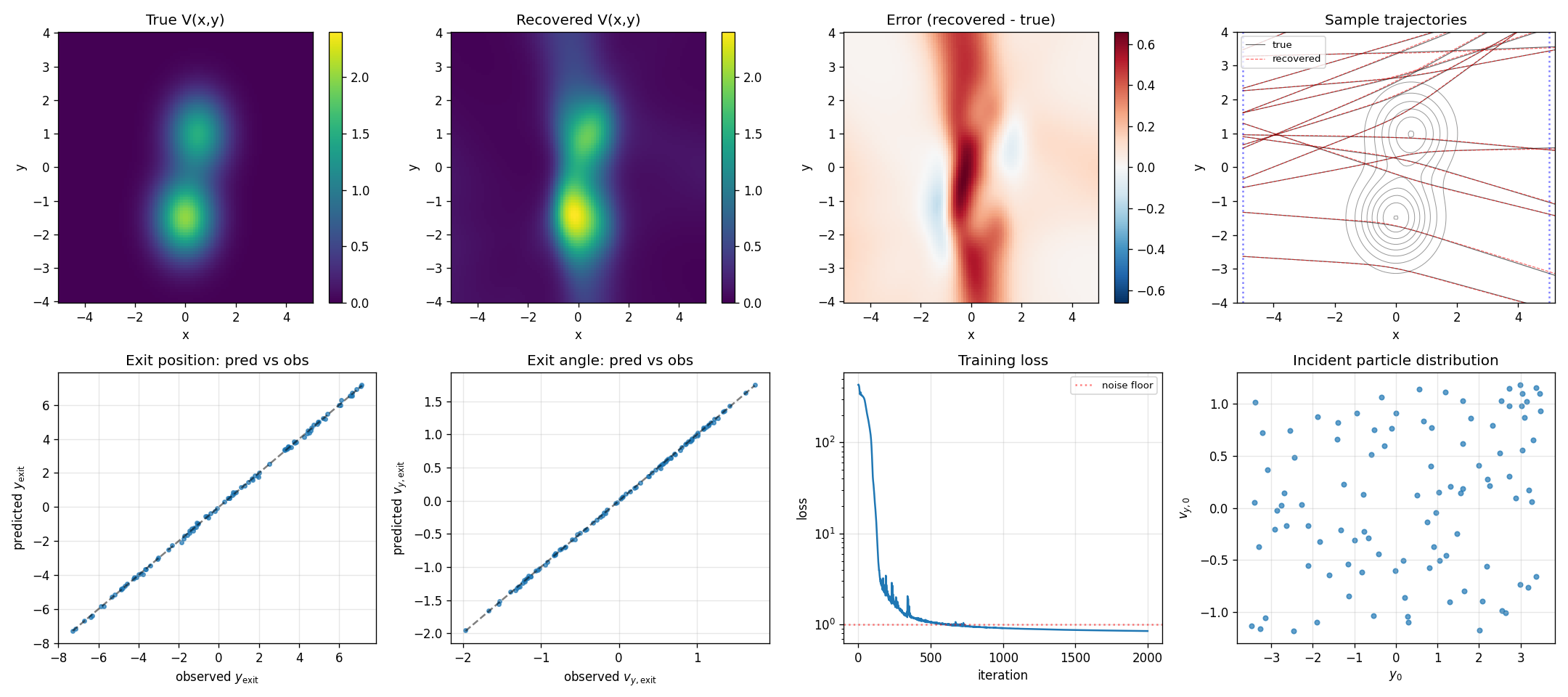
If you shoot particles at an unknown object and watch where they come out, can you reconstruct the object from how the particles were deflected? This inverse scattering problem appears in medical CT imaging, oil exploration, and quantum scattering experiments, and is notoriously messy to solve by classical methods.
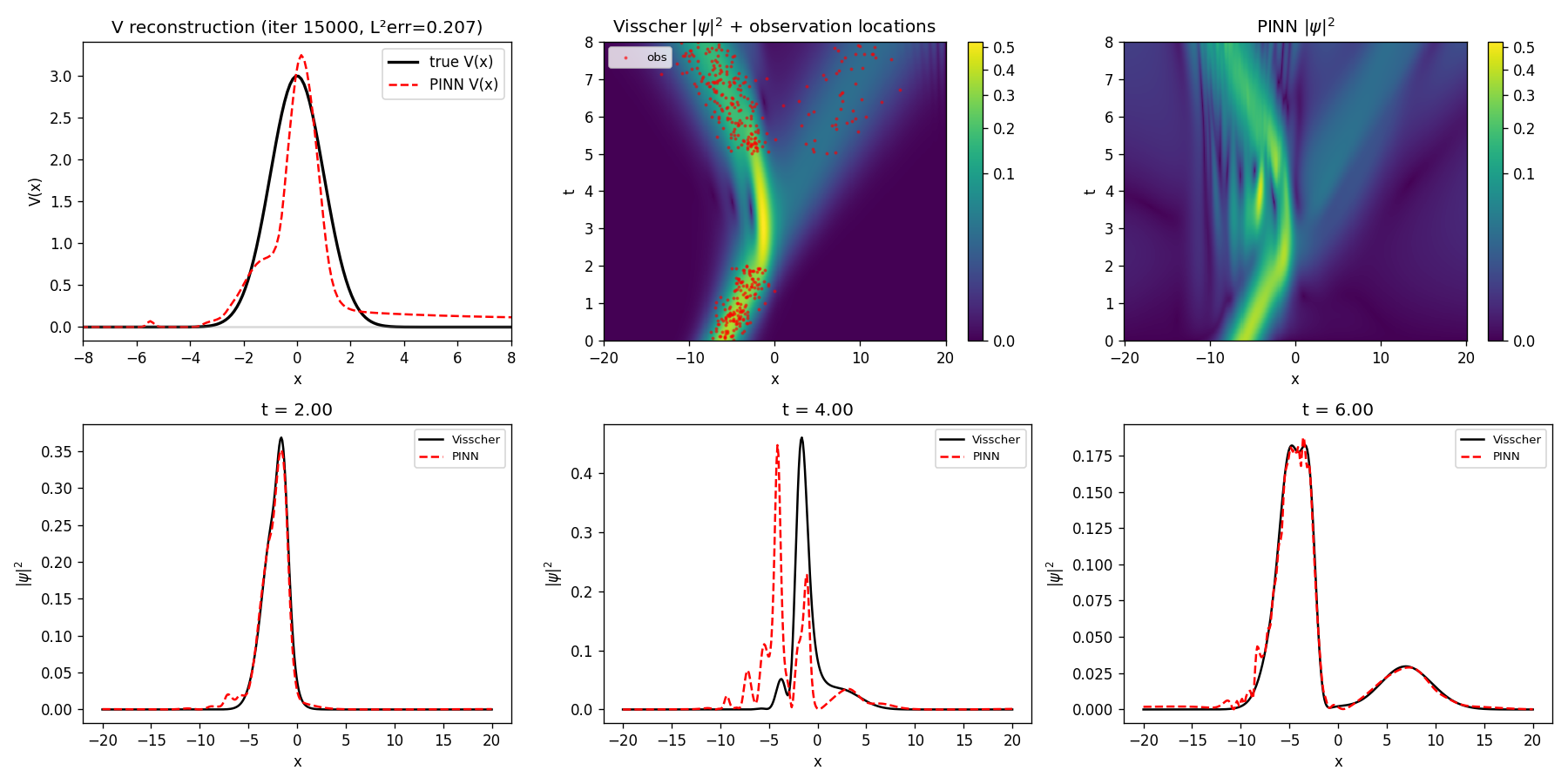
In this project you will tackle various versions of this problem, both in the context of classical physics (where the particle probes obey Newton's laws) and in the context of quantum mechanics (with wavepackets obeying Schrödinger's equation). You will use a modern approach based on machine learning techniques (also known as “physics-informed neural networks”). The idea is simple: parameterise the unknown potential as a small neural network, simulate the physics, and let automatic differentiation tell you how to improve the network until the simulation matches the observed data. You will have the opportunity to learn in which way this modern approach helps with inverse scattering problems, and what are its limitations.
Mode of Operation and Evidence of Learning
During the first few weeks you will mostly learn by reading review papers and articles. You will then focus mostly on doing hands-on work. You will learn by writing or adapting code in Python, by producing visualisations, and by using these programs and images to study questions about what can be recovered from limited measurements and where the methods (sometimes quietly) fail.
As you progress, you will have the opportunity to go into more depth of the mathematics and numerical background, and explore a topic or problem of your own choice. This may involve
- Two-dimensional quantum scattering in a potential.
- Comparison with other, non-machine-learning techniques.
- Applications in fluid flow.
- Other differentiable-physics problems.
Co- and pre-requisites
Having been exposed to quantum mechanics (either through Quantum Mechanics III or another module) is required. And even though you will read a lot and will be provided with sample programs, you will mostly learn by doing. You therefore have to have good Python skills. Prior experience with machine learning is not required.
Some background material
- “Physics-informed neural networks: A deep learning framework for solving forward and inverse problems involving nonlinear partial differential equations”, M. Raissi, P. Perdikaris and G.E. Karniadaki, Journal of Computational Physics 278 (2019) 686-707.