Overview
Research area: Applied mathematics
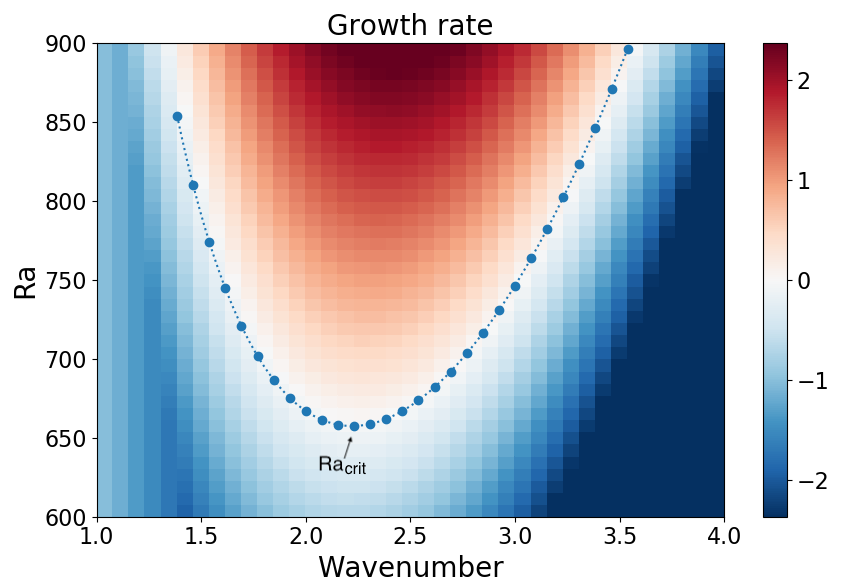
Convection is one of the primary mechanisms by which heat is transported in fluids, occurring when a fluid layer is heated from below or cooled from above. It plays a central role in a wide range of natural systems, from boiling water in a pan to the dynamics of Earth’s atmosphere and oceans, to the interiors of stars and giant planets.
In astrophysics and geophysics, convection governs how energy is transported through stellar interiors, drives atmospheric circulations, and contributes to magnetic field generation in planets. Despite the complexity of these systems, many of their essential features can be understood through simplified mathematical models.
One of the most important and well-studied models is Rayleigh-Bénard convection, which considers a layer of fluid heated from below and cooled from above. For small temperature differences, the fluid remains still and heat is transferred only by conduction. However, as the temperature difference increases, the warmer, less dense fluid at the bottom begins to rise, while cooler, denser fluid sinks.
Whether this motion occurs is determined by the
Group project
In the group component of this project, students will investigate the onset of convection using the Rayleigh-Bénard model. The aims of the group project will be to:
- derive the equations governing Rayleigh-Bénard convection;
- perform a linear stability analysis of the conductive state and determine the critical parameters which determine when convection begins and the characteristic size of convective cells;
- formulate and solve the resulting eigenvalue problem in MATLAB (or Python), and compute the critical values numerically;
- investigate how the onset of convection depends on boundary conditions that are not analytically tractable.
Mode of operation and evidence of learning for the group project
The project will require reading key texts to derive the governing equations and working through key linear stability calculations. The numerical code will be developed by working through standard eigenvalue examples in MATLAB or Python and adapting them to the Rayleigh-Bénard problem.
Students will demonstrate their understanding by comparing analytical predictions with numerical results, writing numerical code to implement core methods, and clearly communicating the material in both written and oral formats.
Individual project
The individual project will build upon the knowledge gained in the group project to explore more advanced topics. Some potential directions include:
- Rotating convection and oscillatory instabilities. Investigating how rotation modifies the onset of convection and can lead to oscillatory (time-dependent) instabilities, relevant to planetary interiors.
- Magnetoconvection. Studying how magnetic fields influence convective stability and flow structure, with applications to stars and planets.
- Double-diffusive convection. Exploring systems with two competing diffusive processes (e.g. heat and composition), leading to rich and complex behaviour.
- Weakly nonlinear convection. Extending linear theory to understand the role of nonlinear processes just above onset of convection.
- Reduced models for nonlinear convection. Investigating simplified or low-dimensional models of convection, including spatially localised structures (“convectons”).
Mode of operation and evidence of learning for the individual project
In the individual strand of the project students will learn through reading and identifying their own relevant resources. Depending on the direction taken, students may adapt the code developed in the group part of the project or develop new code based on related theory.
Students will demonstrate their understanding by deriving theory, exploring examples both analytically and computationally, and clearly communicating their findings in both written and oral formats.
Prerequisites/Corequisites
This is an applied project where you will carry out both analytical work and practical coding. You should therefore be confident with MATLAB and/or Python. Dynamics I and Mathematical Methods II are essential. Computational Mathematics II is also recommended.
It is strongly recommended that Fluid Mechanics III is taken alongside this project.
Resources
- Review paper by Goluskin (for background material on convection)
- Textbook by Chandrasekhar (classic textbook for linear stability problems)
- Lecture notes by Fielding (undergraduate level introduction to Rayleigh-Bénard convection)
- Paper by Hathaway et al. (1980) (research article exploring the onset of convection in an interesting geometry)
For more information email: Laura Currie