Description
Comparing plain numbers is usually straightforward -- no one loses sleep over whether \(1\) is smaller than \(2\). But once we move beyond fixed numbers to random objects, even random variables, things become rather more subtle. At times the comparison is obvious: for instance, a uniform random variable \(X\sim U(0,2)\) is clearly "smaller than" \(Y\sim U(3,5)\). What else could it be? In many other cases, though, the situation is far less clear-cut.
Take, for example, \(X\sim U(0,2)\) and \(Y\sim U(1,3)\). Since both random variables \(X\) and \(Y\) are defined as nice functions of \(\omega\in\Omega\), asking when \(X<Y\) is equivalent to asking when \(Y(\omega)-X(\omega)>0\). But this difference can behave differently, depending on how the two variables are constructed. In each of the diagrams below, the sample space \(\Omega\) is represented by the shaded region, and \(\omega\) is chosen in \(\Omega\) uniformly at random. In both cases, the individual coordinates \(X\) and \(Y\) have the correct marginal distributions, \(U(0,2)\) and \(U(1,3)\). Yet in the left-hand diagram we find that \(P(X<Y)=1\), while in the right-hand diagram this probability drops below \(1\) (can you compute it?).
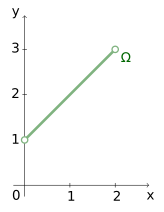
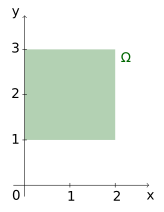
This idea -- building random variables together on a common probability space -- is known as coupling. It is a remarkably versatile technique in probability theory and its applications. Coupling often allows us to turn intuitive comparisons into rigorous arguments, and it provides elegant shortcuts through what might otherwise be rather involved calculations.
Prerequisites and Co-requisites
Probability II is essential. Stochastic Processes III might be helpful, depending on the chosen direction of study.Group Project
The group project will focus on exploring the core ideas behind the coupling method in probability. By the end, we will have a solid grasp of several fundamental concepts as well as a good collection of illustrative examples. In particular, we will have mastered:
- the basic idea of coupling and its formal definition
- monotone and independent coupling, and their relation to stochastic domination
- maximal coupling and the total variation distance
- various examples of coupling for random variables and probability distributions
- examples of coupling for stochastic processes, including random walks and Markov chains
Mode of operation and evidence of learning for the group project
The project will revolve around learning through reading with focus on the underlying theory, mathematical rigour, and the development of deep conceptual understanding. Students will demonstrate their understanding by solving relevant problems, exploring examples and theoretical applications of the material, and clearly communicating it in both written and oral formats.Individual Project
The individual project will build on the understanding developed during the group project and will give you the chance to explore a range of more advanced topics. Using coupling as a central tool, you will be able to investigate areas such as:
- general random walks, Poisson processes, and birth-death chains
- key properties of Markov chains, including mixing times, sampling methods, and card-shuffling models
- probabilistic inequalities and how coupling can be used to prove them
- discrete renewal processes, pinning models, and wetting phenomena
- percolation, Ising model, and other interacting particle systems
- diffusions and their behaviour under different coupling constructions
Mode of Operation and Evidence of Learning for the individual project
The project will revolve around learning through reading with focus on the underlying theory, mathematical rigour, and the development of deep conceptual understanding. Students will demonstrate their understanding by solving relevant problems, exploring examples and theoretical applications of the material, and clearly communicating it in both written and oral formats.Resources
- Wikipedia page on coupling is one of the most accessible entry points. It introduces the key idea and illustrates it with intuitive examples such as coupled random walks.
- Sébastien Roch, Modern Discrete Probability, Chapter 4: Coupling These lecture notes offer a clean, structured introduction. They begin with the formal definition of coupling, derive the coupling inequality, and show how coupling relates to total variation distance. They also include simple applications such as Poisson approximation and Markov chain mixing.
- Frank den Hollander, Probability Theory: The Coupling Method.
This is a slightly more advanced set of lecture notes. It starts with intuitive
games
that illustrate why coupling works, then moves into applications across random walks, Poisson approximation, card shuffling, and more. - Coupling and Convergence, a lecture slides from The Computer Laboratory, Cambridge. These notes introduce coupling through total variation distance and simple Bernoulli examples. They also show how coupling proves convergence of Markov chains.
- Torgny Lindvall, Lectures on the coupling method, Wiley 1992. Hardcopy in the library.
- David Pollard, A User's Guide to Measure Theoretic Probability, Cambridge University Press, 2011. Chapter 10. Representations and couplings, also available from author's webpage. A more advanced source containing a number of further examples.