|
Welcome to Single Maths B in Epiphany term. The course aims to provide the student with a number of important
tools which can be used to solve problems arising in diverse areas of
science. In this term we will extend some of the techniques already
learnt to problems involving several variables. Problem sheets (which
will also be handed out in the relevant Friday
lecture) and solutions will become available during the term in the
"assignments" and "solutions" tab of duo. A brief summary of the topics
we will be looking at in lectures each week can be found from the
"Lectures" Tab. Week
by week assignment question numbers for Epiphany term can be found from
the "Problems" tab. The work
will be set and collected in the Friday lecture.
Any questions, feel free to ask me after the lecture or email me paul.heslop@durham.ac.uk. |
|
Recommended textbook:
|
|
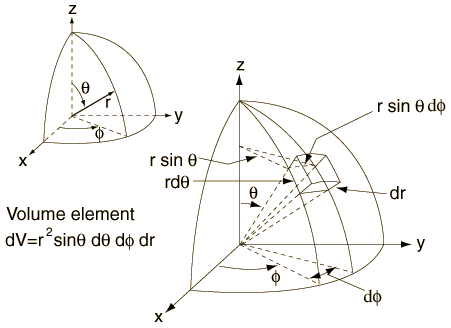
Link to mathematica notebook displaying partial derivatives geometrically. You will need mathematica or Mathematica Player to view this. The latter is free and is already installed on the ITS network PCs. Link to mathematica notebook displaying plots used in critical points examples. Link to mathematica notebook displaying contour example. And contour map of Hellvelyn Link to mathematica notebook showing integration as a sum ofrectangular areas. Link to mathematica notebook showing double integration as a sum ofcuboids. Link to mathematica notebook showing 3d plots of integration regions for triple integration. Link to wolfram demo showing spherical polars. Figure indicating volume element in spherical polars Link to wolfram demo showing Div (flow acrosss the circle) and Curl (flow around the circle) |