Description
This applied maths project is to be taken concurrently with Fluid Mechanics III.
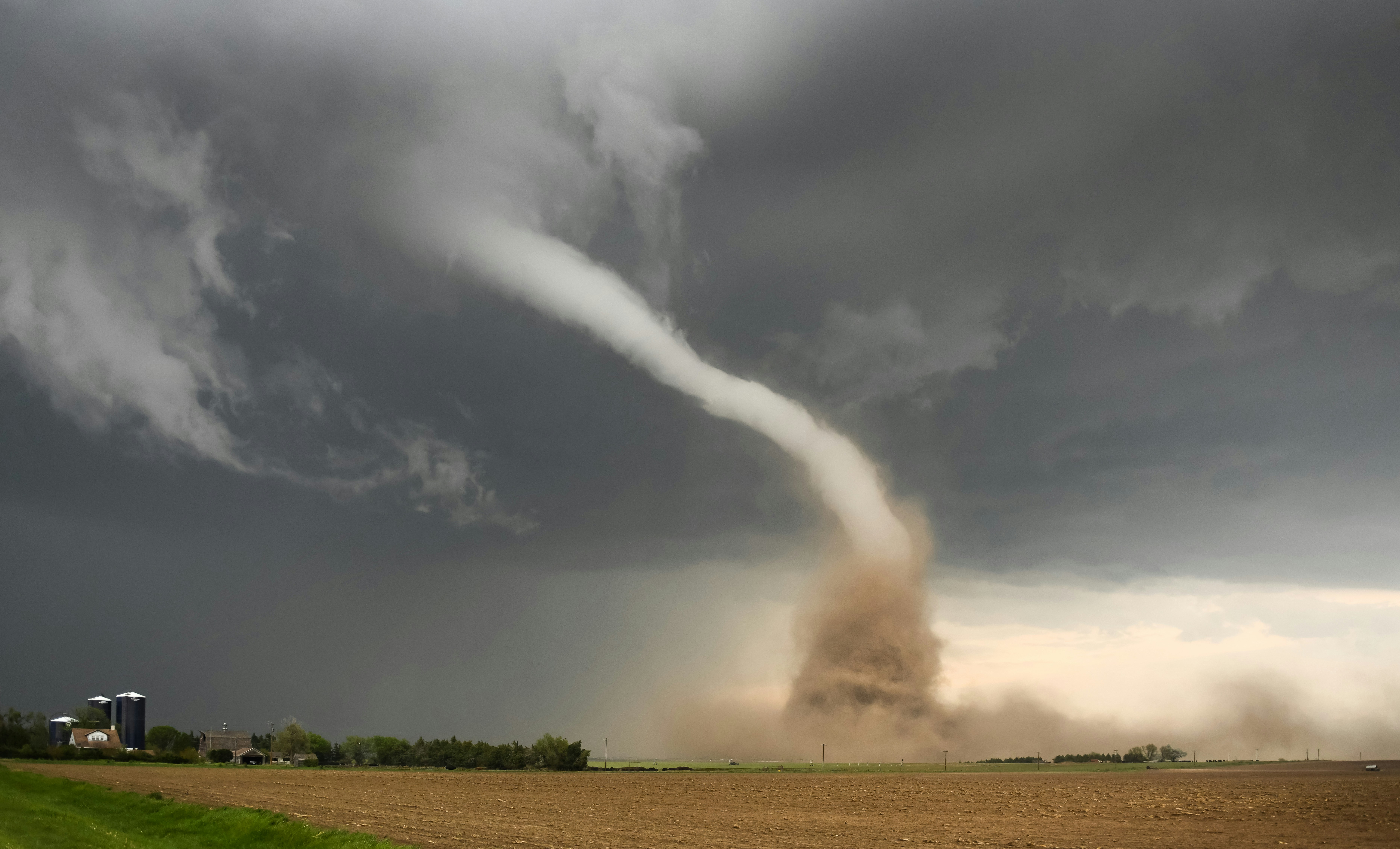
Vortices take many forms in nature with some classic examples being tornadoes, smoke rings, eddies in rivers and the funnel formed as water drains from your sink! We could describe such vortices through the velocity of their flows directly, but it turns out that it's often easier to model the evolution of the local rotation within these flows (its vorticity). For instance, when you see a smoke ring do you see the ring as a torus of rotating air, or as a moving ring? Using vorticity to describe the smoke ring is roughly equivalent to describing that flow by the motion of the ring, i.e. the axis of the air's rotation.
In Fluids III you'll briefly touch upon vortex dynamics and vorticity as a concept. In the project we'll dig deeper into how vortices and their dynamics can be modelled.
Group Project
We'll start in 2D, where vortices can be approximated using "point" vortices. You will explore some basic configurations initially before writing your own code in Python to evolve arbitrary arrangements of point vortices. We'll discover that they have some fun behaviours such as forming vortex pairs which can leap frog each other. Potentially, we can do some real word experiments to compare you're code against. We'll then move on to 3D effects such as vortex stretching and viscosity.
By the end of the project you will have:
- Understood how to visualise fluid flow using vorticity.
- Understood how vorticity evolves in response to fluid flow.
- Written your own Python code to evolve point vortices.
- Understood how vortex stretching and viscosity affect vortices.
Mode of operation and evidence of learning for the group project
The project will revolve around learning through reading and programming in Python. Students will demonstrate their understanding by comparing theory to simulations and experiments, modelling a number of physically inspired flows, and by clearly communicating the material in both written and oral formats.
Individual project
The individual project will build upon the material learned throughout the group project to explore more advanced topics. Some potential directions include:- Oscillations of vortex lines (Kelvin Waves).
- Point vortices in the wake of flow around a cylinder (linked to Karman vortex shedding)
- Other 3D vortex solutions such as Hill's vortex and/or exploring their stability.
- Point vortices on a sphere or lattice.
- Analogues to vortex line dynamics in MHD - field line evolution.
Mode of operation and evidence of learning for the individual project
The project will revolve around learning through reading, working through derivations and programming in Python as appropriate. Students will demonstrate their understanding by comparing theory to simulations and experiments, modelling a number of physically inspired flows, and by clearly communicating the material in both written and oral formats.
Corequisites
Fluid Mechanics III must be taken alongside this project.
Prerequisites
This is an applied project where you will have to do some practical coding. You should therefore be confident with Python.
Dynamics I, Complex Analysis II and Mathematical Methods II are essential. Computational Mathematics II is also recommended.
Resources
Chapter 7 of A First Course in Fluid Dynamics by Patterson gives a good general overview.
Numerical time stepping methods can be found on e.g. Wikipedia.