Description
In Fluids III you learnt about two key incompressible fluid instabilities: the Rayleigh Taylor instability (RTI) and the Kelvin Helmholtz instability (KHI). Both occur in the world around us, but what about in space? Well in space we are mostly dealing with plasmas rather than pure fluids. And to model their behaviours we can use the equations of Magnetohydrodynamics (MHD), which are a coupling of electromagnetism and Navier-Stokes. The good news, however, is that the methods and much of the intuition you gained when studying these instabilities carries over to the MHD counterparts of these instabilities as well as many others.
Some nice examples include Rayleigh-Taylor plasma fingers forming in solar prominences and Kelvin-Helmholtz vortices forming on the flanks of Earth's Magnetosphere (see figure) and eruptions from the Sun. The key new feature in plasmas is that the magnetic field can act like a string threading the plasma, supporting new wave modes but also stabilising certain modes of instability.
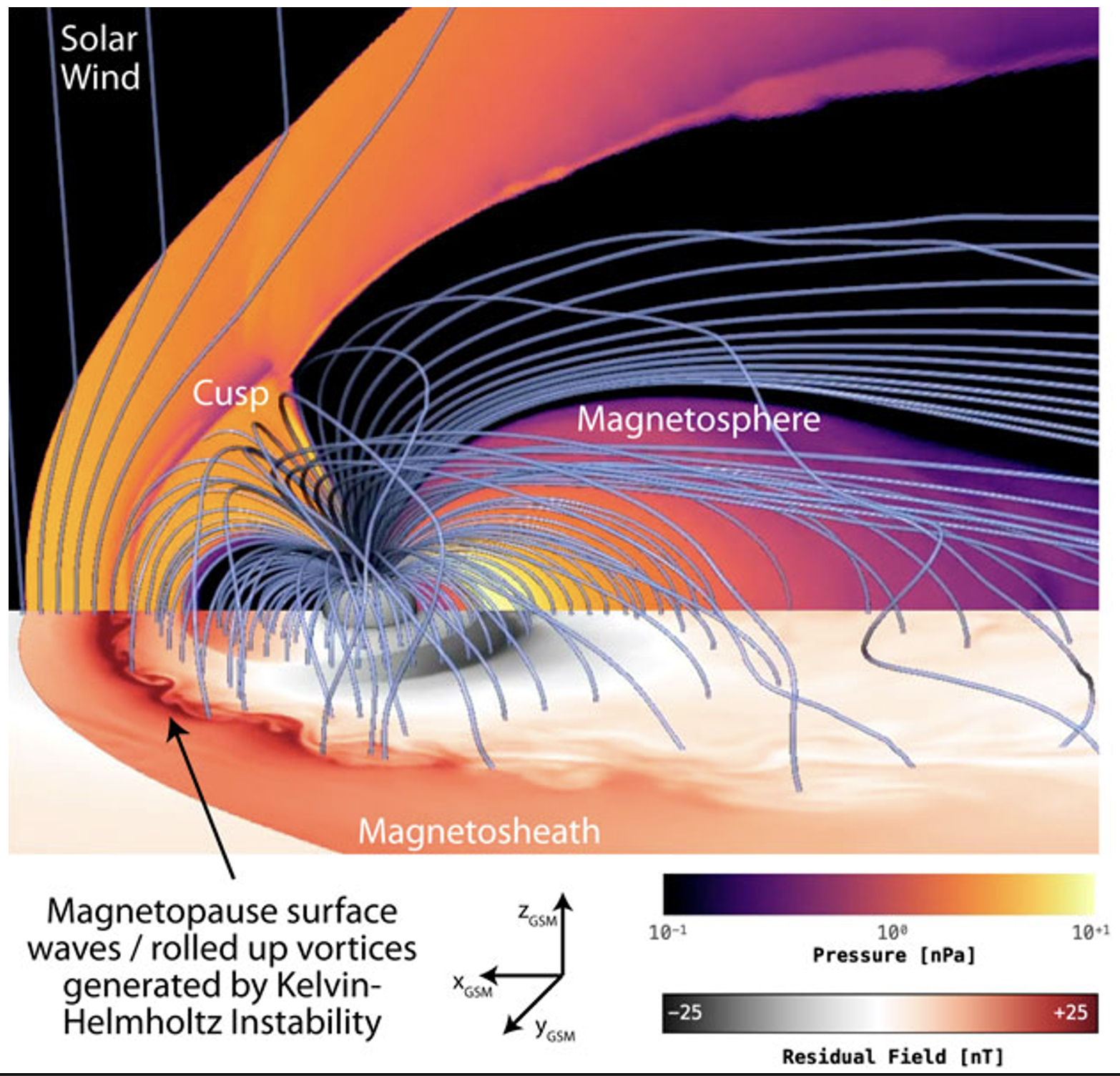 MHD simulation showing the KHI forming on the flanks of Earth's magnetosphere as the solar wind streams past it (from Archer et al. 2024).
The KHI and RTI are just two examples of instabilities that can occur in plasmas. There are a vast number of different instabilities that are supported in MHD (and also in HD) that move beyond what you've seen in Fluids III and will see in GAFDIV. In this project you'll start by reviewing the MHD equations and deriving the basic wave modes supported by a uniform magnetic field (Alfvén waves, slow and fast acoustic waves). These waves form the basis for understanding the dynamics of perturbations in MHD. You'll then explore the literature and decide on a direction based on your interests. Potential avenues include:
- MHD Kelvin-Helmholtz and/or Rayleigh-Taylor.
- MHD waves in structured magnetic fields (flux tubes, the solar wind).
- The resistive tearing instability/plasmoid instability.
- Kelvin waves of vortices (HD).
Mode of operation and evidence of learning for the individual project
The project will revolve around learning through reading, working through derivations and programming in Python as appropriate. Students will demonstrate their understanding by comparing theory to literature and modelling a number of physically inspired plasma and/or fluid scenarios, and by clearly communicating the material in both written and oral formats.
Prerequisites
Linear stability analysis forms a major element of any instability study, so being comfortable with this is essential. As a minimum, some basic python skills would be useful to solve for and plot the dispersion relations and modes. Depending on the direction, incorporating further numerical elements could be investigated.
Fluid Mechanics III is essential. Taking Geophysical and Astrophysical Fluids alongside this project (which introduces MHD and MHD waves in the second term) is also essential. Confidence with vector calculus from Mathematical Methods II is also important. PDEs III would also be useful (but not essential).
Resources
There are many textbooks and lecture notes online covering MHD waves. A nice one can be found here. A classic textbook showing how to find the dispersion relation of the RTI and KHI with a uniform magnetic field is Chandrasekar 1961. A classic textbook on MHD waves in flux tubes is Roberts 2019. Chapter 7 of Priest 2014 gives a general overview of various plasma instabilities, including resisting tearing. The tearing instability in the context of pre-existing current sheets (the plasmoid instability) is nicely shown in Louriero et al. 2007. A nice introduction/review of Kelvin waves in vortices is Dahl 2021.