Description
The focus of this project is to explore ways to visualise properties of matrices through subsets of the complex plane. The set of eigenvalues is such a set, but it doesn't retain much information on the matrix. The numerical range of an \(N\times N\) matrix \(A\) is the subset of the complex numbers \(\mathbb C\) defined by \[W(A):=\left\{\frac{x^*Ax}{x^*x}:\,x\in\mathbb C^N,\,x\neq 0\right\}\] where \(x^*\) denotes the conjugate transpose of a vector \(x\in\mathbb C^N\) (seen as \(N\times 1\) matrix). The aim of this project is to study properties of the numerical range and the connection to the set of eigenvalues.
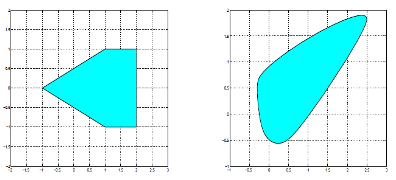
Here you see two examples of numerical ranges. On the left is the numerical range of a diagonal matrix with diagonal entries
\(-1, 1\pm {\rm i}, 2\pm {\rm i}\), each of these five points being an eigenvalue and a corner of the numerical range.
On the right is the numerical range of a "general" matrix whose numerical range has no corners.
Group Project
The group project will revolve around learning basic concepts and results on the numerical range, following Chapter 1 of the book by Gustafson&Rao (reference [2] below). By the end of the group project we will have learned the following:
- If \(A\) is Hermitian, then the numerical range is the (real) interval whose endpoints are the minimal and maximal eigenvalues of \(A\).
- For a more general class of matrices (including all Hermitian ones), the numerical range is a polygonal set with eigenvalues as corners (i.e. \(W(A)\) is equal to the convex hull of the eigenvalues).
-
For general matrices \(A\), the numerical range has the following properties:
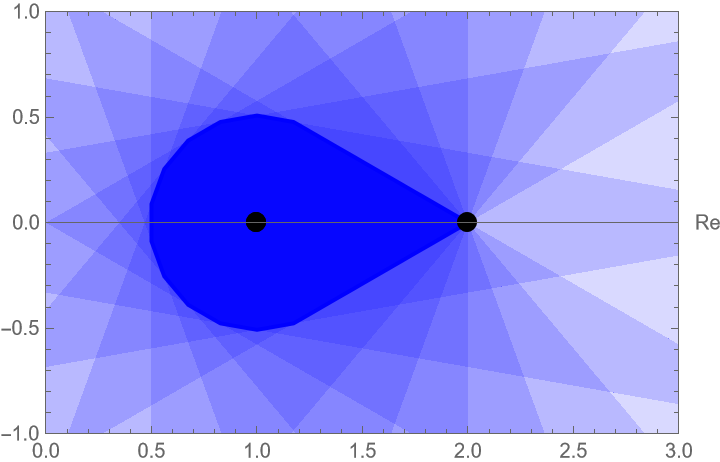 \(W(A)\) contains all eigenvalues of \(A.\)
- For a \(2\times 2\) matrix \(A\) the numerical range is an ellipse.
- Toeplitz-Hausdorff theorem: \(W(A)\) is a convex subset of \(\mathbb C\).
- The convexity can be used for numerical computations of the numerical range, as the intersection of all half-planes containing it.
The matrix in the figure has a simple eigenvalue at \(2\) and a Jordan block at the eigenvalue \(1\).
Mode of operation and evidence of learning
This project will revolve around learning through reading with a focus on the underlying theory, mathematical rigour, and the development of deep conceptual understanding.
Students will demonstrate their understanding of the subject matter by solving relevant problems, exploring and constructing examples, investigating theoretical applications of the material, and clearly communicating it in both written and oral formats.
Individual Project
The individual project will build on the knowledge we have gained in the group project and will explore additional advanced topics. A few examples of topics you would be able to investigate include (but are not limited to):- The Crouzeix conjecture, which is an unsolved problem in matrix analysis (even open for general \(3\times 3\) matrices).
- Block numerical ranges (a generalisation of the numerical range where the matrix \(A\) is first divided into blocks).
- Numerical implementations to compute the numerical range.
Mode of operation and evidence of learning
This project will revolve around learning through reading with a focus on the underlying theory, mathematical rigour, and the development of deep conceptual understanding.
Students will demonstrate their understanding of the subject matter by solving relevant problems, exploring and constructing examples, investigating theoretical applications of the material, and clearly communicating it in both written and oral formats.
Prerequisites and Companion modules
Prerequisites: Analysis I, Linear Algebra I, Complex Analysis II.
Co-requisites: None.
Note for MMath students about potential links to fourth-year modules: Several of the results that we will explore in this project in the setting of matrices have analogues in the setting of linear operators in infinite-dimensional spaces. To work in infinite-dimensional spaces, we would appeal to methods of Functional Analysis that you'll get to explore in your fourth year if you take the module Functional Analysis & Applications IV. If you think you might be interested in that direction, then you might enjoy this project as a first taste.
References
[1] https://en.m.wikipedia.org/wiki/Numerical_range
[2] K.E. Gustafson and D.K.M. Rao. Numerical Range: The Field of Values of Linear Operators and Matrices. Springer New York (1995). Available online via Durham library.
[3] https://en.wikipedia.org/wiki/Crouzeix's_conjecture
[4] C. Tretter. Spectral theory of block operator matrices and applications. Imperial College Press London (2008). Available online via Durham library.