3 Character theory
3.1 Characters
Throughout this section, is a finite group and is a finite dimensional complex vector space.
Definition 3.1.
Let be a finite-dimensional complex representation of . The character of is the function defined by
We might also write instead of .
Remark 3.2.
It is not totally obvious that the process ‘Start with an element , choose a basis for , write as a matrix using that basis, and take the trace’ gives a number that is independent of the choice of basis. One way to see this is to use the change of basis formula and the fact that .
The same argument shows:
Lemma 3.3.
Isomorphic representations have the same character.
It seems that we throw away a lot of information when we pass to the character; the remarkable thing is that, in fact, the character completely determines the representation. Moreover, there is a lot of structure to the characters and it is often possible to find all of the characters of a group, even when it is not clear how to construct the representations!
Example 3.4.
If is a one-dimensional representation, then it is its own character (the trace of a scalar is just itself).
Example 3.5.
Let be the irreducible two-dimensional representation of and let be its character. Then
Lemma 3.6.
If is a representation of , then .
Proof.
Exercise. ∎
We call the degree (or the dimension) of the character .
Lemma 3.7.
If and are representations with characters and , then has character .
Proof.
Use block matrices. ∎
Lemma 3.8.
If is the character of a representation of , then
Proof.
As has finite order, say , we can find a basis such that is diagonal with eigenvalues , and the are $m$th roots of unity. Then is diagonal with eigenvalues , which are , giving the result. ∎
Remark 3.9.
It follows that, if is conjugate to , then is real for every character .
Lemma 3.10.
Let be the character of a representation of . If and are in the same conjugacy class of , then
Proof.
Let for some . Then
since conjugate matrices have the same trace. ∎
Definition 3.11.
A class function is a function that is constant on conjugacy classes.
The previous lemma then says that the character of a representation is a class function. We often organise the information into a character table. This has columns labeled by the conjugacy classes of , and rows labeled by the irreducible representations. The entries are the values of the characters of the irreducible representations on elements of the conjugacy class.
We usually write for the character of the trivial representation.
Example 3.12.
Here is the character table of . We label each column by a representative element of the conjugacy class. It is also common, as here, to write the number of elements in the conjugacy class in the second row.
Example 3.13.
Let and . Then we can write down the character table of ; I will do this for for concreteness. Since is abelian, all conjugacy classes are singletons so I will omit the second row.
Exercise 3.14.
Let act on a finite set , and let be the permutation representation. Then its character is given by
the number of fixed points of .
Exercise 3.15.
What is the character of the regular representation?
3.2 Orthogonality of characters
Definition 3.16.
If and are two class functions on , then their inner product is
You could define this for any old functions on , but we will only use it for class functions. Note that this is a Hermitian inner product on the space of class functions of , whose dimension is the number of conjugacy classes of .
Over the next few section, we will prove the following theorem-
Theorem 3.17.
Let be a finite group with conjugacy classes . If is a class function, write for any .
-
1.
The irreducible characters are orthonormal with respect to the inner product defined above. This means that, if and are irreducible characters, then
We can also see this inner product as the standard inner product of the rows of the character table with the entries weighted by :
-
2.
The number of irreducible representations is equal to the number of conjugacy classes. In other words, the character table is square.
-
3.
The columns of the character table are orthonormal with respect to the weighted inner product from part(1). That is, if , are distinct conjugacy classes, then
while if they are the same conjugacy class then
To complement this, we have:
Theorem 3.18.
Two irreducible representations of are isomorphic if and only if they have the same character.
In other words, each row of the character table corresponds to exactly one isomorphism class of irreducible representation.
Theorem 3.19.
-
1.
A representation is determined up to isomorphism by its character.
-
2.
If is a representation with character , then is irreducible if and only if .
Proof.
Let the irreducible representations be and let be their characters (distinct, by Theorem 3.18 above). By Maschke’s Theorem, any representation with character can be written as for some integers . Its character is then . We then have, for each ,
since for all . Thus the integers are determined by , the character of . But the integers determine up to isomorphism so we are done.
For the second part, note that
Since the are nonnegative integers, this holds if and only if exactly one of the is equal to one and the rest are zero. This means that is irreducible. ∎
3.3 Example: S4
Example 3.20.
We determine the character table of . First, we have the trivial representation and the sign character :
Next, we consider the permutation representation of on . This contains a copy of the trivial representation, so we write for some representation , whose character satisfies
Notice that we also have an operation on representations known as twisting: if is an irreducible representation of with character and is a one-dimensional character of , then we can define a new representation, , of on by the formula . It has character . In this case, we can look at and see that it will also be the character of an irreducible representation.
Since , is irreducible. Note also that is different to , and also irreducible.
There is one more row of the table to find. This can be done using orthonormality with the first column, remembering that the dimension must be a positive integer (in this case, it must be two): we obtain that the full character table is
Notice that we constructed the character of the final representation without constructing the representation itself!
3.3.1 Characters of lifts
Recall that if is a normal subgroup then we can lift representations of to representations of , as in Section 2.2.3.
Lemma 3.21.
If is the character of a representation of and is the character of its lift to , then
for all .
Proof.
Immediate from the definition. ∎
Example 3.22.
In exercise 2.29, we explained how to lift the irreducible two-dimensional representation of to a representation of . Then its character agrees with that called in the character table of .
We can recognise the kernel of a representation using its character.
Proposition 3.23.
Let be a representation of with character and dimension . Then
Proof.
It is clear that then . We leave the converse as an exercise. ∎
3.3.2 Decomposing a representation
Example 3.24.
We apply the method of Theorem 3.19 to decompose a naturally occurring representation of . Let
Then acts on . If we think of as the symmetry group of the tetrahedron with vertices labeled 1, 2, 3, 4, then this is ‘the same as’ the action on the set of edges (each edge being determined by a set of two vertices).
Let be the permutation representation obtained from and let be its character. Then
We have:
Then we compute , . It follows that
So
where is the trivial representation, is isomorphic to the 3-D representation of with character , and is isomorphic to the unique 2-D representation of (which has character ).
Exercise 3.25.
In the previous example, find , , as subspaces of .
Remark 3.26.
The problem of finding irreducible representations of such that is isomorphic to their direct sum is called “decomposing into irreducibles representations (or irreps, or irreducibles)”. It can be solved with character theory as in example 3.24.
The problem of finding irreducible subrepresentations of such that it is their (internal) direct sum is called “decomposing into irreducible subrepresentations” and can require more understanding of the nature of the representation . Exercise 3.25 is an example of this.
3.4 Inner products and homomorphisms
In this and the next section we complete the proof of character orthogonality!
If and are two complex representations of a finite group , then we can define a representation on the vector space
with -action ’by conjugation’:
Lemma 3.27.
-
1.
If and have characters and , then has character .
-
2.
We have
in other words, the -homomorphisms are the -fixed points of .
Proof.
-
1.
Let and let and be bases of and consisting of eigenvectors for and , with the eigenvalue attached to and that attached to . Let send to and all other basis vectors to zero; in matrix terms, this is the matrix with 1 in column , row , and 0 everywhere else. Then the are a basis for . Moreover, recalling that the are roots of unity, we have
So the trace of is
as required.
-
2.
If , then means
for all . Replacing by , we get
for all . So if and only if this holds for all and all , i.e. if and only if is a -homomorphism.∎
The key theoretical result is:
Theorem 3.28.
If and are two representations of with characters and respectively, then
Proof.
Step 1: We first consider the case that is the trivial representation. Then we have to prove that
Note that the operator
maps to and is the identity on . This means that must be a projection onto . It follows that, in some basis, its matrix is diagonal with ‘1’s and the remaining entries ‘0’,11 1 See also problem [[prob-projection]]. so
as required.
Step 2: Note that . The character of is . So, by the first part,
which is exactly what we have to show. ∎
Corollary 3.29.
Suppose that and are irreducible representations with characters and . Then
Proof.
This is immediate from Theorem 3.28 and Schur’s lemma. ∎
We have therefore proved part (1) of Theorem 3.17, as well as Theorem 3.18 and Theorem 3.19. In other words, we know that representations are determined by their characters and that the rows of the character table are orthonormal (with an appropriately weighted inner product). We now only have to show that the character table is square.
3.5 Universal projections
The map constructed in step 1 of the proof of Theorem 3.28 has an interesting feature: for every representation , the map is a -homomorphism . We can generalise this substantially.
Let be any class function. Then define
For every representation , acts on , and we also call this :
If we take to be the constant function with value 1, then is the projection .
Lemma 3.30.
If is any representation, then is a -homomorphism.
Proof.
Let . Then we have
| as is a class function | ||||
| replacing by . ∎ | ||||
Since is a -homomorphism for every , we could call it a universal -homomorphism.
What happens when we take to be an irreducible representation?
Proposition 3.31.
Let be a class function and let be an irreducible representation with character . Then acts as the scalar
on .
In particular, if is the character of an irreducible representation , then acts as on and as 0 on all other irreducible representations.
Proof.
If is irreducible, then by Schur’s lemma must be a scalar. But its trace is
Since the trace of a scalar matrix is just the dimension times that scalar, we get the proposition. ∎
Recall now that, if is an irreducible representation of and is another representation of , then denotes the subrepresentation of generated by all the subrepresentations of isomorphic to .
Corollary 3.32.
Let be an irreducible representation of with character and dimension . Then the operator acts, on any -representation , as the -equivariant projection
Proof.
We have by Maschke’s Theorem. By the proposition, kills for , and acts as the identity on , as required. ∎
So projects any representation onto its -isotypic component. In particular, if has a unique subrepresentation isomorphic to , then is a projection onto that subrepresentation.
Corollary 3.33.
The irreducible characters are a basis for the space of class functions.
Proof.
We already know that they are linearly independent (since they are mutually orthogonal vectors in a Hermitian inner product space), so we have to show that they span. Let be the space of class functions, and let be the subspace spanned by the irreducible characters. Then , and we must show . Suppose that , so for every irreducible character .
We consider the operator . This acts as (a multiple of)
on every irreducible representation with character . As every representation is a direct sum of irreducibles, we see that acts as zero on all representations of .
However, considering the action of on the regular representation , we see that
Since this must be zero, we have for all , as required. ∎
Corollary 3.34.
Parts (2) and (3) of Theorem 3.17 are true.
Proof.
Part (2) follows from the obvious fact that the dimension of the space of class functions is the number of conjugacy classes, together with Corollary 3.33.
For part (3), consider the matrix obtained by multiplying each entry of the character table by , where is the conjugacy class labeling the column. Then row orthogonality says that this is a (square) unitary matrix. But the transpose of a unitary matrix is unitary, which gives the column orthogonality. ∎
Example 3.35.
We give an example of how to use the projection operators. Let , and let be the permutation representation on the set of eight vertices of the cube. Its character is given below.
Then we compute , and (by inspection) that where is the standard three-dimensional representation of whose character is also shown in the table. We label the vertices as in Figure 2, where the labels are shown in red: the labels on the top face are running counterclockwise, and the label on the vertex opposite is , and look for a subspace of isomorphic to .
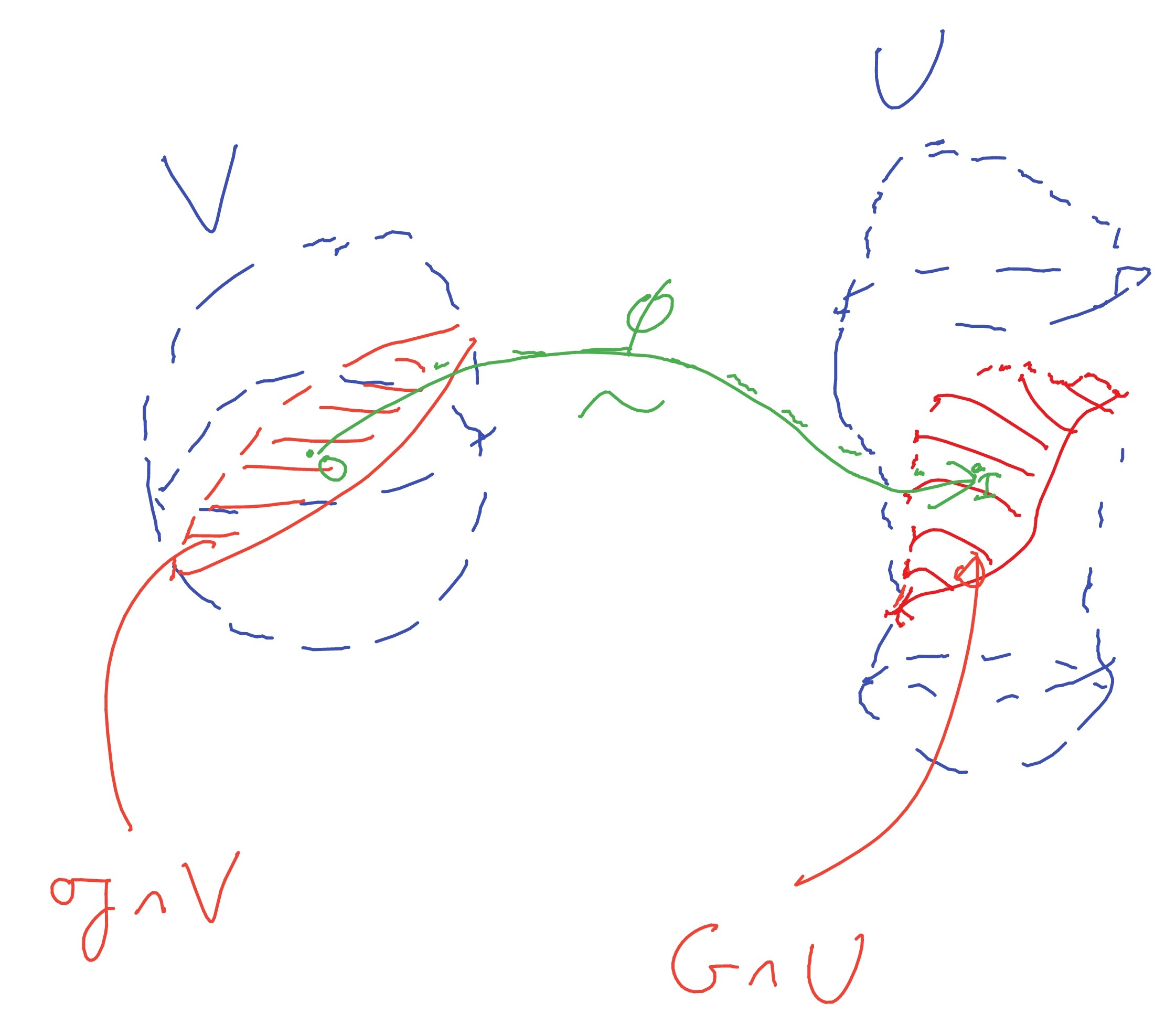
To do this we use the projection operator . Applying this to , we obtain:
which simplifies to (writing )
This is illustrated in green in Figure 2. Starting with a different vector will permute the roles of the , and we see that the image of is the subspace of where the coefficients of opposite vertices are equal, and the sum of all the coefficients is zero. This is therefore the subspace of isomorphic to !
Exercise 3.36.
Complete this example by finding the other irreducible subrepresentations of .
3.6 Linear algebra constructions
We construct new representations from old in various ways, using linear algebra. We continue to work over throughout, though many of these constructions work over any field.
3.6.1 The dual representation
Recall that we earlier defined, for any -representations and , a -representation on the space of linear maps from to . It has character .
Definition 3.37.
If is any vector space, then the dual space of is
We have . To see this, given a basis of , we have the dual basis of given by
There is a bilinear map . The choice of basis identifies with (as column vectors) and then the dual basis realizes as matrices, with the above pairing being the usual matrix/dot product.
If has a -representation , then we take to have the trivial representation and get an action of on defined by . From the formula for the character of , we see
If the matrix of with respect to some basis is , then the matrix of with respect to the dual basis is , the inverse of the transpose of .
3.6.2 Tensor products
Let be two vector spaces. Then the tensor product
is the -vector space generated by the symbols for and , with the “bilinear” relations
Remark 3.38.
Rigorously, we are taking the (infinite dimensional) vector space with a basis element for every and and then forming its quotient by the (infinite dimensional) subspace generated by vectors of the form and by similar expressions corresponding to the other relations; this quotient is then finite dimensional, as the proposition below shows.
Proposition 3.39.
Let be a basis of and be a basis of . Then
is a basis of .
Proof.
Omitted.∎
In particular, the dimension of the tensor product is the product of the dimensions of the vector spaces:
Contrast the direct sum, which has dimension the sum of the dimensions of the vector spaces.
Exercise 3.40.
It is not true that every vector in is of the form . For example, if is two-dimensional with basis then cannot be written in this form.
Then next remark is non-examinable.
Remark 3.41.
Tensor products can be difficult to get used to. Perhaps the most important principle for understanding them is the following:
A linear map is the same as a bilinear map .
The dictionary as follows: given a linear map , we define a bilinear map by sending to . The bilinearity is then a consequence of the relations that hold in the tensor product. Conversely, given a bilinear map , define a linear map by sending to . We have to check that this is well-defined, i.e. that the bilinear relations are respected, and this is equivalent to the bilinearity of .
This all seems very abstract, but it is useful: defining bilinear maps is ‘easy’! In fact, tensor products ‘in real life’ often arise in situations where you have a number that depends on the choice of two vectors (in , say); then this dependency can be expressed as a linear map .
All that said, for this course it will not be important to have such a deep theoretical understanding of tensor products as long as you are able to do calculations with them and are willing to take Proposition 3.39 on trust.
Naturally, we can consider more factors , with linearity in each slot.
Now, if and are both representations of then becomes a representation via
We also write for this representation. If we have bases of and of , with respect to which the matrices of acting on and are and , and we order the resulting basis of as
then the matrix of on is where this is the block matrix
Proposition 3.42.
If and have characters and , then
Proof.
Let and choose bases and such that and . Then
so with respect to the basis of , acts diagonally with entries . So
The tensor product generalises the ’twisting’ construction earlier. If is any vector space then is isomorphic to via the map . If is a -dimensional representation and is any representation of , then is a representation acting on . We have
via the above isomorphism so that
Note that if is irreducible, so is . Furthermore, might or might not be isomorphic to .
Lemma 3.43.
Let and be two finite-dimensional representations of a group . Then
as -modules.
Proof.
The best way to prove this is to show that the map , where , is a -isomorphism. This is straightforward but a bit technical.
Another proof which works in our situation is simply to observe that both sides have character . ∎
3.6.3 Symmetric and alternating powers
The symmetric square of is the vector space spanned by symbols subject to the bilinear relations above and, additionally,
for all .
Remark 3.44.
Formally, is the quotient of by the subspace spanned by all elements of the form , and then is the image of in .
Proposition 3.45.
Given a basis of , the with are a basis of . ∎
Hence
The alternating square of is spanned by elements of the form subject to the bilinear relations above and, additionally,
for all .
Remark 3.46.
Formally, it is the quotient of by the subspace spanned by all elements of the form
and then is the image of in .
If and are representations of , we define actions of on these spaces as for the tensor product.
We can define linear maps and sending and . Any can be written
and this shows that
In fact this decomposition holds as -representations.
Remark 3.47.
The space has an involution22 2 Map whose square is the identity.
As , its eigenvalues are . The decomposition above is the eigenspace decomposition for : is the -eigenspace, the -eigenspace.
Proposition 3.48.
If has character , then
and
Proof.
If has eigenvalues , then diagonalise it as usual to get an eigenvector basis . Using the basis of you find that
This is
as required.
The proof for the symmetric square is similar, or use the decomposition of . ∎
Remark 3.49.
One can also define spaces and for any , the latter vanishing if . The former is spanned by expressions where ‘the order doesn’t matter’, while the latter is spanned by expressions where ‘switching two vectors introduces a minus sign’.
A particular special case is . In this case, is exactly one dimensional (it is easy to see it is spanned by for any basis of , showing that the dimension is at most one, and there is an injective map to given by
which shows that the dimension is at least one).
If is any linear map, then we get a linear map by setting . Since it is a map from a one-dimensional vector space to itself, is just multiplication by some scalar. This scalar is exactly the determinant of !
3.6.4 Matrices in dimension 2
Suppose that is a representation of and that , with being a basis of . Let , and let
be the matrix of in this basis. We compute the matrices of and .
The space is one-dimensional, with basis vector . Then
using that and . We see that
The space is three-dimensional with basis , and
whence the matrix of (in this basis) is
3.7 The character table of S5
Let . We have the trivial representation , the sign representation , and the permutation representation , and its twist, as before. So we can start off the character table:
We then try , which has character as shown (sadly, this is equal to its twist by ). This is an irreducible character.
We can also try , which has character below; it isn’t irreducible.
By taking inner products with the characters we’ve already found, we see that
where is an irreducible character. We get one more from twisting .
This gives all of the irreducible characters, which we assemble into Table 2.
Question 3.50.
Find a more explicit description of the representation with character .