2 Representation theory of finite groups
Throughout, unless specified otherwise, denotes a finite group and denotes a finite dimensional complex vector space (such as ).
2.1 Definitions and first examples
Let be a field (we will almost always take ), and let be a group.
Definition 2.1.
A representation of over is a pair where the
-
•
is a vector space over and
-
•
is a group homomorphism.
The dimension of the representation is the dimension of . We will very often say that is a representation of , or that is a representation of , without mentioning the other part of the definition.
There is another way to think of this. Suppose that is a representation of . Then we define an action of on by . This is an action because is a homomorphism, and it is linear, meaning that for every the map taking to is a linear map. Conversely, given a linear action of on , we can define by . In other words:
A representation of is a linear action on a vector space.
We will often use and interchangeably.
If a basis is given for , then an (invertible) linear map is just the same thing as an (invertible) matrix, where . So, once you choose a basis, a representation is just the same as a homomorphism . In particular:
A one-dimensional representation of is the same as a homomorphism .
Example 2.2.
Let . Recall that there is a homomorphism
taking a permutation to its sign. As this gives a one-dimensional representation of called the sign representation.
Example 2.3.
If is any vector space, then we can always take to be the homomorphism sending every element to the identity. We call this the trivial representation on .
Example 2.4.
Suppose that . Then, if is a representation of it is completely determined by and the invertible linear map (which can be anything). This is because we then have
Thus a representation of is just a vector space together with an invertible linear map from to itself.
We can push this a bit further. Suppose that is a cyclic group of order with generator so
and . Then a representation of is again determined by and which can be any linear map such that .
One source of more interesting examples is geometry.
Example 2.5.
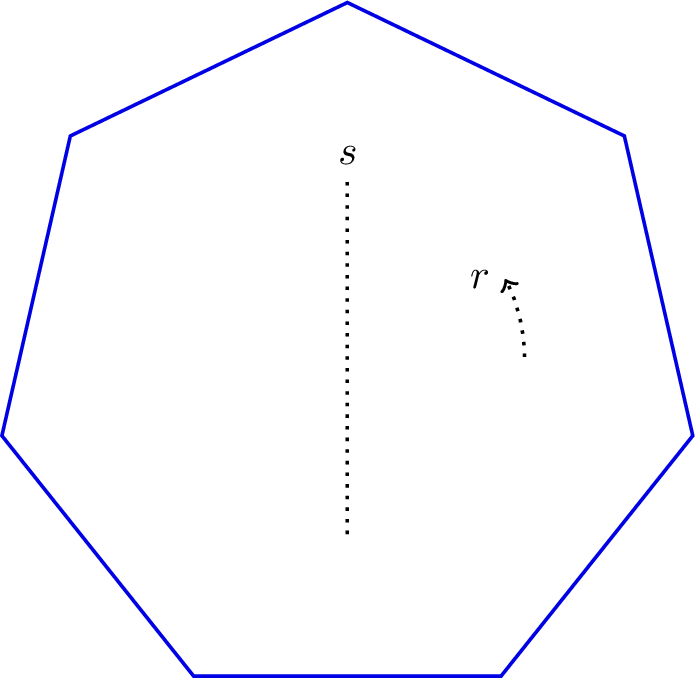
Let be the dihedral group of order the group of symmetries (rotations and reflections) of a regular -gon — see Figure 1. Since each rotation/reflection is an invertible linear map from we get a representation of on . Letting be rotation by and be reflection in the vertical axis, has the presentation
As an explicit homomorphism we have (with )
Example 2.6.
Let . You might remember that this is isomorphic to the group of symmetries (rotations/reflections) of the regular tetrahedron in . We therefore get a representation
It would be a slightly unpleasant exercise to work the matrices out explicitly.
Note that is also isomorphic to the group of rotations of the cube, giving another (different!) three-dimensional representation.
Another source of representations comes from actions of groups on (usually finite) sets.
Example 2.7.
Let and let . Define a representation of on via
where is the standard basis. This is called the permutation representation (over ).
There is a warning here! If you write elements of as , as well you might, then it is not the case that . This actually would define a right action, not a left action. The correct formula is
Definition 2.8.
If is a group acting on a set we consider a -vector space with basis . It has a representation of given by called the permutation representation associated to .
Remark 2.9.
There is another point of view on this, the functional point of view. We didn’t cover this in lectures; as things stand this is optional. For simplicity, let be finite, and define
We give this an action of by the formula
for , , .
Question 2.10.
Why don’t we define ?
Let be the function sending to and everything else to . Then the for are a basis for , and for you can check that
In other words, the behave exactly like the in the permutation representation; when we have a bit more language, we can say that is isomorphic to the permutation representation.
The next example combines geometry and combinatorics.
Example 2.11.
Let be the group of rotations of the cube and let be the set of faces. We can think of an element of the permutation representation as being a way of writing a complex number on each face.
This term is all about finite groups, but next term we will consider representations of Lie groups such as the group of rotations of . These have many applications in physics.
Example 2.12.
In a spherically symmetric situation we might be interested in (smooth) solutions to Laplace’s equation
with radial behaviour for scalars and some integer . Here is the Laplacian
These form a representation of of dimension and in fact the irreducible finite dimensional representations of are exactly those obtained in this way for integers .
The solutions are called spherical harmonics, and representation theory can be used to find particularly nice bases of these spaces!
Here is another example:
Example 2.13.
Let and let . Then is a representation of via
2.2 Formalities
2.2.1 Subrepresentations and irreducibility
Definition 2.14.
A subrepresentation of a representation of is a subspace such that for all .
Then is also a representation of where .
This has a block matrix interpretation: if we choose a basis for and extend it to a basis for , then the matrix of will have the following block matrix form:
Here is also a representation of , the quotient representation.
Definition 2.15.
A representation of is irreducible if it is nonzero and has no subrepresentations except for and itself.
Example 2.16.
Let be the permutation representation of acting on the faces of the cube. Remember that we can see a vector in as a way of writing a complex number on each face. Then we can spot three subrepresentations:
-
•
the subrepresentation where the numbers on all faces are equal
-
•
the subrepresentation where the numbers on opposite faces sum to zero
-
•
the subrepresentation where the numbers on opposite faces are equal and all the labels sum to zero.
Note that in lectures we did the related example of edges of the tetrahedron.
Definition 2.17.
Suppose that is a representation of and that are two subrepresentations such that every element of can be written uniquely as the sum of an element of and an element of . Then we say that is the (internal) direct sum of and and write .
This also has a block matrix interpretation: if we choose bases for and , then the matrix of will have the following block matrix form:
We can generalize this definition to a finite number of subrepresentations . If is the direct sum of subrepresentations that are irreducible, then we will say that is decomposable. We will see that complex representations of finite groups are always decomposable.
Example 2.18.
Consider the permutation representation of . This is the representation on for which where are the standard basis vectors. It is not irreducible!
Let . Then for all so is a subrepresentation (and the action of is trivial).
Let . Then since permutes the coordinates of a vector, it doesn’t change their sum; so and is a subrepresentation (of dimension two). Since and their dimensions add to we have .
I claim that is irreducible. Indeed, suppose is a nonzero subrepresentation; we have to show that . Let be nonzero. As can’t happen, we can apply an element of to permute the coordinates so that . Then applying we have . Taking the difference, ; scaling, . Applying we have . But these vectors span (e.g. because they are linearly independent and ), so as required.
Example 2.19.
If is a finite-dimensional representation of with then has an eigenvector which spans a one-dimensional subrepresentation of . Thus is reducible unless . The irreducible subrepresentations of are exactly the lines spanned by -eigenvectors, and is decomposable if and only if it has a basis of -eigenvectors. This is equivalent to being diagonalizable. As you know from Algebra II (or Linear Algebra I?) this is not always the case! For example,
The next definition is optional: we will avoid using quotient representations.
Definition 2.20.
Suppose that is a representation of and that is a subrepresentation. Then the quotient vector space has a representation of defined by
Remember that is the coset . You should check that this is well-defined, i.e. that if then .
2.2.2 Homomorphisms and isomorphisms
Definition 2.21.
Suppose that and are representations of . Then a -homomorphism (or homomorphism of representations of or map of representations of or if we are being lazy just a homomorphism) is a linear map such that
for all .
In other words, ’commutes’ with the action of : . We write for the (vector space) of -homomorphisms from to .
There is another word that is sometimes used for -homomorphism: intertwiner, or -intertwiner.
Definition 2.22.
A -isomorphism (or just an isomorphism) is a bijective -homomorphism.
If there is a -isomorphism then we write .
Lemma 2.23.
Suppose that and are representations of .
-
1.
If is an isomorphism, then .
-
2.
Suppose and choose bases for them, so that and are (invertible) matrices. Then if and only if there exists such that
for all .
Proof.
Exercise. ∎
Lemma 2.24.
Given then and are subrepresentations.
Proof.
We know that they are subspaces, so we just have to show that they are preserved by the action of .
For the kernel: suppose that and . Then and
so . So is -stable as required.
For the image: suppose . Then for some . Then
is also in the image of . ∎
Example 2.25.
Let where the isomorphism takes and . Let be the permutation representation of so in the basis we have
Then let act on the equilateral triangle centred at 0 with vertex at giving a two dimensional representation on such that
Let be the vertices labeled anticlockwise from the top and let be the linear map taking to . I claim that is a -homomorphism.
The matrix of is
and now we just have to check that
which is true, and a similar equation coming from .
In fact we could see this without calculation; by the way we defined the isomorphism we have that
for all .
The kernel of the homomorphism is the subspace spanned by and in fact defines an isomorphism from the subrepresentation
to .
Remark 2.26.
If and are representations of then we may form their (external) direct sum with underlying vector space such that
for all . If and happen to be subrepresentations of some other representation then saying is the direct sum of and is the same as saying that the map
is an isomorphism.
2.2.3 Change of group
We haven’t yet covered this section; we will come back to it.
Definition 2.27.
If is a subgroup of and is a representation of then we get a representation the restriction of to which is given by
for .
This representation is also written , , or .
If is an irreducible representation of , then need not be. As an extreme example, if then is just copies of the trivial representation!
Example 2.28.
Let be the irreducible two-dimensional representation of realised as the space
of the permutation representation. Let . Then is reducible (as it must be: all irreducible representations of are one-dimensional). Indeed, let and where . Then and are -subrepresentations of with .
The action of on is through the character taking to and the action on is through the character .
Exercise: what is the restriction of to ?
If is a normal subgroup of , then is a group. If is a representation of then we define the lift (or inflation) of to be the homomorphism defined by :
Then is a representation of .
Example 2.29.
Take and take . Then there is an isomorphism
defined as follows: label the three non-identity elements of as . Then acts by conjugation on this set of three elements, giving us a homomorphism . Explicitly, we have
and
Then the homomorphism is surjective with kernel (check these statements!) and so defines an isomorphism
If is any representation of , then its kernel is
This is just the kernel of the homomorphism , and so it is a normal subgroup. If the kernel of is trivial, then we say that is faithful. In this case, determines an embedding of inside !
Lemma 2.30.
If is a normal subgroup, and is a representation of then the following are equivalent:
-
1.
contains ;
-
2.
is isomorphic to the inflation of a representation of .
Proof.
Exercise! ∎
Corollary 2.31.
If is a representation of then is irreducible if and only if is.
Proof.
We prove the equivalent statement that is reducible if and only if is. If is reducible, so has a nonzero proper subrepresentation then so is since is also a subrepresentation of . Conversely, if has a nonzero proper subrepresentation then and so, by the lemma, for a representation of that is then a nonzero proper subrepresentation of . ∎
2.3 Example: dihedral groups
We list the elements of the dihedral group as
We aim to show that Table 1 gives the complete list of representations of , for odd. We leave the case of even as an exercise (there are two more one-dimensional representations in this case).
| Label | Dimension | ||
|---|---|---|---|
| , | |||
Proof.
Take to be an irreducible complex representation of . Let be an eigenvector for with eigenvalue (which must be an th root of unity since ). Let . The key calculation is:
We also have and so is a subrepresentation of . As is irreducible, we see that .
- Case 1
-
Suppose that . Then and are eigenvectors of with distinct eigenvalues, and so are linearly independent. Thus . In the basis the representation is
If for then we get the representations in the first line of the table. Otherwise, for some and we instead take the basis to get again.
- Case 2
-
Suppose that . Then as is odd. Since
we see that spans a subrepresentation of . If then is the trivial representation. Otherwise, and we get the representation .
Strictly speaking, we have only shown that if is an irreducible representation then it is given by matrices as in the table. However, it is easy to see that the matrices given in each row of the table do in fact define representations of : one only has to check that and . ∎
2.4 Schur’s Lemma
We move on to more theoretical considerations. Let be a group.
Theorem 2.32.
Let and be two irreducible finite-dimensional complex representations of . Let be a -homomorphism. Then
-
1.
Either is an isomorphism or .
-
2.
If then
for some scalar .
-
3.
More generally,
Proof.
Part (1) follows directly from Lemma 2.24: suppose that is nonzero. Then and . Since and are irreducible, we must have and .
For (2), we can find an eigenvalue of the endomorphism — here we are using that is a finite-dimensional complex vector space. Then is also a -homomorphism with non-zero kernel. Since is irreducible, by part (1) we must have . Therefore .
For (3), by part (1) we have if they are not isomorphic. So assume that they are isomorphic, so that there is an isomorphism . If is a -homomorphism, then is also a -homomorphism. By (2), for some so . We have shown that is one-dimensional, spanned by . ∎
As a corollary we obtain
Theorem 2.33.
Let be an abelian group. Then every finite-dimensional irreducible complex representation of is one-dimensional.
Proof.
Let be an irreducible representation. For set . Then is actually a -homomorphism : this is because it commutes with for all . Indeed,
Hence by Schur’s Lemma, acts by a scalar on :
for all and a non-zero scalar .
But now, any non-zero spans a -invariant subspace. Since is irreducible, this implies that is one-dimensional, and is a homomorphism . ∎
Remark 2.34.
It is possible to give an alternative proof of this using the fact from linear algebra that any commuting set of linear maps from a finite dimensional vector space to itself has a simultaneous eigenvector.
In Schur’s Lemma and Theorem 2.33, we didn’t assume was finite but we did assume the irreducible representation was finite-dimensional. If, in fact, is finite, then is automatically finite-dimensional.
Proposition 2.35.
Any irreducible representation of a finite group is finite-dimensional.
Proof.
Let be an irreducible representation of the finite group and choose nonzero. Then the subspace spanned by is finite dimensional, and is preserved by (why?). As is irreducible, we have so is finite dimensional. ∎
A homomorphism is often called a character (though this will later cause an unfortunate clash of notation). If is abelian, then the group
is called the character group, or dual group, of . It is a group under the operation .
Example 2.36.
Let be a cyclic group of order . Then .
Indeed, pick a generator of and let be a primitive th root of unity. Then a character of is determined uniquely by which must be an th root of unity . If we let be the homorphism such that then the map
determines a group isomorphism . This is a homomorphism because
In fact, if is any finite abelian group, then . You can prove this using the cyclic case and the fundamental theorem of finite abelian groups.
For arbitrary groups the same method of proof gives:
Proposition 2.37.
Let be an irreducible finite-dimensional representation of and let
be the center of . Then acts on as a character: there is a character such that
for all and .
We call the central character of .
Proof.
Homework; mimic the proof that irreducible representations of abelian groups are one-dimensional. ∎
Finally, we can use our classification of the irreducible representations of abelian groups to get a bound on the dimension of the irreducible representations of any finite group.
Proposition 2.38.
Let be a finite group, let be an abelian subgroup of and let be an irreducible representation of . Then
Proof.
Restrict the representation to and find an irreducible -subrepresentation of . By Theorem 2.33, is one-dimensional, spanned by a vector . So there is a character of such that
for all . Now spans a subrepresentation of hence is equal to by irreducibility. Write for the left cosets of where . Then for we have
But this implies that is already spanned by
so has dimension at most . ∎
Example 2.39.
The group has an abelian subgroup of index two, and so every irreducible representation of has dimension at most .
2.5 Maschke’s theorem and complete reducibility
2.5.1 Maschke’s theorem
Theorem 2.40.
Suppose that is a finite group and that is a representation of over a field of characteristic {not dividing }. Suppose that is a subrepresentation of . Then there is a subrepresentation of such that
Proof.
First we make a useful definition.
Definition 2.41.
If are vector spaces, then a linear map is a projection if
for all .
Exercise 2.42.
If is a projection, then
We will construct a projection that is a -homomorphism (we could call this a -projection). Given such a the proof is easy: let . This is a subrepresentation as is a -homomorphism, and by exercise we have as required.
It remains to construct . Let be any linear map such that (to construct it, choose a basis for and extend it to a basis for . Then define to be the identity on the basis of and whatever you like on the other basis vectors). This might not be a -homomorphism, but we turn it into one using an ‘averaging trick’: define
Then this is a -homomorphism: for any
| writing | ||||
whence .
Finally, if then so is a projection. ∎
Maschke’s Theorem and Schur’s Lemma both hold in the situation that and is finite. From now on, we assume that this is the case, and that all representations are finite-dimensional.
2.5.2 Complete reducibility
The following corollary of Maschke’s theorem says that any (finite-dimensional) representation of a (finite) group can be written as a direct sum of irreducible representations, in an essentially unique way. So irreducible representations are the ’prime numbers’ of representation theory.
Corollary 2.43.
Let be a representation of . Then
for some irreducible representations .
Moreover, the number of times each isomorphism class of irreducible representation shows up in the above decomposition is independent of the exact choice of decomposition.
Proof.
The existence of such a decomposition follows from Maschke’s theorem and induction: let be an irreducible subrepresentation, write by Maschke, repeat starting with .
If is an irreducible representation and then
by Schur’s Lemma (specifically, part (3) of 2.32). This only depends on and not on the choice of decomposition of . ∎
In the previous proof, we used an easy, but important, property of :
Lemma 2.44.
If are representations of then
We isolate the following part of the proof of 2.43 for later use.
Lemma 2.45.
If is an irreducible representation of and is some other representation of then the number of times appears in the irreducible decomposition of is exactly
Example 2.46.
We work out the projections constructed in the proof of Maschke’s theorem when is the permutation representation of on . Then has a subspace . The map
is a -equivariant projection. As in the proof of Maschke’s theorem, its kernel is a complement:
The representation is irreducible (under the isomorphism it is ). We can also write down a -equivariant projection :
The kernel of this projection is .
Remark 2.47.
The decomposition of Corollary 2.43 is not unique: if is the trivial group, then can be written as in infinitely many ways, simply by choosing any two distinct lines. However, if we have an irreducible representation of then for any representation the subspace spanned by all the subrepresentations of isomorphic to is uniquely determined: it is called the -isotypic component of . The key example to keep in mind is, if is generated by and is a character with then is just the -eigenspace of acting on .
2.5.3 Unitarizability
We didn’t cover this section, but it is recommended reading.
Recall that a (Hermitian) inner product on a complex vector space is a map such that
for all , , and that is positive definite, meaning that for all nonzero . The standard example is
on . A (Hermitian) inner product space is a vector space together with a chosen Hermitian inner product.
Remark 2.48.
If is a Hermitian inner product on and and are written as column vectors, then we can write
where is the complex conjugate of the transpose of . The matrix will satisfy
and be diagonalizable with positive real eigenvalues.
If is a Hermitian inner product on and is a subspace, then the orthogonal complement is
As vector spaces, we have .
Definition 2.49.
A representation of is unitarizable if there is a -invariant inner product on ; that is, a Hermitian inner product such that
for all .
If such an inner product is chosen, then the representation is said to be unitary.
Exercise 2.50.
Suppose that is a unitary representation of and that is a subrepresentation. Then is a subrepresentation of .
Theorem 2.51.
If is a complex representation of then is unitarizable.
Proof.
Start with any Hermitian inner product, not necessarily -invariant. Then average it over . ∎
2.6 The group ring and the regular representation
Definition 2.53.
Let be a finite group. The group ring has as elements formal linear combinations
with multiplied according to the ‘rule forced by ’, that is,
This is a noncommutative ring (if is not abelian).
To elaborate, the symbols for are basis vectors for a vector space of dimension , which we call the group ring.
Example 2.54.
Let and be elements of . Then
If is a representation of , then we can ’multiply’ any element of by any element of :
The group ring is a vector space of dimension . It has a linear left action of :
Therefore we have a representation of on called the left regular representation.
In fact, the regular representation is just the permutation representation for the action of on itself by left multiplication. If we adopt the ’functional point of view’ mentioned before, we get another way of thinking about this.
Definition 2.55.
Let
be the space of functions from . Define a representation of on by
Lemma 2.56.
The representation is isomorphic to the regular representation .
This is simply the discussion in Remark 2.9 applied to this partiuclar case.
When we refer to the ’regular representation’, then, we mean either or according to which is most convenient.
Theorem 2.57.
Let be any representation of . Then there is an isomorphism of vector spaces
Equivalently, .
Proof.
This is short, but difficult to wrap your head around. The idea is to provide a recipe to turn a -homomorphism into an element of and a recipe to turn an element of into a -homomorphism and check that these recipes are inverse to each other.
If is a -homomorphism, let
Conversely, if let be given by
you can check that is indeed a -homomorphism.
Then I claim that the maps and are linear maps between and that are two-sided inverses of each other, so these vector spaces are isomorphic. It is clear that they are linear maps. We must check that
and
for all .
-
•
Let . Then
as required.
-
•
Let and let . Then, for
since is a -homomorphism. As are linear, this implies as required. ∎
This has a beautiful consequence: the sum of the squares of the dimensions of the irreducible representations is equal to the order of the group. We write for the set of isomorphism classes of irreducible representations of .
Theorem 2.58.
-
1.
Every irreducible representation of is a constituent of the regular representation with multiplicity . In other words,
-
2.
(Sum of squares formula.) We have
where the sum runs over the isomorphism classes of irreducible representations of . In particular, is finite.
Proof.
-
1.
By Maschke’s theorem, we can decompose as a direct sum of irreducibles in which each isomorphism class of irreducible representations appears times.
-
2.
Immediate from equating dimensions on both sides of the first part and noting that . ∎
Exercise 2.59.
Verify the sum of squares formula for dihedral groups.
Note that this gives another approach to the classification of representations of dihedral groups. First, write down all the irreducible representations and check that they are non-isomorphic. Then, by the sum of squares formula, you have found everything!