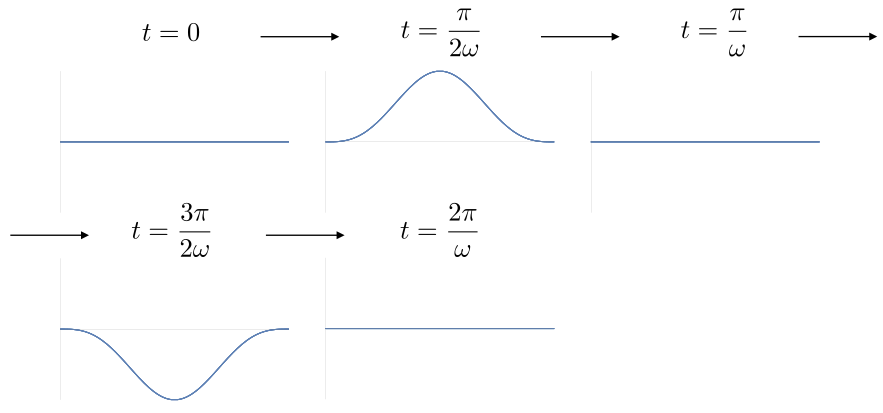
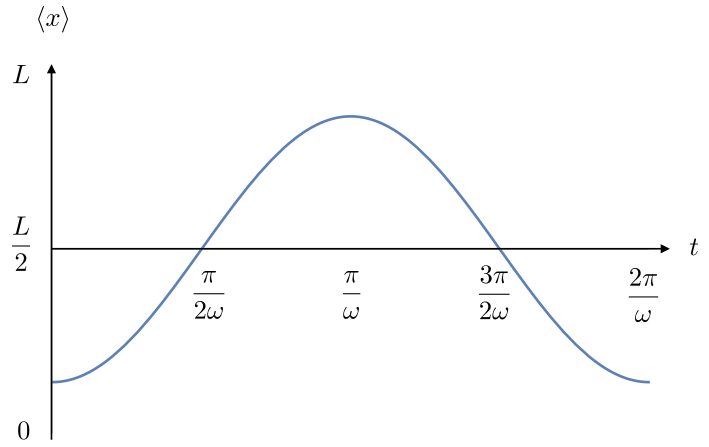
Our starting point is the probability density
\begin{equation}
P(x,t) := \big|\psi(x,t)\big|^2 \,.
\end{equation}
We would like to understand how the probability density depends on
time \(t\). Let us therefore first recall Schrödinger's equation for the wave function and its complex conjugate,
\begin{align}
\partial_t \psi(x,t) & = -\frac{i}{\hbar}\left( - \frac{\hbar^2}{2m} \partial_x^2 + V(x) \right) \psi(x,t) \, , \\[1ex]
\partial_t \overline{\psi}(x,t) & = \frac{i}{\hbar}\left( - \frac{\hbar^2}{2m} \partial_x^2 + V(x) \right) \overline{\psi}(x,t) \, ,
\end{align}
where we recall that the potential \(V(x)\) is a real analytic
function. We can now compute the time derivative of the probability
density,
\begin{align}
\partial_t P & = \partial_t |\psi|^2 \\[1ex]
& = \psi \, ( \partial_t \overline{\psi} ) + \overline{\psi} \, ( \partial_t \psi ) \\[1ex]
& =\frac{i}{\hbar} \psi \left(- \frac{\hbar^2}{2m} \partial_x^2+V \right)\overline\psi - \frac{i}{\hbar} \overline\psi \left(- \frac{\hbar^2}{2m} \partial_x^2 +V \right)\psi \, .
\end{align}
Note that the dependence on the potential \(V(x)\) cancels out between the two terms and the remainder becomes
\begin{align}
\partial_t P & = \frac{\hbar}{2mi}\left( \psi \, \partial_x^2\overline\psi - \bar\psi \, \partial^2_x\psi \right) \\[1ex]
& = \frac{\hbar}{2mi} \partial_x \left( \psi \partial_x \overline\psi - \overline\psi \partial_x \psi \right) \\[1ex]
& = - \partial_x J \, ,
\end{align}
where the symbol \(J\),
\begin{equation}
J := \frac{\hbar}{2mi}( \bar\psi \partial_x \psi - \psi \partial_x \bar\psi )
\end{equation}
is known as the “probability current density”. The result
\begin{equation}
\partial_t P + \partial_x J = 0 \,,
\end{equation}
is known as the “continuity equation”.

 Long-tap anywhere to ask a question (or see the reply).
Right-click anywhere to ask a question (or see the reply).
Long-tap anywhere to ask a question (or see the reply).
Right-click anywhere to ask a question (or see the reply).