In the previous lecture, we introduced the mathematical structure
behind wave functions. We showed that continuous square-integrable
wave functions form a complex vector space with Hermitian inner
product, called the Hilbert space. In this lecture, we study the
mathematical structures behind observables such as position, momentum
and energy.
7.1.More Linear Algebra
We begin with a quick review of some more linear algebra. As before,
we first consider a finite-dimensional complex vector space \(V\) with
Hermitian inner product \(\langle\, \cdot \, , \, \cdot \, \rangle\) and
an orthonormal basis \(\{e_j\}\).
A linear operator is a map \(A : V \to V\) such that
\begin{align}
A \cdot (a_1 v_1 + a_2 v_2) = a_1 (A \cdot v_1)+ a_2 (A \cdot v_2)
\end{align}
for any vectors \(v_1,v_2\in V\) and complex numbers \(a_1,a_2\in\mathbb{C}\). Any linear combination \(a_1A_1+a_2A_2\) and composition \(A_1 \cdot A_2\) of two linear operators \(A_1\), \(A_2\) is again a linear operator. The matrix elements of a linear operator in an orthonormal basis \(\{e_j\}\) are defined by \(A_{ij} = \langle e_i , A\cdot e_j\rangle\).
The adjoint \(A^\dagger\) of a linear operator \(A\) is defined by
\begin{equation}
\langle v_1,A\cdot v_2\rangle = \langle A^\dagger \cdot v_1, v_2\rangle
\end{equation}
for any pair of vectors \(v_1,v_2 \in V\). Let us compute the matrix elements of \(A^\dagger\) with respect to an orthonormal basis,
\begin{align}
A^\dagger_{ij} & = \langle e_i ,A^\dagger e_j\rangle \\ \nonumber
& = \langle A \cdot e_i ,e_j\rangle \\
& = \overline{\langle e_j , A \cdot e_i\rangle} \\
& = \overline{A_{ji}} \, .
\end{align}
On other words, the matrix elements of operators \(A\) and \(A^\dagger\) are related by taking the conjugate transpose of the matrix.
The adjoint operation has the following basic properties
It follows from these properties that \( (A^n)^\dagger = (A^\dagger)^n \) and therefore \(f(A)^\dagger = f(A^\dagger)\) for any polynomial function \(f(a)\).
A Hermitian (or symmetric) operator is a linear operator
which is equal to its adjoint, \(A^\dagger = A\).
A Hermitian operator is a linear operator that is equal to its
adjoint, \(A = A^\dagger\). An equivalent way to say this is that a
Hermitian operator obeys
\begin{equation}
\langle v_1,A\cdot v_2\rangle = \langle A\cdot v_1, v_2\rangle
\label{eq:herm-def}
\end{equation}
for any \(v_1,v_2\in V\). The matrix elements \(A_{ij}\) of a Hermitian
operator form a Hermitian matrix, \(\overline{A_{ji}} = A_{ij}\), hence
the name! We will see that Hermitian operators play an incredible
important role in quantum mechanics.
As an aside: mathematicians tend to call Hermitian operators
‘symmetric operators’, and reserve the word Hermitian for
matrices. There are subtle issues related to the fact that the domain
of \(A\) may not be equal to the domain of \(A^\dagger\), in which case
the operator is symmetric but not ‘self-adjoint’. For a lot of physics
applications the theory around this is more complicated than the
solution, but we may touch on some of this in a problem
later. However, if this is your thing and you cannot wait,
read [
1] (all four volumes of it).
7.2.Linear Differential Operators
We now return to quantum mechanics of a particle moving in one
dimension \(x\in \mathbb{R}\). In the previous lecture, we learnt that
continuous square-integrable wave functions \(\psi(x)\) form a complex
vector space with Hermitian inner product
\begin{equation}
\langle \psi_1,\psi_2\rangle = \int^\infty_{-\infty} \overline{\psi_1(x)} \psi_2(x) {\rm d}x \, .
\end{equation}
Furthermore, it often convenient to introduce a discrete orthonormal
basis of wave functions \(\{ \phi_n(x)\}\). Remember that the index \(n\)
may run over a set with an infinite number of elements, for example \(n
\in \mathbb{Z}_{\gt{}0}\).
A linear operator now corresponds to a linear differential operator
\(A\) built from derivatives with respect to \(x\). We have already
encountered two important examples of linear differential operators:
We define the matrix elements of \(A\) in a discrete orthonormal basis by
\begin{equation}
A_{mn} : = \langle \phi_m , A \cdot \phi_n \rangle = \int^\infty_{-\infty} \overline{\phi_m(x)} \left( A \cdot \phi_n(x) \right) \, .
\end{equation}
If there is an infinite number of wave functions \(\phi_n(x)\) in the
orthonormal basis, this will be an infinite-dimensional matrix.
The adjoint of a linear differential operator is defined by
\begin{equation}
\langle \psi_1,A^\dagger\cdot \psi_2\rangle = \langle A \cdot \psi_1, \psi_2\rangle
\end{equation}
and has the same properties as above. It has matrix elements given by
the conjugate transpose, \(A^\dagger_{mn} = \bar A_{nm}\).
A Hermitian operator again satisfies \(A^\dagger = A\) or equivalently
\begin{equation}
\langle \psi_1,A\cdot \psi_2\rangle = \langle A \cdot \psi_1, \psi_2\rangle \, .
\end{equation}
for any continuous square-normalisable wave functions \(\psi_1(x)\), \(\psi_2(x)\). The matrix elements of a Hermitian operator form a Hermitian matrix \(A_{mn} = \bar A_{nm}\).
7.3.Position, Momentum and Energy
Let us prove the position and momentum operators are Hermitian. First,
using the fact that \(x\) is real we have (on the real line)
\begin{align}
\langle \hat x \cdot \psi_1 , \psi_2 \rangle
& = \int^\infty_{-\infty} \overline{x \psi_1(x)} \, \psi_2(x) \, {\rm d}x \\ \nonumber
& = \int^\infty_{-\infty} \overline{\psi_1(x)} \, x \psi_2(x) \, {\rm d}x \\
& = \langle \psi_1, \hat x \cdot \psi_2\rangle \, .
\end{align}
Second, integrating by parts we find
\begin{align}
\langle \hat p \cdot \psi_1 , \psi_2 \rangle
& = \int^\infty_{-\infty} \overline{-i\hbar\frac{\partial\psi_1(x)}{\partial x}} \psi_2(x) \, {\rm d}x \\ \nonumber
& = \int^\infty_{-\infty} i \hbar\frac{\partial\overline{ \psi_1(x)}}{\partial x} \psi_2(x) \, {\rm d}x \\
& = \int^\infty_{-\infty} \overline{ \psi_1(x)}\left(- i \hbar\frac{\partial \psi_2(x)}{\partial x} \right) \, {\rm d}x + i \hbar \left[ \overline{\psi_1(x)} \psi_2(x) \right]^\infty_{-\infty} \\
& = \langle \psi_1, \hat p \cdot \psi_2\rangle \, .
\end{align}
Proving that operators are Hermitian in general leads to
boundary terms which need to vanish for the proof to work; the
Hermiticity is thus tightly connected to boundary conditions.
In passing to the final line, we have discarded the boundary term from
integrating by parts since the wave functions \(\psi_1(x)\), \(\psi_2(x)\)
vanish as \(x \to \pm \infty\) as a necessary condition for
square-normalizable.
More general Hermitian operators can be constructed from polynomials in the position and momentum operators. An important example is the Hamiltonian operator
\begin{align}
\hat H & = \frac{\hat p^2}{2m} + V(x) \\
& = -\frac{\hbar^2}{2m} \frac{\partial^2}{\partial x^2} + V(x) \, ,
\end{align}
corresponding to measurements of energy. This suggests that perhaps all measurable quantities are represented by Hermitian operators in quantum mechanics. We will explain why this is the case in upcoming lectures.
7.4.Example: Particle in a Box
In a box, the basis of wave functions is countable, and we
can compute the matrix elements of the position, momentum and
Hamiltonian operators for the first few basis vectors.
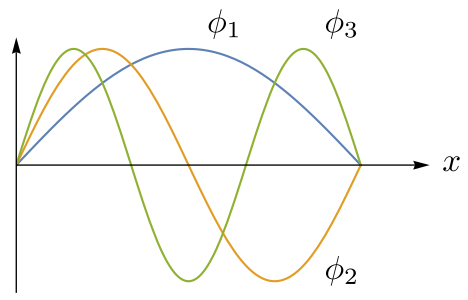
Let us consider an infinite potential well in the region \(0\leq x \leq L\). In the last lecture, we introduced a basis of square-integrable wave functions
\begin{equation}
\phi_n(x) = \sqrt{\frac{2}{L}} \sin\left(\frac{n \pi x}{L}\right) \qquad n \in \mathbb{Z}_{\gt{}0} \, .
\end{equation}
The first few of these functions are displayed in
figure
f:box_ef; note how they satisfy the boundary conditions
that the wave functions vanish at the edge of the box.
We will now compute the matrix elements of position, momentum and
Hamiltonian operators in this basis.
7.4.1.Position
First, for position we find
\begin{align}
x_{mn}& := \langle \phi_m , \hat x \cdot \phi_n\rangle \\
& = \int^L_0 x \, \overline{ \phi_m(x) } \phi_n(x){\rm d}x \\ \nonumber
& = \frac{2}{L}\int^L_0 x \sin\left(\frac{m \pi x}{L}\right)\sin\left(\frac{n \pi x}{L}\right) {\rm d}x \\
& = \frac{1}{L}\int^L_0 x \left[ \cos\left(\frac{(m-n) \pi x}{L}\right) - \cos\left(\frac{(m+n) \pi x}{L}\right) \right] \, {\rm d}x \, . \end{align}
It is convenient to introduce \(y = \pi x / L\) and use
\begin{equation}
\int^\pi_0 y \cos(n y) dy =
\frac{(-1)^n-1}{n^2} \qquad n \neq 0 \, ,
\end{equation}
which you can prove by integration by parts. Combining the two contributions to the integral we find
\begin{align}
x_{mn} =
\begin{cases}
\frac{L}{2} & \mathrm{if} \quad m = n \\
\frac{4L}{\pi^2} \frac{ m n}{\left(m^2-n^2\right)^2} \left((-1)^{m+n} - 1 \right) & \mathrm{if} \quad m \neq n \\
\end{cases} \, ,
\end{align}
which is a Hermitian matrix
\begin{equation}
x_{mn} = \left(
\begin{array}{ccccc}
\frac{L}{2} & -\frac{16 L}{9 \pi ^2} & 0 & -\frac{32 L}{225 \pi ^2} & \cdots \\
-\frac{16 L}{9 \pi ^2} & \frac{L}{2} & -\frac{48 L}{25 \pi ^2} & 0 \\
0 & -\frac{48 L}{25 \pi ^2} & \frac{L}{2} & -\frac{96 L}{49 \pi ^2} \\
-\frac{32 L}{225 \pi ^2} & 0 & -\frac{96 L}{49 \pi ^2} & \frac{L}{2} \\
\vdots & & & & \ddots
\end{array}
\right) \, .
\end{equation}
7.4.2.Momentum
Second, for momentum we find
\begin{align}
p_{mn} & := \langle \phi_m , \hat p \cdot \phi_n\rangle \\
& = - i \hbar \int^L_0 \, \overline{\phi_m(x)} \, \frac{\partial \phi_n(x)}{\partial x} \, {\rm d}x \\ \nonumber
& = - i \hbar \frac{2}{L}\int^L_0 \sin\left(\frac{m \pi x}{L}\right) \frac{n\pi}{L} \cos\left(\frac{n \pi x}{L}\right) {\rm d}x \\
& =- \frac{i \hbar n\pi}{L^2} \int^L_0 \left[ \sin\left(\frac{(m+n) \pi x}{L}\right) + \sin\left(\frac{(m-n) \pi x}{L}\right) \right] {\rm d}x \, .
\end{align}
It is convenient to introduce \(y = \pi x / L\) and use
\begin{equation}
\int^\pi_0 \sin(n y) \, dy =
\frac{1-(-1)^n}{n} \quad n \neq 0
\end{equation}
to find
\begin{align}
p_{mn} & = \begin{cases}
0 & \mathrm{if} \quad m = n \\
\frac{2 i \hbar}{L} \frac{m n }{ \left(m^2-n^2\right)}\left((-1)^{m+n} - 1\right) & \mathrm{if} \quad m \neq n \\
\end{cases} \, .
\end{align}
This is again a Hermitian matrix
\begin{equation}
\left(
\begin{array}{ccccc}
0 & \frac{8 i \hbar}{3 L} & 0 & \frac{16 i \hbar}{15 L} & \cdots \\
-\frac{8 i \hbar}{3 L} & 0 & \frac{24 i \hbar}{5 L} & 0 \\
0 & -\frac{24 i \hbar}{5 L} & 0 & \frac{48 i \hbar}{7 L} \\
-\frac{16 i \hbar}{15 L} & 0 & -\frac{48 i \hbar}{7 L} & 0 \\
\vdots & & & & \ddots
\end{array}
\right) \, .
\end{equation}
7.4.3.Energy
The Hamiltonian operator is
\begin{equation}
\hat H = \frac{\hat p^2}{2m} = - \frac{\hbar^2}{2m} \frac{\partial^2}{\partial x^2} \, .
\end{equation}
in the region \(0\lt{}x\lt{}L\). The matrix elements of the Hamiltonian are then
\begin{align}
H_{mn} & := \langle \phi_m , H \cdot \phi_n\rangle \\
& = - \frac{\hbar^2}{2m} \int^L_0 \, \overline{ \phi_m(x)} \, \partial^2_x \phi_n(x) \, {\rm d}x \\ \nonumber
& = \frac{\hbar^2 \pi^2 n^2 }{2mL^2} \cdot \frac{2}{L}\int^L_0 \sin\left(\frac{m \pi x}{L}\right)\sin\left(\frac{n \pi x}{L}\right) {\rm d}x \\
& = E_n \delta_{mn} \, .
\end{align}
where
\begin{equation}
E_n = \frac{\hbar^2 \pi^2 n^2 }{2mL^2} \, .
\end{equation}
This is a diagonal Hermitian matrix. In fact, the above computation
shows that the wave functions \(\phi_n(x)\) in our orthonormal basis are
in fact ‘eigenfunctions’ of the Hamiltonian operator,
\begin{equation}
\hat H \cdot \phi_n(x) = E_n \phi_n(x) \, .
\end{equation}
More about eigenfunctions in the next chapter.

 Long-tap anywhere to ask a question (or see the reply).
Right-click anywhere to ask a question (or see the reply).
Long-tap anywhere to ask a question (or see the reply).
Right-click anywhere to ask a question (or see the reply).