17.1.Introduction to Scattering Problems
Quantum
particles scattering off a potential barrier typically have both a
non-zero probability to reflect as well as a non-zero probability to
transmit.
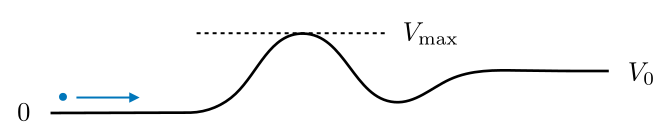
Consider a potential that becomes constant as \(x \to \pm \infty\). For instance,
\begin{equation}
V(x) \to \begin{cases}
0 & \quad x \to - \infty \\
V_0 & \quad x \to +\infty \, .
\end{cases}
\end{equation}
In a scattering problem, we ask the question: what is the fate of a
particle with energy \(E\) incoming from \(x = -\infty\)?
The answer in classical mechanics is simple. Let \(V_{\text{max}}\)
denote the maximum value of the potential. Conservation of energy
tells us that:
If \(E\lt{}V_{\text{max}}\), the particle will be “reflected” back to \(x = - \infty\) with probability \(1\).
If \(E\gt{}V_{\text{max}}\), the particle will be “transmitted” to \(x = \infty\) with probability \(1\).
The answer in quantum mechanics is much more interesting!
17.2.Scattering Wavepackets
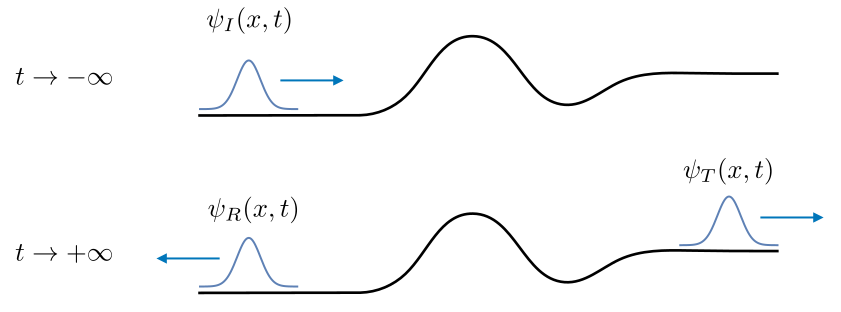
A quantum-mechanical wave packet incident on a potential
barrier will split into a reflected part and a transmitted part, in
contrast to classical mechanics.
What do we mean by the scattering of particles in quantum mechanics?
The proper answer is to consider the scattering of “wavepackets”,
which you can imagine as Gaussian wave functions.
For \(t \to - \infty\), the wave function has the form of an incoming wavepacket,
\begin{equation}
\psi(x,t) \to \psi_I(x,t) \, .
\end{equation}
The incoming wavepacket will then “scatter” from the potential
and as \(t\to \infty\), the wave function tends to a sum of reflected
and transmitted wavepackets,
\begin{equation}
\psi(x,t) \to \psi_R(x,t) + \psi_T(x,t) \, .
\end{equation}
In the limit \(t \to \infty\), the reflected and transmitted wavepackets are completely separated in space and show no interference. The probability for the particle to be reflected or transmitted is then defined by
\begin{align}
R = \lim_{t\to \infty} \int |\psi_R(x,t)|^2 {\rm d}x\,,\\[1ex]
T = \lim_{t\to \infty} \int |\psi_T(x,t)|^2 {\rm d}x\, ,
\end{align}
such that
\begin{equation}
R +T = 1
\end{equation}
if the total wave function is correctly normalized.
For a general potential \(V(x)\) and incoming wave function
\(\psi_I(x,t)\), computing \(R\) and \(T\) is extremely hard. Fortunately,
we do not need to solve this problem in general to answer important
questions about scattering experiments.
17.3.Scattering Plane Waves
Scattering plane waves is easier computationally (than
wave packets), but still captures the reflection and transmission
behaviour, by making using of the probability current density.
Scattering experiments typically involve incoming particles with a
small energy uncertainty \(\Delta E\). This suggests that instead it is
useful to consider stationary wave functions with energy \(E\gt{}0\),
\begin{equation}
\psi(x,t) = \phi(x)e^{-iEt/\hbar}\,, \qquad \hat H \cdot \phi(x) = E\phi(x) \, .
\end{equation}
It is straightforward to find the form of the Hamiltonian
eigenfunction \(\phi(x)\) in the asymptotic regions where the potential
is constant: these are plane waves.
For \(x \to -\infty\), Hamiltonian eigenfunctions obey
\begin{equation}
\frac{\partial^2\phi(x)}{\partial x^2} = - k^2 \phi(x)\,,
\qquad
k = \sqrt{2mE/\hbar^2} \, .
\end{equation}
The general solution is
\begin{equation}
\phi(x) = e^{ikx} + r e^{-ikx} \, .
\end{equation}
This is a superposition of incoming and reflected waves. Since the wave functions are not square-normalizable, the overall constant is not physically meaningful: for convenience we have set the coefficient of the incoming wave to \(1\).
For \(x \to + \infty\), \(V(x) = V_0\). For scattering problems we assume that \(E \gt{} V_0\). The Hamiltonian eigenfunctions are solutions to
\begin{equation}
\frac{\partial^2\psi(x)}{\partial x^2} = - k'^2 \psi(x)\,,
\qquad
k' =\sqrt{2m(E-V_0)/\hbar^2} \, .
\end{equation}
We consider the solution
\begin{equation}
\psi(x) = t e^{ik'x}
\end{equation}
corresponding to a transmitted wave. There is another solution \(e^{-ik'x}\). which corresponds to a wave incoming from \(x = +\infty\). We discard this solution as we only want waves incoming from \(x = - \infty\).
In summary we have asymptotic plane waves,
\begin{equation}
\phi(x) \to \begin{cases}
e^{ikx} + r e^{-ikx} & \quad x \to -\infty \\[1ex]
t e^{ik'x} & \quad x \to + \infty
\end{cases} \, .
\end{equation}
How do we extract physical information from these wave functions? To
answer this question, we consider the probability current. For
stationary solutions this takes the form
\begin{align}
J
& = \frac{\hbar}{2mi}\left( \bar\psi \partial_x \psi - \psi \partial_x \bar\psi \right) \\[1ex]
& = \frac{\hbar}{2mi}\left( \bar\phi \partial_x \phi - \phi \partial_x \bar\phi \right)\,,
\end{align}
where the phase \(e^{-iEt/\hbar}\) has cancelled out. For a plane wave
\(\phi(x) = e^{ikx}\), the probability current is
\begin{equation}
J(\phi = e^{ikx}) = \frac{\hbar}{2mi}\left( e^{-ikx} \partial_x e^{ikx} - e^{ikx}\partial_x e^{-ikx} \right) = \frac{\hbar k}{m} \, .
\end{equation}
(once again, this does not violate the statement that the probability
current vanishes for
square-normalisable stationary solutions
because plane waves are not square-normalisable). The probability
current in the asymptotic regions is therefore
\begin{equation}
J(x) \to \begin{cases}
J_I - J_R& \quad x \to -\infty \\[1ex]
J_T & \quad x \to + \infty\,,
\end{cases}
\end{equation}
where
\begin{equation}
J_I := \frac{\hbar k}{m}\,, \quad\qquad
J_R := \frac{\hbar k}{m} |r|^2\,, \quad\qquad
J_T := \frac{\hbar k'}{m} |t|^2\,,
\end{equation}
are defined such that \(J_I,J_R,J_T\gt{}0\). They are the contributions to
the probability current in the asymptotic regions from the incident,
reflected, and transmitted waves.
There is an immediate constraint on these currents from the continuity
equation \(\partial_t P + \partial_xJ = 0\). Since the the wave
functions are stationary, \(\partial_t P = 0\), and the probability
current is constant in space. We conclude that
\begin{equation}
J(-\infty) = J(\infty)
\end{equation}
and therefore
\begin{equation}
J_I - J_R = J_T \, .
\end{equation}
This means that if we define
\begin{align}
R & := \frac{J_R}{J_I} = |r|^2 \qquad & T & := \frac{J_T}{J_I} = \frac{k'}{k}|t|^2
\end{align}
then \(R+T = 1\).
This suggests we interpret \(R\) and \(T\) as the probability for an
incoming particle with definite energy \(E\gt{}V_0\) to be reflected and
transmitted by the potential. This in fact coincides with a careful
analysis of the scattering of wavepackets in the limit \(\Delta E \to
0\) of small uncertainty in energy. We are therefore justified in using
the simpler definition in terms of plane waves.
For more information, see section 5.4 of [
4].
17.4.Example: Finite Step Potential
For a finite step potential the plane wave functions on
the left- and right-hand side can be written down explicitly, and
imposing continuity and differentiability at the step then
determines the reflection and transmission coefficients.
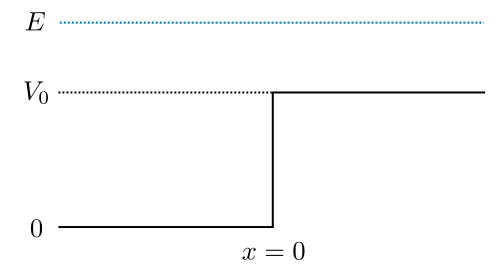
Let us consider the finite step potential
\begin{equation}
V(x) = \begin{cases}
0 & \quad x \lt{} 0 \\[1ex]
V_0 & \quad x \geq 0
\end{cases}
\end{equation}
where we assume that \(V_0 \gt{}0\). This is a simple approximation for a
more realistic smooth potential interpolating between \(0\) and
\(V_0\). It might represent the boundary between two different
materials.
There are two cases to consider: \(E\gt{}V_0\) or \(E\lt{}V_0\). The ``scattering
problem'' considered above corresponds to \(E\gt{}V_0\). However, \(0\lt{}E\lt{}V_0\)
is also extremely interesting and is known as the ``tunnelling
problem''. We consider it further in the next lecture.
Let us therefore restrict here to \(E\gt{}V_0\). In this example, the
asymptotic plane wave solutions considered above are valid all the
way up to \(x = 0\). In summary,
\begin{equation}
\phi(x) = \begin{cases}
e^{ikx} + r e^{-ikx} & \quad x \lt{} 0 \\[1ex]
t e^{ik'x} & \quad x \gt{} 0
\end{cases} \, .
\end{equation}
We now need to impose boundary conditions at the discontinuity in the potential at \(x = 0\). Since the potential remains finite we require that both \(\phi(x)\) and \(\partial_x\phi(x)\) are continuous across \(x = 0\). This requires
\begin{equation}
1 + r = t \qquad k (1-r) = k't \, .
\end{equation}
We have two equations for two unknowns \(r,t\) and the solution is unique
\begin{equation}
r = \frac{k-k'}{k+k'}\,, \qquad t = \frac{2k}{k+k'} \,,
\end{equation}
and hence
\begin{equation}
R = \left( \frac{k-k'}{k+k'} \right)^2\,, \qquad T = \frac{k'}{k}\left( \frac{2k}{k+k'} \right)^2 = \frac{4kk'}{(k+k')^2} \, .
\end{equation}
As a consistency check we see that \(R + T = 1\) as required.
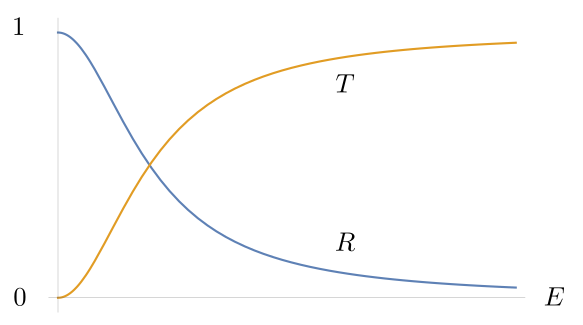
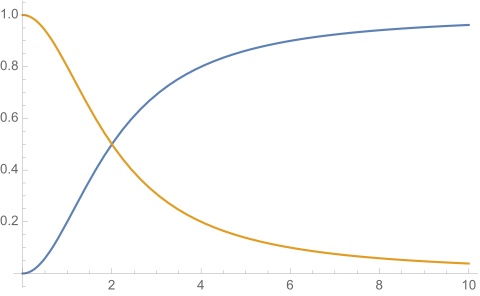
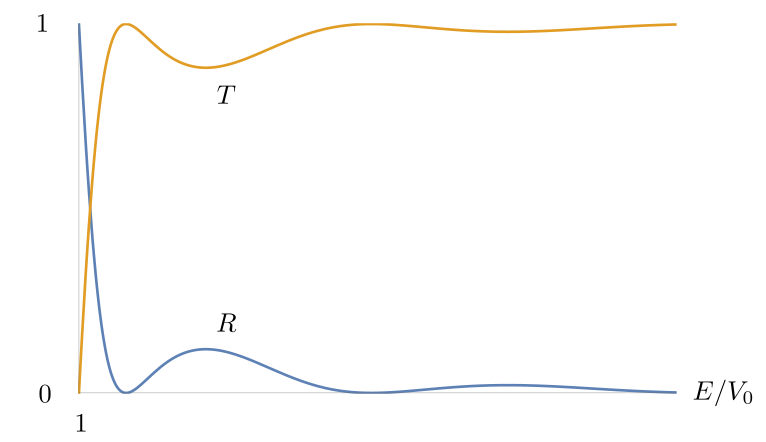
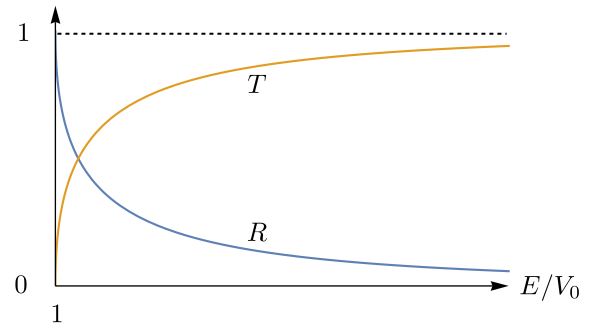
The reflection and transmission probabilities as a function of the
dimensionless ratio \(E/V_0\) are shown above. There are two important
limits:
As \(E \to \infty\) or \(V_0 \to 0\) we find \(R \to 0\) and \(T \to
1\): the potential step effectively disappears and the incoming
particle is transmitted with probability \(1\). Note that this
coincides with the classical expectation for particles with \(E\gt{}V_0\).
As \(E \to V_0\) from above we find \(R \to 1\) and \(T \to 0\): the
incoming particle is reflected with probability \(1\). This coincides
with the classical expectation for particles with \(E\leq V_0\).
As mentioned above, an important question is what happens in quantum
mechanics when \(E\lt{}V_0\). We will address this problem in the next
lecture!

 Long-tap anywhere to ask a question (or see the reply).
Right-click anywhere to ask a question (or see the reply).
Long-tap anywhere to ask a question (or see the reply).
Right-click anywhere to ask a question (or see the reply).