Introduction to Quantum Mechanics
1.Why Quantum Mechanics?
2.The Double Slit Experiment
3.Wave function and Probabilities
4.Momentum and Planck's constant
5.Schrödinger's Equation
6.The Hilbert Space
7.Hermitian Operators
8.The Spectrum of a Hermitian Operator
9.Postulates of Quantum Mechanics
10.Commutators and Uncertainty Principle
11.Energy Revisited
12.Stationary states
13.Case Study: The Free Particle
14.Two-particle systems
15.Simple Harmonic Oscillator
16.The Continuity Equation
17.Scattering Problems
18.Tunnelling
18.1.Finite Step Revisited
18.2.Finite Potential Barrier
18.3.Problems
19.Momentum-space Wave function
20.Ehrenfest's Theorem
21.Bibliography
18.Tunnelling
In quantum mechanics, particles can tunnel through a potential barrier which is classically fully reflective.
Consider the potential barrier shown below. In classical mechanics, an incoming particle with energy \(E \lt{} V_{\mathrm{max}}\) is reflected with probability \(1\) and cannot reach \(x = + \infty\). In quantum mechanics, there can be a non-zero probability for the particle to be transmitted through to \(x =+\infty\). This phenomenon is known as ``quantum tunnelling''.
Figure 18.1: When \(E\lt{}V_{\text{max}}\) a quantum mechanical wave packet will still partially tunnel through the barrier, while a classical particle would be fully reflected.
18.1.Finite Step Revisited
Let us revisit the finite step potential,
\begin{equation} V(x) = \begin{cases} 0 & \quad x \lt{} 0 \\ V_0 & \quad x \geq 0 \end{cases} \, , \end{equation}
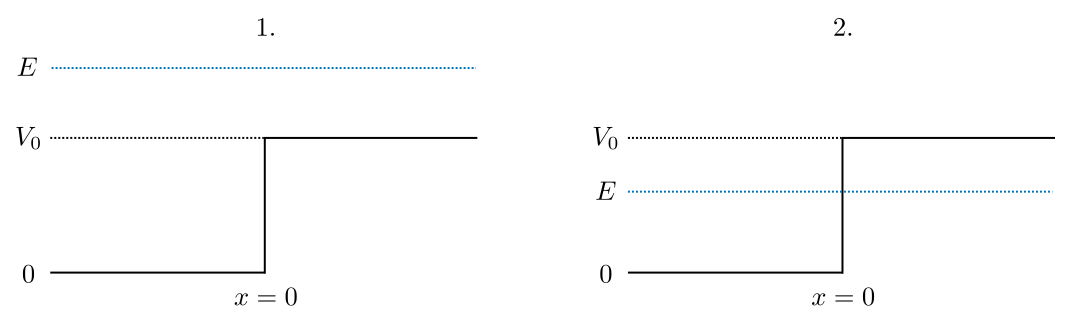
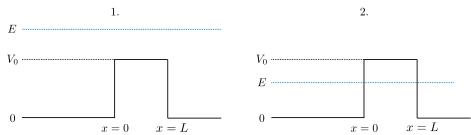
where we assume \(V_0 \gt{}0\). We consider incoming particles of definite energy \(E\gt{}0\). There are two regimes to consider:
  1. Scattering” : \(E\gt{}V_0\).
  2. Tunnelling” : \(0\lt{}E\lt{}V_0\).
Figure 18.2: Two regimes for the finite step potential: when \(E\gt{}V_0\) we are in the scattering regime, while for \(E\lt{}V_0\) we are in the tunnelling regime.
18.1.1.Scattering on a step
In the scattering regime of the finite step problem, the wave function is oscillatory on both sides of the step. There is an incoming part, as well as a reflected and transmitted part, all described by plane waves.
The scattering regime \(E\gt{}V_0\) corresponds to the case where classically an incoming particle would be automatically transmitted. We covered this in the last lecture so we summarise the results here.
The Hamiltonian eigenfunctions take the form
\begin{equation} \phi(x) = \begin{cases} e^{ikx} + r e^{-ikx} & \quad x \lt{} 0 \\ t e^{ik'x} & \quad x \gt{} 0 \end{cases} \, , \end{equation}
where
\begin{equation} k = \sqrt{2mE/\hbar^2} \qquad k' = \sqrt{2m(E-V_0)/\hbar^2} \, . \end{equation}
The coefficients \(r\), \(t\) are found by requiring that the wave function and its derivative are continuous at \(x = 0\), with the result
\begin{equation} r = \frac{k-k'}{k+k'} \qquad t = \frac{2k}{k+k'} \, . \end{equation}
The wave functions are not square-normalizable and to extract physical information we instead compute ratios of probability currents. The probability current is
\begin{equation} J(x) = \begin{cases} J_I - J_R& \quad x \lt{} 0 \\ J_T & \quad x \gt{}0 \end{cases} \end{equation}
where
\begin{equation} J_I = \frac{\hbar k}{m} \qquad J_R = \frac{\hbar k}{m} |r|^2 \qquad J_T = \frac{\hbar k'}{m} |t|^2 \, . \end{equation}
The reflection and transmission probabilities are then
\begin{align} R & = \frac{J_R}{J_I} = |r|^2 = \left( \frac{k-k'}{k+k'} \right)^2 \\ \nonumber T & = \frac{J_T}{J_I} = \frac{k'}{k}|t|^2 = \frac{4kk'}{(k+k')^2} \, . \end{align}
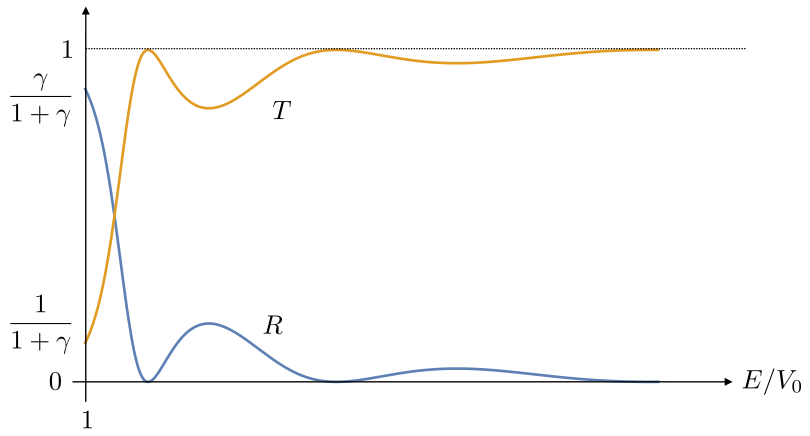
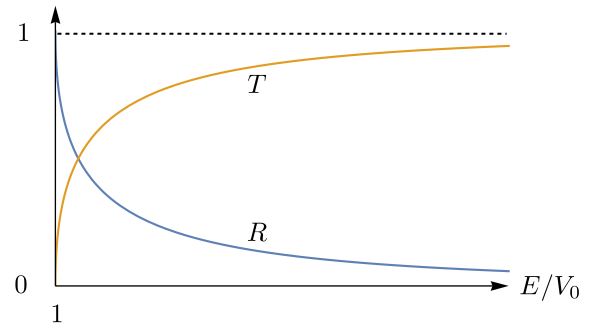
As a consistency check, we have \(R + T = 1\). The reflection and transmission coefficients are sketched below for \(V_0 \lt{} E \lt{} \infty\).
Figure 18.3: The transmission and reflection coefficients for the scattering regime, as a function of the dimensionless ratio of the energy of the incoming wave divided by the height of the step.
18.1.2.Tunnelling into a step
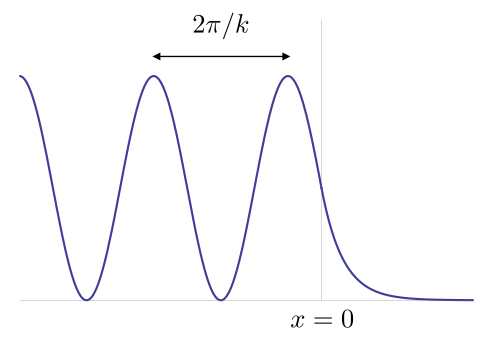
In the tunnelling regime of the finite step problem, the wave function is oscillatory to the left of the step, but exponentially damped (but nonzero) to the right of the step.
Now consider \(0\lt{}E\lt{}V_0\). In the region \(x\gt{}0\), where \(E-V_0\) has changed sign, the Hamiltonian eigenfunction now has an exponential decay
\begin{equation} \phi(x) = \begin{cases} e^{ikx} + r e^{-ikx} & \quad x \lt{} 0 \\ t e^{-\kappa x} & \quad x \gt{} 0 \end{cases} \, , \end{equation}
where now \(\kappa = \sqrt{2m(V_0-E)/\hbar^2}\). We discard the other potential solution \(e^{\kappa x}\) which would diverge at \(x \to +\infty\).
Notice that the above wave function can be obtained from the scattering problem by replacing \(k' \to i \kappa\). This means we can immediately write down the solution for the coefficients \(r\), \(t\),
\begin{equation} r = \frac{k-i\kappa }{k+i\kappa} \qquad t = \frac{2k}{k+i\kappa} \, . \end{equation}
This dramatically changes the computation of the probability currents, which involve both the wave function and its conjugate. In particular, the reflected probability current is now equal to the incoming probability current,
\begin{equation} J_R = \frac{\hbar k }{m}|r|^2 = \frac{\hbar k }{m}\left| \frac{k-i\kappa }{k+i\kappa} \right|^2 = \frac{\hbar k}{m} = J_I \, . \end{equation}
Meanwhile, the transmitted probability current now vanishes,
\begin{align} J_T & = \frac{\hbar}{2mi}(\overline{\phi(x)}\partial_x \phi(x) - \phi(x)\partial_x \overline{\phi(x)}) \qquad x\gt{}0 \\ \nonumber & =\frac{\hbar}{2mi}(e^{-\kappa x}\partial_x e^{-\kappa x} - e^{-\kappa x}\partial e^{-\kappa x}) \\ & = 0 \, , \end{align}
because \(e^{-\kappa x}\) is a real function of \(x\).
In summary, we conclude that
\begin{equation} R = 1 \qquad T = 0 \end{equation}
in the tunnelling regime \(0\lt{}E\lt{}V_0\). Note the following points:
  • This is consistent with the limit \(E \to V^+_0\) in the scattering regime \(E\gt{}V_0\).
  • It coincides with the classical expectation that the particle is always reflected when \(0\lt{}E\lt{}V_0\).
Despite the fact that \(T = 0\), the probability density is non-zero in the region \(x\gt{}0\) so there is therefore a non-vanishing probability to find the particle with \(x\gt{}0\). The probability density is sketched below. In contrast, the particle is forbidden from the region \(x\gt{}0\) in classical mechanics
Figure 18.4: The probability density in the presence of a finite step potential, for the tunnelling regime, which clearly shows that the wave function can penetrate into the barrier.
This has important consequences if we were to add a step down to \(V(x) = 0\) at some finite distance \(x = L\). The wave function would then be expected to decay exponentially for \(0\lt{}x\lt{}L\), but then become trigonometric again for \(x\gt{}L\) and there is a possibility for the particle to escape to \(x \to + \infty\). This is known as “quantum tunnelling”. We explore this in more detail now.
18.2.Finite Potential Barrier
Let us now consider the finite barrier potential
\begin{equation} V(x) = \begin{cases} 0 & \quad x \lt{} 0 \\ V_0 & \quad 0 \leq x \leq L \\ 0 & \quad x\gt{}L \end{cases} \, . \end{equation}
Figure 18.5: Scattering and tunnelling regimes for the finite barrier problem.
In this case, we will see that there is a non-zero probability to find the particle to the right of the barrier even when \(E\lt{}V_0\).
18.2.1.Scattering off a barrier
For a finite width potential barrier, the scattering regime exhibits full transmission (‘resonance’) for a discrete set of energies, corresponding to a wave-length which fits an integer number of times ‘inside’ the barrier.
The scattering regime corresponds again to \(E\gt{}V_0\). The Hamiltonian eigenfunctions are trigonometric in all regions,
\begin{equation} \phi(x) = \begin{cases} e^{ikx} + r e^{-ikx} & \quad x \lt{} 0 \\ A e^{ik' x} + B e^{-ik' x} & \quad 0\lt{}x\lt{}L \\ t e^{ i k x} & \quad x \gt{} L \end{cases} \, , \end{equation}
where the wavenumbers \(k\), \(k'\) are defined as above.
Since the potential remains finite at \(x = 0\) and \(x = L\), we need to impose that the wave function and its derivative are continuous there. This gives the constraints
\begin{align} 1+r & = A+B \\ k(1-r) &= k'(A-B) \end{align}
from \(x=0\) and
\begin{align} Ae^{i k' L} + Be^{- i k'L} & = t e^{ikL} \\ k' (Ae^{ i k' L} - Be^{- ik' L}) & = k t e^{ikL} \, . \end{align}
from \(x=L\). We have four linear equations for four variables \(r\), \(t\), \(A\), \(B\). The solution is found by elementary but tedious linear algebra that I will not reproduce here. The important output is the reflection / transmission probabilities
\begin{align} R & = |r|^2 = \frac{(k^2-k'^2)^2 \sin^2(k'L)}{\left(k^2+k'^2\right)^2\sin^2(k'L) +4 k^2 k'^2 \cos^2(k'L)}\\ T & = |t|^2 = 1-R\, . \end{align}
The important features are summarized below.
Figure 18.6: Transmission and reflection for a finite barrier, as a function of the incident energy, for the scattering regime. The case \(E/V_0=1\) is called “critical scattering”.
  • The limit \(E\to \infty\) corresponds to \(k,k' \to \infty\) with \(k/k' \to 1\). We find \(R \to 0\), \(T\to1\) reproducing the classical expectation for \(E\gt{}V_0\). The potential barrier is negligible compared to the energy and the particle is transmitted with probability \(1\).
  • The limit \(E \to V_0^+\) corresponds to \(k' \to0^+\), with
    \begin{equation} R \to \frac{\gamma}{1+\gamma} \qquad T \to \frac{1}{1+\gamma} \end{equation}
    where \(\gamma = mL^2V_0 / 2\hbar^2\) is a dimensionless parameter.
  • The function has trigonometric dependence on \(k'\). In particular, the transmission probability becomes \(1\) whenever \(k'L = n\pi\) or equivalently
    \begin{equation} E = V_0 + \frac{\hbar^2}{2m}\left(\frac{n\pi}{L} \right)^2\, . \end{equation}
    These “transmission resonances” correspond to a standing wave in \(0\lt{}x\lt{}L\). If we remember that the wavelength is \(\lambda = 2\pi / k'\), the condition becomes \(2L = n\lambda\) so the distance from \(x=0\) to \(x=L\) and back is an integer number of wavelengths. Intuitively, there is constructive interference between incident wave at \(x = 0\) and the standing wave in the region \(0\lt{}x\lt{}L\).
18.2.2.Tunnelling through a barrier
In the tunnelling regime there are no resonances, and the transmission goes to zero as the barrier height goes to infinity.
The tunnelling regime is \(0\lt{}E\lt{}V_0\). The Hamiltonian eigenfunctions are now
\begin{equation} \phi(x) = \begin{cases} e^{ikx} + r e^{-ikx} & \quad x \lt{} 0 \\ A e^{\kappa x} + B e^{-\kappa x} & \quad 0\lt{}x\lt{}L \\ t e^{ i k x} & \quad x \gt{} L \end{cases} \, , \end{equation}
where \(k\) and \(\kappa\) are defined as above.
A Jupyter notebook (on Colab) to compute the time dependence of a wave packet incident on a finite-height barrier, and see the effect of tunnelling.
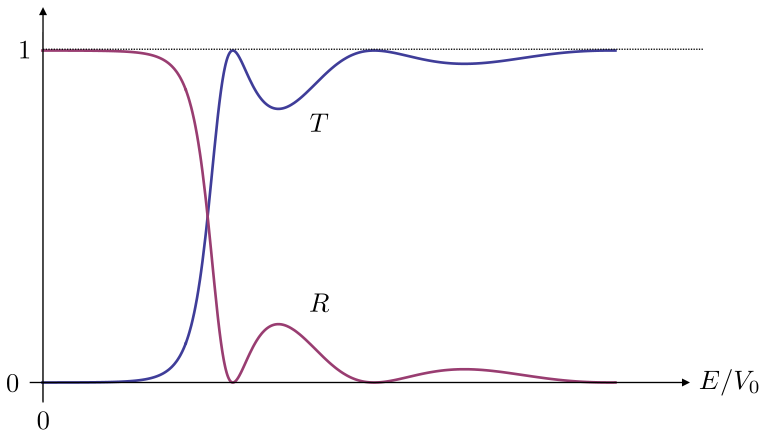
Figure 18.7: Transmission and reflection coefficients for a finite size potential barrier, for all potential heights.
As before, the coefficients \(r\), \(t\) are found by replacing \(k' \to i\kappa\) in the scattering regime. This modifies the reflection and transmission coefficients to
\begin{align} R & = \frac{\left(k^2+\kappa ^2\right)^2 \sinh^2(\kappa L)}{\left(k^2-\kappa ^2\right)^2\sinh^2(\kappa L) +4 \kappa ^2 k^2 \cosh^2(\kappa L)} \\ T & = 1-R \, . \end{align}
Note that there is a non-vanishing probability for the particle to be transmitted through the potential barrier and reach \(x = +\infty\), which is forbidden in classically. This is known as “quantum tunnelling”.
  • The limit \(E \to 0\) corresponds to \(k \to 0\) with \(\kappa\) fixed. We find \(R\to 1\), \(T \to 0\) reproducing the classical expectation for \(E\lt{}V_0\).
  • The limit \(E \to V^-_0\) in the tunnelling regime coincides with the limit \(E \to V_0^+\) in the scattering regime.
  • Note the exponential rather than trigonometric dependence on \(\kappa\) in \(0\lt{}x\lt{}L\). In particular, there are no “resonances” like in the scattering regime.
Finally, we can combine the results in the scattering and tunnelling regimes to sketch the reflection / transmission probabilities across the entire range \(0\lt{}E\lt{}\infty\).
18.3.Problems
  1. Tunneling through a finite step potential
    Consider the same problem but with \(E\lt{}V_0\).
    1. How do the hamiltonian eigenfunctions change in the region \(x\gt{}0\)?
    2. Explain why the probability current \(J\) vanishes for \(x\gt{}0\).
    3. Show that \(R = 1\) and \(T=0\).
    4. Sketch the probability density in the region \(x\gt{}0\).
  2. Bound States in a Finite Potential Well
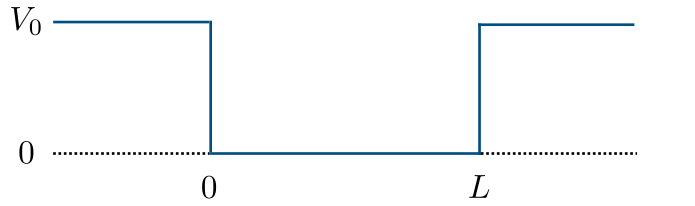
    (This problem is similar to problem 9 of the May 2019 exam and provided here to illustrate the method required to solve it. This problem was not part of the 2020-2021 module). Consider the finite potential well
    \[ V(x) =\begin{cases} V_0 & \quad x \leq 0 \\ 0 & \quad 0\lt{}x\lt{}L \\ V_0 & \quad x \geq L \end{cases} \, . \]
    Consider the following ansatz for ``bound state" wavefunctions,
    \[ \phi(x) = \begin{cases} A e^{\kappa x} & \quad x \lt{} 0 \\ B \sin{kx}+C \cos(kx) & \quad 0\lt{}x\lt{}L \\ D e^{-\kappa x} & \quad x\gt{} L \, . \end{cases} \]
    1. Find constants \(\kappa\), \(k\) in terms of \(E\), \(V_0\) such that this is a Hamiltonian eigenfunction with energy \(0\lt{}E\lt{}V_0\).
    2. Explain why there are no terms in the ansatz proportional to \(e^{-\kappa x}\) for \(x\lt{}0\) and \(e^{\kappa x}\) for \(x\gt{}L\).
    3. What boundary conditions do the wavefunction obey at \(x = 0\) and \(x = L\)?
    4. Impose the boundary conditions and eliminate \(A\), \(B\), \(C\), \(D\) to obtain the ``quantisation condition"
      \[ \frac{\kappa}{k} = \frac{\tan kL - \frac{\kappa}{k}}{1+\frac{\kappa}{k}\tan kL} \, . \]
    5. Illustrate solutions of the quantisation condition graphically and show that
      1. There is at least one solution independent of \(L\) and \(V_0\).
      2. Show that you reproduce the spectrum of the infinite potential well in the limit \(V_0 \to \infty\).
    Solution:
    1. The Hamiltonian operator for \(x\lt{}0\) and \(x\gt{}0\) is
      \[ \hat H = - \frac{\hbar^2}{2m} \partial_x^2 + V_0 \]
      so the ansatz is a Hamiltonian eigenfunction with energy \(0\lt{}E\lt{}V_0\) provided \(\kappa = \sqrt{2m(V_0-E)/\hbar^2}\). The Hamiltonian operator for \(0\lt{}x\lt{}L\) is
      \[ \hat H = - \frac{\hbar^2}{2m} \partial_x^2 \]
      and the ansatz is a Hamiltonian eigenfunction with energy \(0\lt{}E\lt{}V_0\) provided \(k = \sqrt{2mE/\hbar^2}\).
    2. These solutions diverge as \(x \to -\infty\) and \(x \to \infty\) respectively and are therefore not square-normalisable.
    3. Since the potential remains finite both the wavefunction \(\phi(x)\) and its derivative \(\phi'(x)\) are continuous at \(x = 0\) and \(x = L\).

      Although not asked for in the question, we can show this as follows. First, continuity of \(\phi(x)\) is required for a probabilistic interpretation. Second, consider the equation obeyed by a Hamiltonian eigenfunction
      \[ \phi''(x) =\frac{2m}{\hbar^2}(V(x)-E)\phi(x) \, . \]
      We now integrate this over a small interval \(-\epsilon \lt{} x\lt{} \epsilon\) around the discontinuity in the potential at \(x = 0\) to find
      \[ \phi'(x)|_\epsilon - \phi'(x)|_{-\epsilon} = \frac{2m}{\hbar^2}\int^\epsilon_{-\epsilon} (V(x)-E)\phi(x)dx \, , \]
      where we assume \(\phi'(x)\) is continuous away from the discontinuity. Provided \(V(x)\) remains finite in \(-\epsilon \lt{} x\lt{} \epsilon\), the integral on right vanishes in the limit \(\epsilon \to0\). We conclude that \(\psi'(x)\) also remains continuous across \(x = 0\). The argument is identical at \(x = L\).
    4. We now impose the boundary conditions at \(x = 0\) and \(x=L\). First, from the requirement that the wavefunction and its derivative are continuous across \(x=0\), we have
      \[ A = C \qquad \kappa A = kB \, . \]
      We can immediately eliminate \(A\), leaving \(\kappa C = k B\). Second, from the requirement that the wavefunction and its derivative are continuous across \(x=0\), we have
      \begin{align} A'e^{-\kappa L} & = B \sin kL +C \cos kL \\ & = C \left( \frac{\kappa}{k} \sin kL + \cos kL \right) \\ -\kappa A'e^{-\kappa L} & = k( B \cos kL - C \sin kL ) \\ & = \kappa C \left( \cos kL - \frac{k}{\kappa} \sin kL \right) \end{align}
      where we have eliminated \(B\) using \(\kappa C = k B\). Dividing these equations, we can eliminate the remaining constants \(A'\) and \(C\) to find
      \begin{align} \frac{\kappa}{k} & = \frac{\sin kL - \frac{\kappa}{k} \cos kL}{\cos kL+\frac{\kappa}{k}\sin kL} \\ & = \frac{\tan kL - \frac{\kappa}{k} }{1+\frac{\kappa}{k}\tan kL} \, . \end{align}
    5. We first rearrange to find a quadratic equation for the ratio \(\kappa / k\),
      \[ \tan kL \, \left(\frac{\kappa}{k}\right)^2 + 2 \left( \frac{\kappa}{k} \right) - \tan kL =0 \, . \]
      whose solution is
      \[ \frac{\kappa}{k} = \frac{1}{\tan kL} \left( -1\pm \sqrt{1+\tan^2kL}\right) = \begin{cases} +\tan\left( \frac{kL}{2}\right) \\ -\cot\left( \frac{kL}{2}\right) \end{cases} \]
      Since \(\kappa\), \(k\) can be expressed in terms of \(E\), this is a constraint or ``quantisation condition" on the possible eigenvalues \(E\). It is impossible to solve analytically. However, we can understand the solutions graphically. For this purpose, it is convenient to introduce the dimensionless variables
      \[ z = \frac{L}{2}\sqrt{\frac{2mE}{\hbar^2}} \qquad z_0 = \frac{L}{2}\sqrt{\frac{2mV_0}{\hbar^2}} \, . \]
      The quantisation condition then becomes
      \[ \sqrt{z_0^2/z^2-1} = \begin{cases} +\tan z \\ -\cot z \end{cases} \, . \]
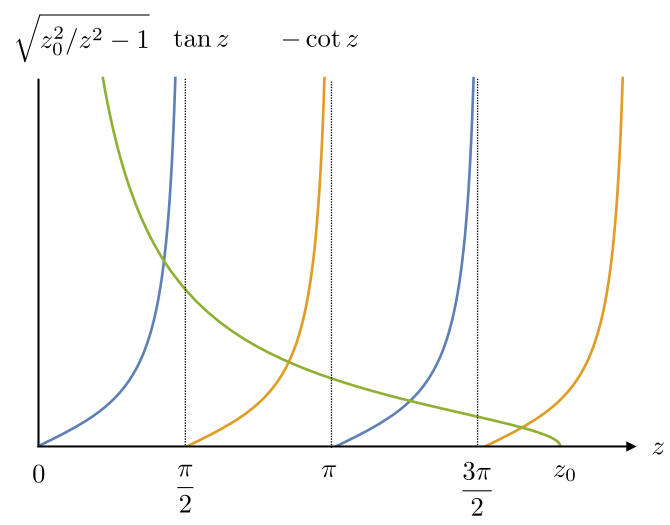
      We can now understand the solutions by plotting both sides of this equation on the same graph and looking for their intersection points.
      Figure 18.9: Graphical method to solve the non-linear equation which determines the energy spectrum.
      1. There is a discrete number of solutions, which increases with the dimensionless parameter \(z_0\). It is clear graphically that there is always at least one intersection point for \(0\lt{}z_0\lt{}\infty\).
      2. The limit \(V_0 \to \infty\) corresponds to \(z_0 \to \infty\). In this limit, there are an infinite number of intersection points that move closer to the asymptotes \(z = \frac{n\pi}{2}\) for \(n \in \mathbb{Z}_{\gt{}0}\). From the definition of \(z\), the intersection points in this limit correspond to energies
        \[ E = \frac{\hbar^2}{2m}\left(\frac{n\pi}{L}\right)^2 \, , \]
        which are those of an infinite square well.
Enter your question about the highlighted paragraph(s). Use '$...$' to type LaTeX maths.
Your question will be raised anonymously and the answer will appear here at some point.
Long-tap anywhere to ask a question (or see the reply). Right-click anywhere to ask a question (or see the reply).