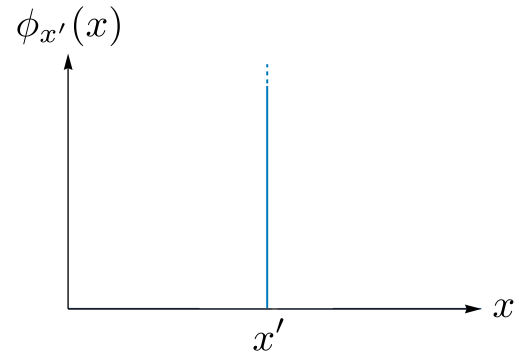
A measurement of \(A\) that yields an eigenvalue \(a_j\) / \(a\) causes the wave function to immediately collapse to the corresponding eigenfunction,
\begin{equation}
\psi(x) \to \psi_j(x) \, /\, \psi_a(x)
\end{equation}
in the discrete / continuous case. In the continuous case, you should be concerned that the wave function immediately after the measurement is a not square-normalisable,
\begin{equation}
\langle \phi_a,\phi_a \rangle = \infty\, .
\end{equation}
This assumes an ``idealised" measurement of a continuous parameter where the outcome is determined with infinite accuracy. A real-world measurement will always have some experimental uncertainty \(\epsilon\). The wave function immediately after the measurement is then a square-normalisable wave function
\begin{equation}
\int {\rm d}a' \, \delta_\epsilon(a-a') \phi_{a'}(x) \, ,
\end{equation}
where \(\delta_\epsilon(a-a')\) is sharply peaked around \(a' =a\) with width \(\epsilon\).
The idealised measurement corresponds to the limit \(\epsilon \to 0\) where \(\delta_\epsilon(a-a') \to \delta(a-a')\). This is a convenient and useful mathematical ideal.

 Long-tap anywhere to ask a question (or see the reply).
Right-click anywhere to ask a question (or see the reply).
Long-tap anywhere to ask a question (or see the reply).
Right-click anywhere to ask a question (or see the reply).