Introduction to Quantum Mechanics
1.Why Quantum Mechanics?
2.The Double Slit Experiment
3.Wave function and Probabilities
3.1.The Wave function
3.2.Expectation Values
3.3.Examples
3.4.Phases
3.5.Collapse of the Wave function
3.6.Problems
4.Momentum and Planck's constant
5.Schrödinger's Equation
6.The Hilbert Space
7.Hermitian Operators
8.The Spectrum of a Hermitian Operator
9.Postulates of Quantum Mechanics
10.Commutators and Uncertainty Principle
11.Energy Revisited
12.Stationary states
13.Case Study: The Free Particle
14.Two-particle systems
15.Simple Harmonic Oscillator
16.The Continuity Equation
17.Scattering Problems
18.Tunnelling
19.Momentum-space Wave function
20.Ehrenfest's Theorem
21.Bibliography
3.Wave function and Probabilities
Throughout the lecture course, we focus on a particle of mass \(m\) moving in one dimension with potential \(V(x)\). In classical mechanics, the particle has definite position and momentum \((x(t),p(t))\), which evolve according to Hamilton's equations with Hamiltonian \(H = \frac{p^2}{2m} +V(x)\).
Introducing the wave function which leads to the probabilistic character of quantum mechanics.
Motivated by the the double slit experiment, however, we must give up the idea that a particle as a definite position and momentum \((x(t),p(t))\). Instead, the particle is described by a complex wave function \(\psi(x,t)\) that encodes the probability for a measurement of position or momentum to yield values in a given range. In this lecture, we consider measurements of position. In the subsequent lectures, we will consider measurements of momentum and energy.
3.1.The Wave function
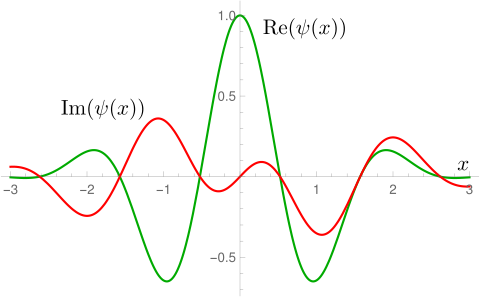
The wave function \(\psi(x,t)\) is a complex function of position \(x\) and time \(t\). Putting on our analysis hat, the wave function defines a continuous function
\begin{eqnarray} \psi_t & : \mathbb{R} \to \mathbb{C} \\ & : x \mapsto \psi(x,t) \end{eqnarray}
at each time \(t\in \mathbb{R}\). We will discuss to what extent the wave function should be differentiable later in the course.
The probability density to find a particle at position \(x\) at time \(t\) is given by \(P(x,t)=|\psi(x,t)|^2\).
A basic postulate of quantum mechanics is that the modulus squared of the wave function,
\begin{equation} P(x,t) := |\psi(x,t)|^2 \, , \end{equation}
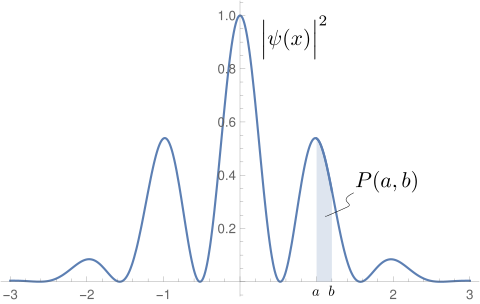
is the ‘probability density’ for a measurement at time \(t\) to find the particle at position \(x\). There are two equivalent ways to say what this means:
Figure 3.1: A typical wave function (top), having both a real and imaginary part, and the corresponding probability density (bottom). Also indicated is the probability to find the particle in a finite interval \(a\lt{}x\lt{}b\).
We find an immediate constraint on the wave function \(\psi(x,t)\) from the requirement that the probability to find the particle anywhere must be \(1\). In particular, a physical wave function \(\psi(x,t)\) should obey
\begin{equation} \int_{-\infty}^{\infty} P(x,t) dx = 1 \label{eq:norm} \end{equation}
at any time \(t\). This constraint typically requires that the wave function should decay fast enough as \(x\to \pm \infty\). Some terminology:
3.2.Expectation Values
The mean of measurements of position, \(\langle x\rangle\), for many measurements of particles described by the same wave function, is given by weighing the position by the probability, \(\displaystyle \langle x\rangle = \int\, x |\psi(x,t)|^2 {\rm d}x\).
As for any probability distribution, the expectation value of a polynomial function \(f(x)\) is given by
\begin{equation} \begin{aligned} \langle f(x) \rangle := & \int_{-\infty}^\infty f(x) P(x,t) \,{\rm d}x \\[1ex] = & \int_{-\infty}^\infty f(x) \big|\psi(x,t)\big|^2\, {\rm d}x \, . \end{aligned} \end{equation}
There are two important expectation values that will feature in these lectures:
3.3.Examples
In the first part of the course, we consider wave functions and expectation values at a fixed point in time \(t\) - how the wave function evolves in time will be considered later. With this understood, we denote the wave function by \(\psi(x)\).
3.3.1.Gaussian Wave function
Consider the wave function
\begin{equation} \psi(x) = C \, e^{-x^2/4\Delta^2} \, , \end{equation}
where \(\Delta \gt{}0\) has units of length and \(C\) is a normalisation constant. To determine the normalisation constant \(C\), we require that the probability to find the particle anywhere is \(1\),
\begin{align} 1 & = \int^\infty_{-\infty} |\psi(x)|^2 dx \\[1ex] & = |C|^2 \int^\infty_{-\infty} e^{-x^2/2\Delta^2} dx \\[1ex] & = |C|^2 \sqrt{2\Delta^2} \int^\infty_{-\infty} e^{-y^2} dy \\[1ex] & = |C|^2 \sqrt{2\pi \Delta^2} \, , \end{align}
where we have used the substitution \(y = \sqrt{2\Delta^2}\) and the standard Gaussian integral
\begin{equation} \int^\infty_{-\infty} e^{-y^2} dy = \sqrt{\pi} \, . \end{equation}
We can therefore choose \(C = (2\pi \Delta^2)^{-1/4}\). Note that we could have multiplied the normalisation by a constant phase \(e^{i\theta}\). This would not change the probability density or position expectation values, so for convenience we can set it to \(1\).
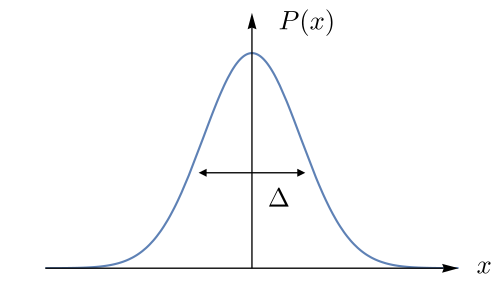
Figure 3.2: Gaussian probability density with width \(\Delta\).
The normalised probability distribution is
\begin{equation} P(x) = \frac{1}{\sqrt{2\pi \Delta^2}} e^{-x^2/2\Delta^2} \end{equation}
which is a standard Gaussian probability distribution. Before doing any computations, we can immediately say that:
  • \(\langle x^{2n+1}\rangle = 0\) for \(n\in\mathbb{Z}_{\geq 0}\) since the integrand is an odd function of \(x\).
  • Since \(\Delta\) is the only length in the problem, dimensional analysis tells us that \(\langle x^{2n}\rangle \propto \Delta^{2n}\) for \(n\in \mathbb{Z}_{\geq 0}\).
In one of the problems, you are asked to verify that \(\langle x^2\rangle = \Delta^2\) and therefore the spread \(\Delta x = \Delta\).
3.3.2.Infinite Potential Well
Consider a particle confined to the region \(0 \lt{} x \lt{} L\). You can regard this as a particle in an infinite potential well,
\begin{equation} V(x) = \begin{cases} 0 & 0 \lt{} x \lt{} L \\ \infty & \mathrm{other} \end{cases} \, . \end{equation}
The particle would require infinite energy to be found with \(x\leq 0\) or \(x \geq L\). We therefore require the wave function vanishes in these regions so that the probability to find it there is zero.
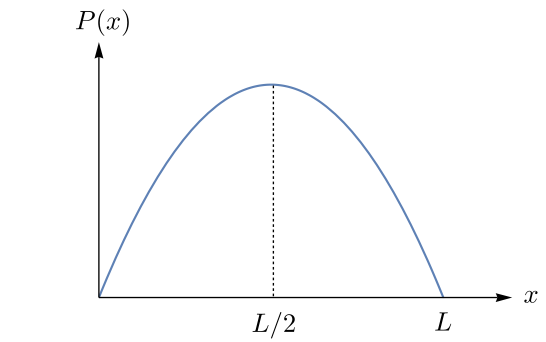
Figure 3.3: Probability density for a particule in an infinite potential well.
A wave function that meets this requirement is
\begin{equation} \psi(x) = \begin{cases} C \sqrt{x(L-x)} & 0 \lt{} x \lt{} L \\ 0 & \mathrm{otherwise} \end{cases}\, . \end{equation}
To determine the normalisation \(C\), we require that the probability to find the particle anywhere is \(1\),
\begin{equation} 1 %& = \int^\infty_{-\infty} |\psi(x)|^2 dx \\ =| C|^2 \int^L_0 x(L-x) dx = |C|^2 \frac{L^3}{6} \, , \end{equation}
and therefore \(C = \sqrt{6/L^3} \, e^{i\theta}\). For convenience, we can choose \(e^{i\theta} =1\).
We can now compute some expectation values. Since \(L\) is the only length in the problem, dimensional analysis means that \(\langle x^n\rangle \propto L^n\) for any \(n\in \mathbb{Z}_{\geq 0}\). Computing the first few, we find
\begin{equation} \begin{aligned} \langle x\rangle & = \frac{6}{L^3} \int^L_0 x^2(L-x)\, {\rm d}x = \frac{L}{2}\,, \\[1ex] \langle x^2\rangle & = \frac{6}{L^3} \int^L_0 x^3(L-x)\, {\rm d}x = \frac{3L^2}{10}\,. \, . \end{aligned} \end{equation}
Since the probability density is symmetric around \(L/2\), we should have expected \(\langle x\rangle = L/2\). Finally, the uncertainty is
\begin{equation} \Delta x = \sqrt{\langle x^2\rangle - \langle x\rangle^2} = \frac{L}{\sqrt{20}} \, . \end{equation}
This example shows that we will, at some point, have to be more
The wave function is continuous. It is also differentiable, except at places where \(V(x)\) is not finite.
precise about the continuity and differentiability properties of the wave function. For the infinite potential well, we see that \(\psi(x)\) is continuous everywhere, and differentiable except at the edges of the well. Jumping ahead a bit, we will find that this holds in general: the wave function \(\psi(x)\) will always have to be continuous, and it will have to be differentiable except at positions \(x\) where the potential \(V(x)\) is not finite. We will discuss and derive these conditions in more detail once we have introduced the Schrödinger equation.
3.4.Phases
In is important to note that if we multiply the wave function \(\psi(x)\) by a position-dependent phase, the probability density is unchanged
\begin{eqnarray} \psi(x) & \to e^{i\theta(x)} \psi(x)\,, \qquad P(x) & \to P(x) \, . \end{eqnarray}
This means that measurements of position cannot detect the difference between the wave functions \(\psi(x)\) and \(e^{i\theta(x)}\psi(x)\). In the next lecture, however, we will show that measurements of momentum can detect the difference between these wave functions, unless \(\theta(x)\) is constant. On the other hand, a constant phase \(e^{i\theta}\) cannot be detected by any measurement and the wave functions \(\psi(x)\) and \(e^{i\theta}\psi(x)\) describe the same physical state.
3.5.Collapse of the Wave function
We now mention an important subtlety with the interpretation of the probability density \(P(x,t)\) in quantum mechanics compared to other areas of mathematical sciences.
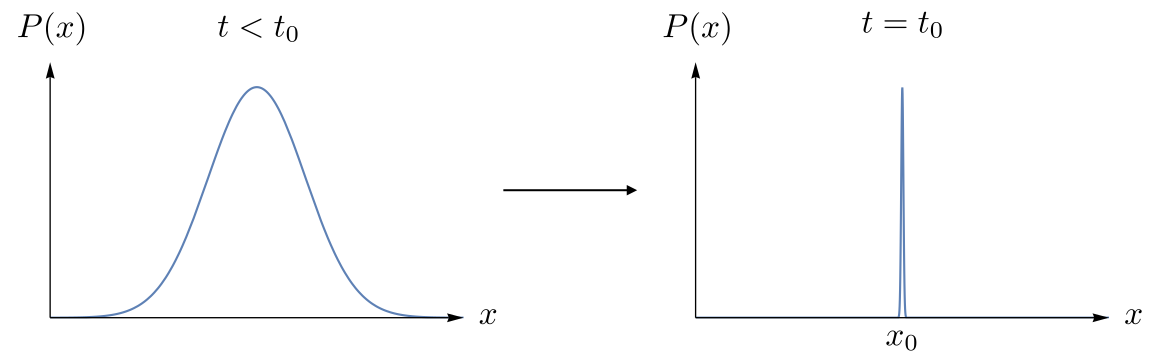
Suppose a particle has wave function \(\psi(x,t)\) for \(t\lt{}t_0\). Then at \(t = t_0\) the position of the particle is measured and the particle is found at \(x = x_0\). What is the wave function after the measurement?
Figure 3.4: When a measurement of position is made, the wave function ‘collapses’ to one which is sharply peaked at the position where we have found the particle.
It turns out that another measurement immediately after the first will find the particle at \(x = x_0\) with probability \(1\).
When a particle's position is measured, its wave function ‘collapses’ to a wave function which is sharply peaked at the position where we found the particle.
This is known as wave function collapse. It means that the act of measurement modifies the wave function to something that is tightly localised around \(x=x_0\). We will describe this phenomenon more precisely in a future lecture.
This is why we must carefully specify the meaning of expectation values such as \(\langle x\rangle\). It is not obtained by averaging over repeated measurements of the same wave function. Instead, it is the average of measurements made on an ensemble of particles with the same wave function \(\psi(x,t)\).
3.6.Problems
  1. 1
    Practice with wave functions
    The wave function of a particle at time \(t=0\) is
    \begin{equation} \psi(x) = \begin{cases} \; C \, \dfrac{x}{a} & \quad 0 \leq x \leq a \\[10pt] \; C \, \dfrac{b-x}{b-a} & \quad a \lt{} x \leq b \\[10pt] \; 0 & \quad \mathrm{otherwise} \end{cases} \end{equation}
    for constants \(0\lt{}a\lt{}b\).
    1. What principle fixes the normalisation \(C\)?
    2. Find \(C\) in terms of \(a\) and \(b\).
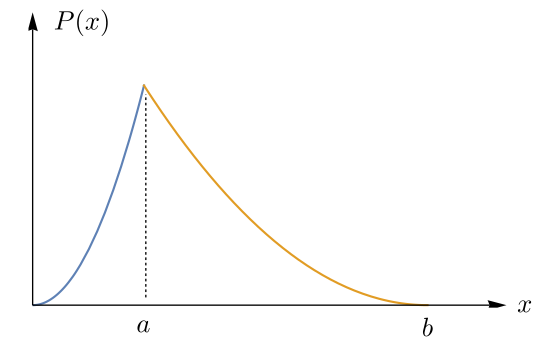
    3. Sketch the probability density \(P(x) = |\psi(x)|^2\).
    4. Where is the particle most likely to be found?
    5. Compute the position expectation value \(\langle x\rangle\). Does it coincide with your previous answer?
    6. What is the probability of finding the particle in the region \(x \lt{} a\)?
    Solution:
    1. The probability to find the particle anywhere should be 1.
    2. The total probability is
      \[ 1 = \int^\infty_{-\infty}dx | \psi(x)|^2 = |C|^2 \int^a_0 dx \left(\frac{x}{a}\right)^2 + |C|^2 \int^b_a dx \left( \frac{b-x}{b-a} \right)^2 = \frac{b}{3} | C|^2 \, . \]
      Therefore \(C = \sqrt{\frac{3}{b}}\) up to a phase.
    3. Plot of probability density:
    4. The most likely value (mode) is \(x = a\).
    5. The expectation value of \(x\) (mean) is
      \[ \langle x \rangle = \int^b_0 dx \, x |\psi(x)|^2 = \frac{3}{b} \int^a_0 dx \, x \left(\frac{x}{a}\right)^2 + \frac{3}{b} \int^b_a dx\, x \left( \frac{b-x}{b-a} \right)^2 = \frac{1}{4}(2a+b) \, . \]
      The probability distribution is skewed for generic constants \(0\lt{}a\lt{}b\) and therefore the mode and mean to not coincide. However, for \(a = \frac{b}{2}\) the probability distribution is symmetric and both answers give the same result, \(\frac{b}{2}\).
    6. The probability to find the particle in the region \(x\lt{}a\) is
      \[ P(x\lt{}a) = \int^a_{0} |\psi(x)|^2 = \frac{3}{b} \int^a_0 \left(\frac{x}{a}\right)^2 =\frac{a}{b} \, . \]
  2. More practice with wave functions
    Consider the wave function
    \begin{equation} \psi(x,t) = C e^{-\lambda|x|} e^{- i \omega t} \end{equation}
    where \(C\), \(\lambda\), \(\omega \in \mathbb{R}_{\gt{}0}\).
    1. Find the normalisation \(C\).
    2. Find the expectation values \(\langle x\rangle\) and \(\langle x^2\rangle\) and the uncertainty \(\Delta x\).
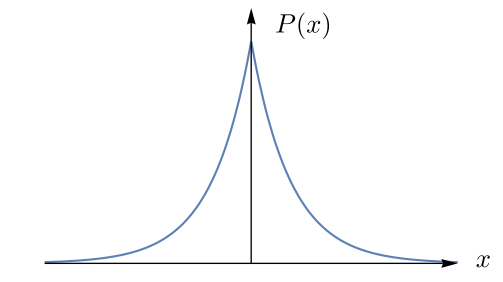
    3. Sketch the probability density \(P(x)\) and mark the points \(x_\pm := \langle x\rangle \pm \Delta x\).
    4. What is the probability to find the particle in the region \(x_- \lt{} x \lt{} x_+\)?
    5. Can the wave function be physical if \(\omega\) has an imaginary part?
    Solution:
    1. The probability to find the particle anywhere must be \(1\).
      \[ 1 = \int^\infty_\infty |\psi(x,t)|^2 dx = |C|^2 \int^\infty_{-\infty} e^{-2\lambda|x|} dx = 2 |C|^2 \int^\infty_0 e^{-2\lambda x} dx = \frac{ |C|^2}{\lambda}\, . \]
      Therefore \(C = \sqrt{\lambda}\) up to a phase.
    2. First, \(\langle x\rangle = 0\) since the integrand is an odd function of \(x\). Second,
      \begin{align} \langle x^2\rangle & = \lambda \int^\infty_{-\infty} x^2 e^{-2\lambda |x|} dx \\ \nonumber & = 2 \lambda \int^\infty_{0} x^2 e^{-2\lambda x} dx \\ & = \frac{\lambda}{2}\frac{\partial^2}{\partial \lambda^2} \int^\infty_0e^{-2\lambda x} dx\\ & = \frac{1}{2\lambda^2}\, . \end{align}
      Finally, \(\Delta x = \sqrt{\langle x^2\rangle - \langle x\rangle^2} =1 /\sqrt{2}\lambda\).
    3. The probability density is \(P(x,t) = \lambda e^{-2\lambda |x|}\).
    4. We have \(x_\pm = \pm 1 /\sqrt{2}\lambda\). The probability to find the particle in the region \(x_- \lt{} x \lt{} x_+\) is therefore
      \[ \int^{1 /\sqrt{2}\lambda}_{-1 /\sqrt{2}\lambda} \lambda e^{-2\lambda |x|} dx = 2 \lambda \int^{1 /\sqrt{2}\lambda}_{0} e^{-2\lambda x} dx = 1-e^{-\sqrt{2}}\, . \]
    5. If \(\omega\) had an imaginary part, the probability density would become
      \begin{align} \nonumber P(x,t) & = |C|^2 e^{-2\lambda|x|} e^{-i(\omega-\omega^*) t} \\ & = |C|^2 e^{-2\lambda|x|} e^{2 \Im(\omega) t} \, . \end{align}
      Attempting to normalise the wave function we would find
      \[ 1 = \frac{|C|^2}{\lambda} e^{2 \Im(\omega) t} \, , \]
      which cannot be satisfied for all time \(t\) unless \(\Im(\omega) = 0\). Therefore the wave function is not physical if \(\Im(\omega) \neq 0\).
  3. Gaussian wave function
    The quantum mechanical wave function of a particle at time \(t=0\) is
    \[ \psi(x) = C e^{-(x-x_0)^2 / 4 \Delta^2} \]
    1. Find the normalisation \(C\).
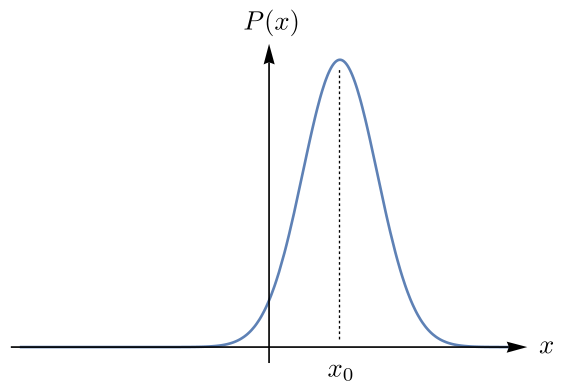
    2. Sketch the probability density \(P(x) = |\psi(x)|^2\).
    3. Find the expectation values \(\langle x \rangle\) and \(\langle x^2\rangle\) and the uncertainty \(\Delta x\).
    4. Which parameter controls how well the particle is localised in position space?
    You may use the Gaussian integrals
    \[ \int^{\infty}_{-\infty} e^{-y^2} dy = \sqrt{\pi} %\qquad \int^{\infty}_{-\infty} y e^{-y^2} dy = 0 \qquad \int^{\infty}_{-\infty} y^2e^{-y^2} dy = \frac{\sqrt{\pi}}{2}\, . \]
    Solution:
    1. Probability to find the particle anywhere should be \(1\). We find,
      \begin{align} 1 & = |C|^2 \int^\infty_{-\infty} dx \, e^{-(x-x_0)^2 / 2 \Delta^2} \\ \nonumber & = \sqrt{2\Delta^2} |C|^2 \int^\infty_{-\infty} dy \, e^{-y^2} \\ & = \sqrt{2\pi \Delta^2} \, |C|^2 \, , \end{align}
      where we defined \(y = (x-x_0) / \sqrt{2\Delta^2}\). Therefore
      \[ C = 1/(2\pi\Delta^2)^{1/4} \]
      up to a phase.
    2. Sketch of the probability density.
    3. First,
      \begin{align} \langle x\rangle & = \frac{1}{\sqrt{2\pi \Delta^2}} \int^\infty_{-\infty} dx \, x \, e^{-(x-x_0)^2 / 2 \Delta^2} \\ \nonumber & = \frac{1}{\sqrt{\pi}} \int^\infty_{-\infty} dy \, ( x_0 + \sqrt{2\Delta^2} \, y ) \, e^{-y^2} \\ & = \frac{x_0}{\sqrt{\pi}} \, \int^\infty_{-\infty} dy \, e^{-y^2} \\ %+ \frac{1}{\sqrt{\pi}} \int^\infty_{-\infty} dy \, y e^{-y^2} \\ & = x_0 \, . \end{align}
      Second,
      \begin{align} \langle x^2\rangle & = \frac{1}{\sqrt{2\pi \Delta^2}} \int^\infty_{-\infty} dx \, x^2 \, e^{-(x-x_0)^2 / 2 \Delta^2} \\ \nonumber & = \frac{1}{\sqrt{\pi}} \int^\infty_{-\infty} dy \, ( x_0 + \sqrt{2\Delta^2} \, y )^2 \, e^{-y^2} \\ & = \frac{x_0^2}{\sqrt{\pi}} \int^\infty_{-\infty} dy \, e^{-y^2} % + \frac{\sqrt{2\Delta^2} }{\sqrt{\pi}}x_0 \int^\infty_{-\infty} dy \, y \, e^{-y^2} + \frac{2\Delta^2}{\sqrt{\pi}} \int^\infty_{-\infty} dy \, y^2 \, e^{-y^2} \\ & = x_0^2 + \Delta^2 \, . \end{align}
      Finally,
      \[ \Delta x = \sqrt{\langle x^2\rangle - \langle x\rangle^2} = \Delta \, . \]
    4. \(\Delta x = \Delta\) is a measure of how well localised the particle is in space.
  4. 1
    Another wave packet
    Consider the following wave function
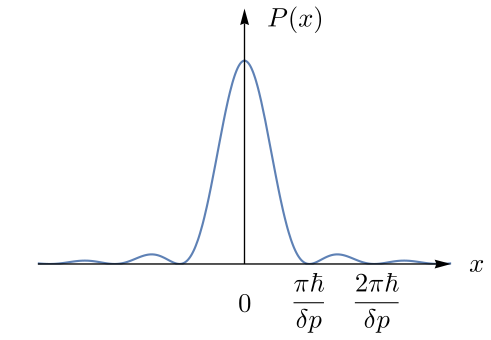
    \[ \psi(x) = \sqrt{ \frac{1}{4\pi\hbar\delta p} } \int^{p_0+\delta p}_{p_0-\delta p} e^{i p x / \hbar} dp \, . \]
    1. Compute and sketch the probability density \(P(x)\).
    2. Verify that the wave function is normalised.
    3. What happens if you try to compute \(\Delta x\)?
    4. Instead compute the distance \(\delta x\) between the zeroes of \(P(x)\) closest to the origin and show that
      \[ \delta x \, \delta p = 2\pi \hbar \, . \]
      You may assume the following integral,
      \[ \int^\infty_{-\infty} \frac{\sin^2(y)}{y^2} = \pi \, . \]
    Solution:
    1. We first compute the integral
      \begin{align} \psi(x) & = \sqrt{ \frac{1}{4\pi\hbar\delta p} } \int^{p_0+\delta p}_{p_0-\delta p} e^{i p x / \hbar} dp \\ \nonumber & = \sqrt{ \frac{\hbar}{\pi \delta p}} \frac{e^{i p_0 x / h} \sin \left( x \delta p / \hbar\right)}{x} \, . \end{align}
      The probability density is therefore
      \[ P(x) = \frac{\hbar}{\pi \delta p} \frac{\sin^2 \left( x \delta p / \hbar\right)}{x^2} \, . \]
    2. Changing variables to \(y = x \delta p/\hbar\), we have
      \begin{align} \nonumber \int^\infty_{-\infty} P(x) dx & = \frac{\hbar}{\pi \delta p} \int_{-\infty}^\infty \frac{\sin^2 \left( x \delta p / \hbar\right)}{x^2} dx \\ & = \frac{1}{\pi}\int^\infty_{-\infty} \frac{\sin^2(y)}{y^2} = 1 \, . \end{align}
    3. The integrals required to compute \(\langle x^n\rangle\) for \(n\gt{}0\) do not converge. Therefore we cannot compute the uncertainty \(\Delta x\).
    4. The zeroes closest to the origin are at \(\pm \pi \hbar / \delta p\). We therefore take \(\delta x = 2\pi \hbar / \delta p\).
    5. Hence \(\delta x \delta p = 2\pi \hbar\).
Enter your question about the highlighted paragraph(s). Use '$...$' to type LaTeX maths.
Your question will be raised anonymously and the answer will appear here at some point.
Long-tap anywhere to ask a question (or see the reply). Right-click anywhere to ask a question (or see the reply).