We have so far only looked at the quantum mechanics of a single
particle in one dimension. That certainly provided some interesting
results and contrasts with classical mechanics. But the full glory of
quantum mechanics only becomes visible if we allow ourselves to look
at somewhat more complicated systems, with more degrees of
freedom. The system which is closest to what we have analysed so far
is that of
two particles in one dimension. The mathematics is
not all that much more complicated than what we have seen so far, but
the results we get out will challenge our intuition, as we touch on
the important concept of
entanglement.
14.1.Two-particle wave functions
A system of two (or three, or one hundred) particles only
has one wave function.
If we have two particles in one dimension, our system is described by
two positions (and classically, two momenta). So instead of having a
wave function \(\psi(x)\), we will now need a wave
function \(\psi(x_1,x_2)\), and a probability
density \(P(x_1,x_2)=\big|\psi(x_1,x_2)\big|^2\). It is important to
understand what this probability density describes. It gives us, for
any pair of positions of the first and second particle, the
probability density of finding the system in that particular situation
(state). Whereas for a single particle we had
\begin{equation}
\text{probability to find particle in $a\lt{}x\lt{}b$} \quad =
\int_{a}^{b} P(x)\,{\rm d}x\,,
\end{equation}
we now have a
\begin{equation}
\begin{aligned}
\text{probability to find particle 1 in $a\lt{}x_1\lt{}b$}\\
\text{and particle 2 in $c\lt{}x_2\lt{}d$}
\end{aligned}
\quad = \int_{a}^{b} \int_{c}^{d} P(x_1, x_2) \, {\rm d}x_1 {\rm d}x_2\,.
\end{equation}
Note that this is probabilitity density is constructed from
one
function of
two variables. You may have thought that a system
of two particles requires two wave functions, one for the first and
one for the second particle. But that is not how things work. You have
one wave function, which maps any point in the space of
classical configurations (with points labelled by \((x_1,x_2)\)) to a single complex
number.
If you are only interested in the probability density of one of the
particles, we need to integrate the density over the position of the
other. So we can write
\begin{equation}
P(x_1) = \int P(x_1, x_2) {\rm d}x_2\,,
\end{equation}
and similar for \(P(x_2)\). Intuitively this should make sense: if
you do not care about where particle 2 is located, you need to ‘collect’
all situations which lead to particle 1 being at position \(x_1\).
By analogy with the one-particle situation, you will not be surprised
to learn that if you measure
both the positions of particle 1
and particle 2 to be \(\tilde{x}_1\) and \(\tilde{x}_2\), the wave
function collapses to the product of position eigenstates of the two
particles,
\begin{equation}
\psi_{\text{before}}(x_1,x_2) ~\rightarrow~
\psi_{\text{after}}(x_1,x_2) \propto \delta(x_1-\tilde{x}_1) \delta(x_2-\tilde{x}_2)
\end{equation}
What happens if you decide to only measure the position of, say,
particle 1, but not measure particle 2? Well, in that case the wave
function collapses according to
\begin{equation}
\begin{aligned}
\psi_{\text{before}}(x_1,x_2) ~\rightarrow~
\psi_{\text{after}}(x_1,x_2) & \propto \delta(x_1-\tilde{x}_1)
\psi_{\text{before}}(x_1,x_2)\\[1ex]
& = \delta(x_1-\tilde{x}_1) \psi_{\text{before}}(\tilde{x}_1,x_2) \,.
\end{aligned}
\end{equation}
That is to say, the wave function now is a ‘slice’ of the original
wave function, taken at the position where we found particle 1.
14.2.Hamiltonian eigenfunctions in a box
The eigenfunctions of a the Hamiltonian of two free
particles are simply products of single-particle eigenfunctions;
these are separable.
To keep things concrete, let us now assume that our two particles are
put in a box of size \(L\), so that the positions \(x_1\) and \(x_2\)
satisfy \(0\lt{}x_1\lt{}L\) and \(0\lt{}x_2\lt{}L\). We will also assume that the
potential vanishes. The Hamiltonain for two free, or non-interacting,
particles is simply the sum of two single-particle Hamiltonians. If
they have equal masses, then we have
\begin{equation}
\label{e:twoH}
\hat{H} = \frac{1}{2m}\hat{p_1}^2 +\frac{1}{2m}\hat{p_2}^2
= -\frac{\hbar^2}{2m} \frac{\partial}{\partial x_1^2}
- \frac{\hbar^2}{2m} \frac{\partial}{\partial x_2^2} \,.
\end{equation}
It is therefore easy to find eigenfunctions: they are simply products of
single-particle eigenfunctions. So
\begin{equation}
\label{e:twobasis}
\phi(x_1, x_2) = \frac{2}{L} \sin\left(\frac{n \pi x_1}{L}\right)
\sin\left(\frac{m\pi x_2}{L}\right)
\end{equation}
is a unit-normalised eigenfunction of \eqref{e:twoH} for any
two integers \(m\) and \(n\). The time-dependence can be found easily by using
our knowledge of stationary states. We simply need to find the
eigenvalue of this wave function, and then the time-dependence is a
simple factor \(\exp(-iEt/\hbar)\). The Hamiltonian acting on the wave
function above gives
\begin{equation}
\hat{H} \phi(x_1,x_2) = \frac{\hbar^2}{2m}\frac{\pi^2}{L^2} \left(
n^2 + m^2 \right) \phi(x_1, x_2)\,.
\end{equation}
and the energy eigenvalue is simply the sum of the eigenvalues of the
individual particle wave functions.
A wave function of the type \eqref{e:twobasis} is called ‘separable’,
as it separates into a product of an \(x_1\)-dependent function and an
\(x_2\)-dependent function.
14.3.Non-separable wave functions: entanglement
Non-separable wave functions describe entangled particles,
for which measurement of the position of one particle influences the
subsequent measurement of the position of the other.
Interesting things happen when we add two basis
functions \eqref{e:twobasis} together (remember, Schrödinger's
equation is linear, so we can do that). An example is
\begin{equation}
\label{e:example2}
\psi(x_1, x_2) = \sqrt{\frac{18}{5}}\frac{1}{L}\left[ \sin\left(\frac{\pi x_1}{L}\right)
\sin\left(\frac{3\pi x_2}{L}\right)
+ \frac{1}{3}\sin\left(\frac{3\pi x_1}{L}\right)
\sin\left(\frac{2\pi x_2}{L}\right)\right]\,.
\end{equation}
This is no longer a separable wave function; you cannot write it as
the product of one function of only \(x_1\) and another one of
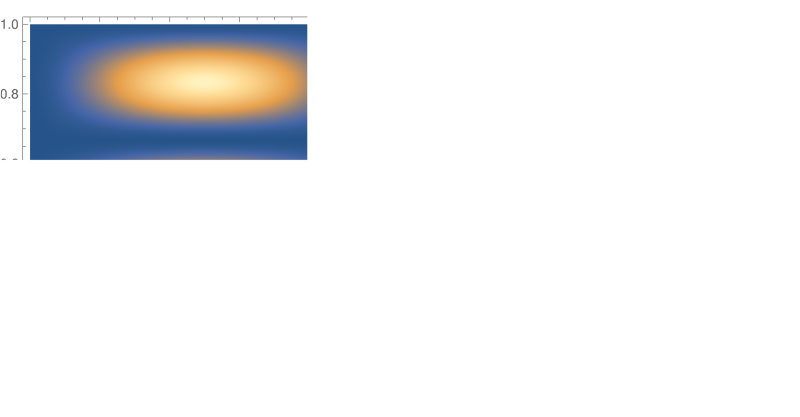
only \(x_2\). The probability density is plotted in the figure on the
right below.
The probability density of the position of particle 1 is obtained as
above by integrating over \(x_2\). This computation gives
\begin{equation}
\label{e:P1before}
P_{\text{before $x_2$ measurement}}(x_1) = \int_{0}^{L} \big|\psi(x_1, x_2)\big|^2\, {\rm d}x_2\,.
\end{equation}
However, if you
first measure the position of particle \(x_2\) to
be \(\tilde{x}_2\), the wave function collapses to \(\psi(x_1,
\tilde{x}_2)\). In this case the probability density is
\begin{equation}
\label{e:P1after}
P_{\text{after $x_2$ measurement}}(x_1) \propto \big|\psi(x_1, \tilde{x}_2)\big|^2\,.
\end{equation}
The probability density \eqref{e:P1before} integrates, for every value
of \(x_1\) the density along a vertical line in the plot. The
density \eqref{e:P1after}, on the other hand, simply takes a
horizontal slice through the plot. These clearly do not have to
agree. To make this concrete, the density for our example
state \eqref{e:example2} before the measurement is
\begin{equation}
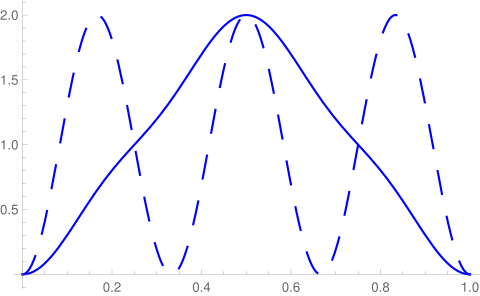
P_{\text{before $x_2$ measurement}}(x_1) = \frac{2}{5L} \sin(\pi x_1)^2 \Big[
6 + 2\cos(2\pi x_1) + \cos(4\pi x_1)
\Big]\,,
\end{equation}
On the other hand, if we measure, for example, the position of
particle 2 to be \(x_2=L/3\), then the density for the other particle
after that measurement will be
\begin{equation}
P_{\text{after $x_2=L/3$ measurement}}(x_1) = \frac{2}{L}
\sin(3 \pi x_1)^2\,.
\end{equation}
This clearly is not the same.
We thus see that the measurement of one particule
influences
the subsequent measurement of the other particle. Quantum states with
that property are called
entangled states. Non-separable wave
functions thus describe entangled particles.
Now that you have seen how one-particle wave functions can be used to
build two-particle wave functions, you can of course apply knowledge
from previous chapters to construct more interesting two-particle
states. One useful example is the combination of Gaussian wave
functions. A Gaussian for two particles is given by
\begin{equation}
\psi(x_1,x_2) = \frac{1}{\sqrt{2\pi\Delta^2}} \exp\left[
- \frac{x_1^2 + x_2^2}{4\Delta^2}\right]\,.
\end{equation}
This is clearly a separable state. It can be considered an initial
wave function, and its time evolution then follows by using the
results computed in the previous chapter. More complicated wave
functions can be obtained by linear superposition. A separable and a
non-separable example are given in the figure below.
More complicated things happen when we consider interacting particles,
that is, systems for which \(V(x_1,x_2)\not = 0\). Needless to say,
solving the Schrödinger equation for such systems is even more
complicated than for a single particle with a non-zero potential, and
this almost always requires numerical techniques. This goes beyond the
scope of the current module. We may touch on these briefly in a
problem session later.
For further reading on the topic in this chapter,
see [
3], and also see Schroeder's book.

 Long-tap anywhere to ask a question (or see the reply).
Right-click anywhere to ask a question (or see the reply).
Long-tap anywhere to ask a question (or see the reply).
Right-click anywhere to ask a question (or see the reply).