In this lecture we further develop the properties of Hermitian
operators and why they are important in quantum mechanics. In
particular we study the eigenfunctions and eigenvalues of Hermitian
operators and the difference between a discrete and continuous
spectrum.
8.1.Hermitian Differential Operators
Recall that a linear differential operator \(A\) is Hermitian if
\begin{equation}
\langle \psi_1 , A \cdot \psi_2 \rangle = \langle A \cdot \psi_1 , \psi_2\rangle
\end{equation}
for all continuous square normalisable wave functions \(\psi_1(x)\), \(\psi_2(x)\). More succinctly, a Hermitian operator obeys \(A^\dagger = A\). We demonstrated last time that position, momentum and energy are represented by Hermitian differential operators,
\begin{equation}
\hat x = x\,, \quad\qquad \hat p = - i \hbar \displaystyle \frac{\partial}{\partial x}\,, \quad\qquad
\hat H = -\displaystyle \frac{\hbar^2}{2m} \frac{\partial^2}{\partial x^2} + V(x) \, .
\end{equation}
Our working assumption is that all measurable quantities are represented by Hermitian differential operators in quantum mechanics.
A wave function \(\psi_a(x)\) is an eigenfunction of a Hermitian
differential operator \(A\) with eigenvalue \(a\) if it obeys
\begin{equation}
A \cdot \psi_a(x) = a \psi_a(x) \, .
\end{equation}
Such wave functions play a distinguished role in quantum mechanics due to the following observations.
Expectation values: let us first compute the expectation value of measurements of \(A\). Assuming \(\psi_a(x)\) is normalised, we find
\begin{equation}
\langle A \rangle = \langle \psi_a, A \cdot \psi_a\rangle = \langle \psi_a , a \psi_a \rangle = a \langle \psi_a , \psi_a \rangle = a \, .
\end{equation}
Similarly, \(\langle A^n \rangle = a^n\) for any positive integer \(n \gt{}0\).
Uncertainty: the uncertainty in measurements of \(A\) is therefore
\begin{equation}
\Delta A = \sqrt{\langle A^2\rangle - \langle A\rangle^2} = \sqrt{a^2 - a^2} = 0 \, .
\end{equation}
This is therefore a wave function with a definite value \(a\) for the measurable quantity \(A\). In other words, measurements of \(A\) should yield the result \(a\) with probability \(1\).
Hermitian operators are important for physics because
their eigenvalues are real. If the system is in an eigenstate of
this operator, measurement of the observable will yield a real
answer given by the corresponding eigenvalue.
In addition, the eigenfunctions and eigenvalues of Hermitian operators have the following important properties.
Theorem: Let \(A\) be a Hermitian operator.
The eigenvalues of \(A\) are real: \(a \in \mathbb{R}\).
Two eigenfunctions \(\psi_1(x)\), \(\psi_2(x)\) of \(A\) with distinct eigenvalues \(a_1 \neq a_2\) are orthogonal.
Proof:
Suppose \(\psi_1(x)\), \(\psi_2(x)\) are eigenfunctions of \(A\) with eigenvalues \(a_1\), \(a_2\),
\begin{equation}
A \cdot \psi_1(x) = a_1 \psi_1(x) \qquad A \cdot \psi_2(x) = a_2 \psi_2(x) \, .
\end{equation}
Then
\begin{align}
\langle \psi_1 , A\cdot \psi_2\rangle & = \langle \psi_1 , a_2\psi_2\rangle = a_2\langle \psi_1,\psi_2\rangle \\[1ex]
\langle A\cdot \psi_1 , \psi_2\rangle & = \langle a_1 \psi_1 ,\psi_2\rangle = \bar a_1\langle \psi_1,\psi_2\rangle \, .
\end{align}
Subtracting these two equations we find \(0 = (\bar a_1 - a_2) \langle \psi_1,\psi_2\rangle\).
First suppose that \(a_2=a_2 = a\) and \(\psi_1 = \psi_2 = \psi\). Then we find
\begin{equation}
(\bar a-a)\langle \psi,\psi\rangle = 0\, .
\end{equation}
Recall that \(\langle \psi , \psi \rangle = 0\) if and only if \(\psi(x) = 0\) identically. Therefore, provided the eigenfunction is not zero, we have \(\bar a = a\) or equivalently \(a \in \mathbb{R}\).
Second suppose that \(a_1 \neq a_2\). Importing the result from part (i) we now have
\begin{equation}
(a_1-a_2)\langle \psi_1,\psi_2\rangle = 0
\end{equation}
and therefore \(\langle \psi_1,\psi_2\rangle = 0\).
Furthermore, an extension of the second part of this theorem is that
the eigenfunctions of a Hermitian operator can be chosen to form an
orthonormal basis. However, what we mean by ``orthonormal basis"
depends on whether the spectrum of eigenvalues is discrete or
continuous.
8.2.Discrete Spectrum
Suppose \(A\) has a discrete spectrum of eigenvalues \(\{a_n\}\) labelled by an index \(n\). We will for simplicity assume the spectrum is non-degenerate: there is one linearly independent eigenfunction \(\phi_n(x)\) for each distinct eigenvalue \(a_n\).
In this case, we can choose the eigenfunctions \(\phi_n(x)\) to form a complete orthonormal basis in the standard sense. This means that as well as eigenfunctions with different eigenvalues being orthogonal, all of the eigenfunctions are normalised. In summary,
\begin{equation}
\langle \phi_{m} , \phi_{n} \rangle = \delta_{mn} \, .
\end{equation}
where \(\delta_{mn}\) is the unit matrix. Furthermore, any continuous square-integrable wave function has a unique expansion
\begin{equation}
\psi(x) = \sum_{n} c_{n} \phi_{n}(x)
\end{equation}
with coefficients \(c_n \in \mathbb{C}\) (yes, there are subtleties here
which we ignore for now).
The coefficients are found using the inner product and orthonormality,
\begin{equation}
\langle \phi_m,\psi\rangle = \sum_n c_n \langle \phi_m , \phi_n \rangle = \sum_n c_n \delta_{mn} = c_m \, .
\end{equation}
The norm of a wave function is
\begin{equation}
\langle \psi, \psi\rangle = \sum_{mn} \bar c_m c_n \langle \phi_m,\phi_n\rangle = \sum_n |c_n|^2 \, .
\end{equation}
If the wave function is normalised,
The decomposition of a wave function in an eigenbasis \(\{\phi_m\}\) of an
Hermitian operator, with coefficients \(c_n\), strongly suggests
\(|c_n|^2\) is the probability of finding the system in the
state \(\phi_n\) for which measurement leads to the value \(a_n\).
\begin{equation}
\langle \psi , \psi\rangle = \sum_n |c_n|^2 = 1 \, .
\end{equation}
This suggests that we interpret \(|c_n|^2\) as the probability for a
measurement of \(A\) to yield the result \(a_n\): these probabilities
should add up to \(1\).
Example: Energy in an Infinite Square Well
Consider the Hamiltonian operator for an infinite potential well in the region \(0\lt{}x\lt{}L\),
\begin{equation}
\hat H = \frac{\hat p^2}{2m} = - \frac{\hbar^2}{2m} \frac{\partial^2}{\partial x^2} \, .
\end{equation}
It is straightforward to see that
\begin{equation}
\phi_n(x) = \sqrt{\frac{2}{L}} \sin\left( \frac{n\pi x}{L}\right) \qquad n \in \mathbb{Z}_{\gt{}0}
\end{equation}
are Hamiltonian eigenfunctions with eigenvalues
\begin{equation}
E_n = \frac{\hbar^2}{2m}\left( \frac{n\pi}{L} \right)^2 \, .
\end{equation}
We have already shown that these eigenfunctions are orthonormal. The fact that any continuous wave function can be expressed uniquely as a linear combination of these wave functions is the content of Fourier's theorem.
In particular, if we expand any wave function
\begin{equation}
\psi(x) = \sum_{n \gt{} 0} c_n \phi_n(x)
\end{equation}
then \(|c_n|^2\) is the probability that a measurement of energy will yield the result \(E_n\). The fact that these probabilities sum to \(1\) is Parceval's theorem.
8.3.Continuous Spectrum
A Hermitian operator \(A\) can also have a continuous spectrum of
eigenvalues, say \(a \in \mathbb{R}\), or some interval in
\(\mathbb{R}\). In this case, we cannot choose the eigenfunctions to
form a complete orthonormal basis in the standard sense - we need a
``continuous" version of the unit matrix \(\delta_{mn}\).
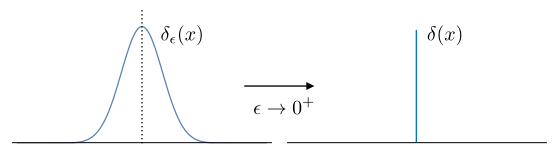
For this purpose, we will introduce the
Dirac delta
function, denoted by \(\delta(a)\). This is not a function but a
‘distribution’. This means it behaves as a function inside
integrals. You can think about it roughly as a function with
\begin{equation}
\delta(a) = \begin{cases}
0 & \quad a \neq 0 \\
\infty & \quad a = 0
\end{cases} \,
\end{equation}
but where the area under the function is \(1\),
\begin{equation}
\int^\infty_{-\infty} \delta(a)\, {\rm d}a = 1 \, .
\end{equation}
A more precise definition is as a limit of a Gaussian function
\begin{equation}
\delta_\epsilon(a) = \frac{1}{\epsilon \sqrt{\pi}}e^{-a^2 / \epsilon^2}
\end{equation}
as it becomes infinitely thin \(\epsilon \to 0^+\).
For the calculations that we need to do in this course, we will accept
the following important properties of the Dirac delta function.
The Dirac delta is for a continuous basis what a Kronecker
delta is for a discrete basis.
For a Hermitian operator \(A\) with a continuous spectrum, it is
possible to find a basis of eigenfunctions \(\phi_a(x)\) with
eigenvalues \(a \in \mathbb{R}\) such that
\begin{equation}
\langle \phi_{a} , \phi_{a'} \rangle = \delta(a-a') \, .
\end{equation}
This means the eigenfunctions \(\psi_a(x)\) are not square-normalisable since \(\langle \psi_a , \psi_{a} \rangle = \infty\). Nevertheless, any square-normalisable wave function can still be uniquely expanded
\begin{equation}
\psi(x) = \int^\infty_{-\infty} \, c(a) \, \phi_a(x)\, {\rm d}a\,,
\end{equation}
with complex coefficients \(c(a)\) depending continuously on \(a\).
Eigenfunctions of an operator with continuous spectrum are
not unit-normalisable, but can be ‘delta-function normalised’.
The coefficients can be calculated using the inner product,
\begin{align}
\langle \phi_{a} , \psi \rangle
& = \int^\infty_{-\infty} c(a') \, \langle \phi_{a} , \phi_{a'}
\rangle\, {\rm d}a'\\
& = \int^\infty_{-\infty} c(a') \, \delta(a-a')\, {\rm d}a' \\
& = c(a) \, .
\end{align}
This is the continuous analogue of the discrete result \(\langle \phi_n ,\psi\rangle = c_n\).
The norm of a wave function can be expressed
\begin{align}
\langle \psi , \psi \rangle & = \int^\infty_{-\infty} \overline{c(a)}
c(a') \langle \phi_{a} , \phi_{a'} \rangle\, {\rm d}a {\rm d}a' \\
& = \int^\infty_{-\infty} \overline{c(a)} c(a') \delta(a-a') \, {\rm d}a {\rm d}a'\\
& = \int^\infty_{-\infty} |c(a)|^2\,{\rm d}a \, .
\end{align}
This is the continuous analogue of the discrete result \(\langle \psi,\psi\rangle = \sum_n |c_n|^2\).
For a normalised wave function
\begin{equation}
\langle \psi , \psi \rangle = \int^\infty_{-\infty}|c(a)|^2\, {\rm d}a = 1 \, .
\end{equation}
This suggests that we should treat \(|c(a)|^2\) as a probability distribution for measurements of \(A\).
An example is the momentum operator \(\hat p = -i \hbar \partial_x\) for
a particle moving in one dimension. It is straightforward to see that
the eigenfunctions are plane waves \(e^{ipx/\hbar}\) with eigenvalue
\(p\). We choose the normalisation
\begin{equation}
\phi_p(x) = \frac{1}{\sqrt{2\pi\hbar}} e^{ipx/\hbar} \, .
\end{equation}
so that
\begin{equation}
\langle \psi_p, \psi_p'\rangle = \frac{1}{2\pi \hbar}
\int^\infty_{-\infty} e^{i(p-p')x/\hbar} {\rm d}x= \delta(p-p') \, .
\end{equation}
as required.
Expanding a wave function as a linear combination of momentum eigenfunctions we find
\begin{align}
\psi(x)
& = \int^{\infty}_{-\infty} c(p) \phi_p(x) \, {\rm d}p\\
& = \frac{1}{\sqrt{2\pi \hbar}}\int^{\infty}_{-\infty} c(p) \, e^{ipx/\hbar}\,{\rm d}p \, .
\end{align}
This is nothing other than the Fourier transform (we will see later
that this is the Fourier transform between the position and momentum
space wave functions).

 Long-tap anywhere to ask a question (or see the reply).
Right-click anywhere to ask a question (or see the reply).
Long-tap anywhere to ask a question (or see the reply).
Right-click anywhere to ask a question (or see the reply).