In this lecture, we begin to understand how the wave function evolves
in time in quantum mechanics. The basic question is: given an initial
wave function \(\psi(x,0)\), what is the wave function \(\psi(x,t)\) at
later times \(t\gt{}0\)? This will allow us to determine how statistical
predictions for the outcomes of measurements evolve in time. For
example, we can determine how expectation values of observables such
as \(\langle x\rangle\), \(\langle p\rangle\), \(\langle H\rangle\) depend on time.
5.1.Time Evolution in Classical Mechanics
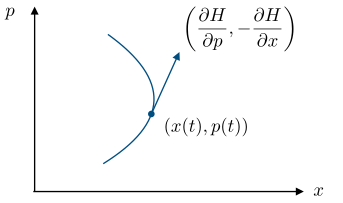
In the Hamiltonian formulation of classical mechanics, a particle is
described by a definite position and momentum \((x(t),p(t))\), which
evolve in time according to Hamilton's equations
\begin{equation}
\dot x = + \frac{\partial H}{\partial p} \qquad
\dot p = - \frac{\partial H}{\partial x} \, ,
\end{equation}
where \(H\) is the Hamiltonian of the system.
It is useful to reformulate time-evolution as a canonical
transformation. First, we note that Hamilton's equations can be
expressed as
\begin{equation}
\dot x = \{ x,H\} \qquad
\dot p = \{ p,H\} \, ,
\end{equation}
where
\begin{equation}
\{ A , B \} := \frac{\partial A}{\partial x}\frac{\partial B}{\partial p}-\frac{\partial A}{\partial p}\frac{\partial B}{\partial x}
\end{equation}
is the Poisson bracket. This shows that an infinitesimal time
evolution \(t \mapsto t +\epsilon\) of position and momentum can be expressed
\begin{align}
x & \mapsto x+\epsilon \dot x = x + \epsilon\{ x,H\} \\
p & \mapsto p+\epsilon \dot p = p + \epsilon\{ p,H\} \, ,
\end{align}
which is an infinitesimal canonical transformation generated by the
Hamiltonian \(H\). In other words, the Hamiltonian is the generator of
time translations.
This is similar to the statement that momentum is the generator of
translations in space from lecture
lec3. We will follow the same
logic here to understand time-evolution in quantum mechanics.
5.2.Schrödinger's Equation
We now use the idea of the Hamiltonian as the generator of time translations to understand time-evolution in quantum mechanics.
Let us consider a wave function \(\psi(x,t)\). The small change in the
wave function due to an infinitesimal time translation \(t \mapsto
t+\epsilon\) is
\begin{align}
\delta_\epsilon \psi(x,t) & = \psi(x,t+\epsilon) - \psi(x,t) \\
& = \epsilon \frac{\partial \psi(x,t)}{\partial t} + {\cal O}(\epsilon^2) \, .
\end{align}
We want this transformation to be ``generated" by the Hamiltonian operator \(\hat H\). This means the change in the wave function is proportional to the action of the Hamiltonian \(H\) on the wave function,
\begin{align}
\delta_\epsilon \psi(x,t) & = \frac{\epsilon}{\alpha} \hat H \, \psi(x,t) \, .
\end{align}
where \(\alpha \in \mathbb{C}\) is an unknown constant of proportionality.
Equating the two expressions for the change in the wave function under the infinitesimal time translation \(t \mapsto t + \epsilon\), we find
\begin{equation}
\alpha \frac{\partial \psi(x,t)}{\partial t} = \hat H \, \psi(x,t) \, .
\end{equation}
How can we determine the constant of proportionality \(\alpha \in \mathbb{C}\)?
Dimensional Analysis. The hamiltonian has units of energy
\( ML^2T^{-2}\), while the derivative \(\partial_t\) has units
\(T^{-1}\). The constant of proportionality \(\alpha\) therefore has
units of angular momentum \(ML^2T^{-1}\). Note that these are the same
units as \(\hbar\).
Conservation of Total Probability. The probability to find
the particle anywhere in space should be \(1\) at any time. This
requires that the normalisation \(\int \psi^*(x),\psi(x)\, {\rm d}x\) is constant in
time for any square-normalisable wave function,
\begin{align}
0 & = \partial_t \int\!\psi^*\psi\, {\rm d}x \\
& = \int \partial_t \psi^* \psi\, {\rm d}x + \int \psi^*\, \partial_t\psi\, {\rm d}x \\
& = \int \frac{1}{\alpha} \big(\hat{H} \, \psi\big)^*\, \psi {\rm d}x
+ \int \psi^* \frac{1}{\alpha} \hat H\, \psi {\rm d}x \\
& = \left( \frac{1}{\bar \alpha} + \frac{1}{\alpha} \right) \int \psi^* \hat H \psi\,{\rm d}x \\
& = \frac{\alpha+\bar\alpha}{|\alpha|^2} \int\psi^* H \psi\,{\rm d}x \, .
\end{align}
In passing to the fourth line, we have used the fact that we know the
form of \(\hat H\) in terms of derivatives with respect to \(x\). We can
integrate by parts with respect to those, and hence show that you can
‘move’ the operator \(\hat H\) from the \(\bar\psi\) factor to the \(\psi\)
factor. We thus conclude that \(\alpha = -\bar\alpha\) and therefore \(\alpha\)
is imaginary.
These observations suggest the constant of proportionality is \(\alpha = i \hbar\) where \(\hbar\) is Planck's constant - this is indeed the value chosen by nature!
The Schrödinger equation determines the time-evolution of
the wave function in terms of the Hamiltonian operator acting on the
wave function.
In summary we have
\begin{equation}
i\hbar \frac{\partial \psi(x,t)}{\partial t} = \hat H \, \psi(x,t)
\end{equation}
or written out in full
\begin{equation}
i \hbar \frac{\partial \psi(x,t)}{\partial t} = -\frac{\hbar^2}{2m} \frac{\partial^2\psi(x,t)}{\partial x^2} + V(x) \psi(x,t) \, .
\end{equation}
This is the
“
Schrödinger equation”.
It is a linear partial differential equation for the
wave function \(\psi(x,t)\). This is probably the most profound equation
you will come across in your degree: it is the most fundamental
description of nature we have at short distances.
Note that there is also something called the ``time-independent
Schrödinger equation'', which is essentially what you get when
\(\partial\psi(x,t)/\partial t\) evaluates to a constant
times \(\psi(x,t)\). We will return to that special case in the chapter
on “stationary states”.
5.3.Properties
The following properties of Schrödinger's equation are very important in the development of quantum mechanics.
1st Order in Time.
Schrödinger's equation has only a first order time derivative. This means that if we know the initial wave function \(\psi(x,0)\), Schrödinger's equation uniquely determines the wave function \(\psi(x,t)\) for \(t\geq 0\).
Linearity.
Schrödinger's equation is linear PDE for the wave function \(\psi(x,t)\). This means that given two solutions \(\psi_1(x,t)\) and \(\psi_2(x,t)\), any linear combination
\begin{equation}
a_1 \psi_1(x,t) + a_2 \psi_2(x,t)
\end{equation}
with constants \(a_1,a_2\in \mathbb{C}\) is another solution. This is known as the “principle of superposition”.
The combination of these two properties, together with the decomposition of a wave function \(\psi(x,t)\) into orthonormal eigenstates of the Hamiltonian \(\hat H\) provides a powerful and systematic method of solving Schrödinger's equation. The next lecture is dedicated to explaining this method. For now we look at some simple examples.
5.4.Example: Plane Waves
Consider a wave function of the form
\[
\psi_p(x,t) = \frac{1}{\sqrt{2\pi \hbar}} e^{ipx/\hbar}e^{-iE(p) t / \hbar}\, ,
\]
where \(E(p)\) is some function of momentum \(p \in \mathbb{R}\). Then,
\begin{align}
i\hbar \frac{\partial \psi(x,t)}{\partial t} = E(p)\psi(x,t) \\
-\frac{\hbar^2}{2m} \frac{\partial^2\psi(x,t)}{\partial x^2} = \frac{p^2}{2m} \psi(x,t) \, .
\end{align}
If we choose \(E(p) = p^2/2m\) then
\begin{equation}
i\hbar \frac{\partial \psi(x,t)}{\partial t} = - \frac{\hbar^2}{2m} \frac{\partial^2\psi(x,t)}{\partial x^2} \, .
\end{equation}
We have therefore found a solution of Schrödinger's equation with \(V(x)=0\). This corresponds to plane wave solution for a free particle of mass \(m\).
5.5.Example: Ground State in Infinite Potential Well
Now consider the wave function
\begin{align}
\psi(x,t)
& = \phi_1(x) e^{-iE_1t/\hbar} \\
& = \sqrt{\frac{2}{L}} \sin\left(\frac{\pi x}{L} \right)\exp\left( -i \frac{\hbar\pi^2}{2mL^2} t \right)
\end{align}
in an infinite potential well \(0 \lt{} x \lt{} L\).
We find
\begin{align}
i\hbar \frac{\partial \psi(x,t)}{\partial t} & = \frac{\hbar^2\pi^2}{2mL^2} \psi(x,t) \\
-\frac{\hbar^2}{2m} \frac{\partial^2\psi(x,t)}{\partial x^2} & = \frac{\hbar^2}{2m}\left(\frac{\pi}{L}\right)^2 \psi(x,t)
\end{align}
and therefore
\begin{equation}
i\hbar \frac{\partial \psi(x,t)}{\partial t} = - \frac{\hbar^2}{2m} \frac{\partial^2\psi(x,t)}{\partial x^2} \, .
\end{equation}
so \(\psi(x,t)\) is a solution of Schrödinger's equation in the infinite potential well. Note that \(\psi(x,0) = \phi_1(x)\) is the ground state Hamiltonian eigenfunction with lowest energy
\begin{equation}
E_1 = \frac{\hbar^2}{2m}\left(\frac{\pi}{L}\right)^2 = \frac{\hbar\pi^2}{2mL^2} \, .
\end{equation}
The wave function \(\psi(x,t)\) is therefore the unique time evolution of \(\phi_1(x)\).
These examples have something in common: they are both of the form
\begin{equation}
\label{e:first_stationary_state}
\psi(x,t) = \phi(x) e^{-iEt/\hbar}\,,
\end{equation}
where \(\phi(x)\) is an eigenfunction of the Hamiltonian \(H\) with
eigenvalue \(E\). We will see later (chapter
sec:energy) why this
is always a solution of Schrödinger's equation and that any solution
can be expressed as a linear combination of such solutions.
5.6.Wave function continuity and differentiability
When we first introduced the wave function, and discussed its form in
an infinite potential well, we mentioned in passing that the wave
fuction is always continuous, and differentiable except at points
where \(V(x)\) is not finite. We are now in a position to back up this
claim.
First look at differentiability. You can prove this formally by
writing down the Schrödinger equation for a state of the
form \eqref{e:first_stationary_state}. Re-arranging a bit, this gives
\begin{equation}
\label{e:first_time_indep_schroedinger}
-\frac{\hbar^2}{2m} \frac{{\rm d}^2}{{\rm d}x^2} \phi(x) = (E-V(x))\phi(x)\,.
\end{equation}
Now integrate both sides over a small interval interval around a point
of interest. If \(E-V(x)\) remains finite, the right-hand side goes to zero
in the limit of infinitesimally small interval, so the left-hand side
should too. That means that the 2nd derivative of \(\phi(x)\) has to
remain finite, which can only be true if the 1st derivative is
continuous.
You have seen a counterexample of this when we discussed the infinite
potential well, where \(V(x)\) is infinite outside the range
\(0\lt{}x\lt{}L\). Another counterexample which we will see later is the
delta-function potential.
For the continuity of \(\phi(x)\) itself, consider what happens if you have
the simplest type of discontinuity, namely a step,
\begin{equation}
\phi(x) = \begin{cases}a & \text{for $x\lt{}0$,}\\[1ex]
b & \text{for $x\gt{}0$.}\end{cases}
\end{equation}
Then \(\phi'(x) = (b-a) \delta(x)\), which you may still be happy with, but
the second derivative is then undefined, and you will struggle to make
sense of \eqref{e:first_time_indep_schroedinger} above. For this
reason, we take the wave function to be continuous.

 Long-tap anywhere to ask a question (or see the reply).
Right-click anywhere to ask a question (or see the reply).
Long-tap anywhere to ask a question (or see the reply).
Right-click anywhere to ask a question (or see the reply).