Introduction to Quantum Mechanics
1.Why Quantum Mechanics?
2.The Double Slit Experiment
3.Wave function and Probabilities
4.Momentum and Planck's constant
5.Schrödinger's Equation
6.The Hilbert Space
7.Hermitian Operators
8.The Spectrum of a Hermitian Operator
9.Postulates of Quantum Mechanics
10.Commutators and Uncertainty Principle
11.Energy Revisited
12.Stationary states
13.Case Study: The Free Particle
14.Two-particle systems
15.Simple Harmonic Oscillator
16.The Continuity Equation
17.Scattering Problems
18.Tunnelling
19.Momentum-space Wave function
19.1.Motivation
19.2.The Fourier Transform
19.3.The Momentum-space Wave function
19.4.Examples
19.5.Properties
19.6.Problems
20.Ehrenfest's Theorem
21.Bibliography
19.Momentum-space Wave function
The symmetry between position and momentum is restored by the momentum-space representation of quantum mechanics.
So far position and momentum have appeared asymmetrically in quantum mechanics. In this lecture, we rectify the situation by introducing a ‘momentum-space’ wave function. We work at a fixed time \(t\).
19.1.Motivation
In the Hamiltonian formulation of classical mechanics, position and momentum appear in a symmetrical way as coordinates \((x,p)\) on phase space. Moreover, there is a canonical transformation that exchanges them!
In classical mechanics position and momentum appear very symmetrically, and there is a map (a canonical transformation) which exchanges them and leaves Hamilton's equations unchanged.
Recall that a canonical transformation is a change of coordinates \((x,p) \to (x',p')\) that leaves Hamilton's equations invariant. Under the transformation
\begin{equation} (x,p) \to (p,-x) \, , \end{equation}
we find
\begin{align} \dot x = + \frac{\partial H}{\partial p} \quad & \to \quad \dot p = -\frac{\partial H}{\partial x} \\ \dot p = - \frac{\partial H}{\partial x} \quad & \to \quad \dot x = + \frac{\partial H}{\partial p} \, . \end{align}
So Hamilton's equations are indeed unchanged but the role of position and momentum has been reversed.
19.2.The Fourier Transform
The Fourier transform translates things in position-space to things in momentum-space.
In contrast, position and momentum appear quite asymmetrically in our description of quantum mechanics so far. We have introduced a ‘position-space’ wave function \(\psi(x)\) on which position and momentum act as operators
\begin{align} \hat x & = x\,, \\[1ex] \hat p & = - i \hbar \frac{\partial}{\partial x} \, . \end{align}
The canonical transformation \((x,p) \to (p,-x)\) from classical mechanics suggests there should another formulation of quantum mechanics with a ‘momentum-space’ wave function \(\widetilde{\psi}(p)\) on which position and momentum act as operators
\begin{align} \hat x & = i \hbar \frac{\partial}{\partial p}\,, \\[1ex] \hat p & = p \, . \end{align}
We claim that the position and momentum wave functions are in fact related by the following pair of integrals
\begin{align} \psi(x) & = \frac{1}{\sqrt{2\pi \hbar}}\int^\infty_{-\infty} {\rm d}p \, \widetilde{\psi}(p) \, e^{ipx/\hbar} \,, \\[1ex] \widetilde{\psi}(p) & = \frac{1}{\sqrt{2\pi \hbar}}\int^\infty_{-\infty} {\rm d}x \, \psi(x) \, e^{-ipx/\hbar} \, . \end{align}
This is an example of a ‘Fourier transform’.
Let us see that these are consistent with the expected form of the position and momentum operators above.
The action of position and momentum operators on position and momentum wave functions is summarised in the following table.
\begin{equation} \begin{aligned} &\quad & \psi(x) &\qquad& \widetilde{\psi}(p) \\[1ex] \hat{x} &\quad & x &\qquad& +i\hbar\frac{\partial}{\partial p} \\[1ex] \hat{p} &\quad& -i\hbar\frac{\partial}{\partial x} &\qquad& p \end{aligned} \end{equation}
19.3.The Momentum-space Wave function
Because we can formulate quantum mechanics using a wave function which is a function of momentum rather than position, there is indeed a symmetry between the two.
The function \(\widetilde{\psi}(x)\) is known as the momentum-space wave function. Everything we have learnt about the position-space wave function has analogues for the momentum-space wave function.
19.4.Examples
19.4.1.Example 1: bound state of the delta-function potential
In general, the momentum-space wave function is different from the position-space wave function (the Fourier transform is non-trivial).
Consider the wave function
\begin{equation} \psi(x) = C e^{-\lambda |x| / \hbar} \end{equation}
where \(\lambda \gt{}0\) is a constant; we have seen this wave function in the discussion of the delta function potential. To find the normalisation \(C\), we require the probability to find the particle anywhere is \(1\),
\begin{align} 1 & = |C|^2 \int^\infty_{-\infty} e^{-2 \lambda |x| / \hbar} \, {\rm d}x \\ & = 2 |C|^2 \int^\infty_0 e^{-2\lambda x / \hbar} \, {\rm d}x \\ & = |C|^2 \frac{\hbar}{\lambda} \, , \end{align}
and therefore \(C = \sqrt{\lambda / \hbar}\) up to a constant phase.
Let us now compute the momentum-space wave function,
\begin{align} \widetilde{\psi}(p) & = \frac{1}{\sqrt{2\pi \hbar}} \int^\infty_{-\infty} {\rm d}p \, e^{-i px / \hbar} \psi(x) \\ & = \sqrt{\frac{\lambda}{2 \pi \hbar^2}} \int^\infty_{-\infty} {\rm d}p \, e^{-i px / \hbar} e^{-\lambda|x| / \hbar} \\ & = \sqrt{\frac{\lambda}{2 \pi \hbar^2}}\left( \int^\infty_0 e^{(-i p-\lambda)x / \hbar} + \int^0_{-\infty} e^{(-i p+\lambda)x / \hbar} \right) \\ & = \sqrt{\frac{\lambda}{2 \pi}}\left( \frac{1}{ip+\lambda} +\frac{1}{-ip+\lambda} \right) \\ & = \sqrt{\frac{2}{\pi}} \frac{\lambda^{3/2}}{p^2+\lambda^2} \, . \end{align}
You may wish to verify that \(\widetilde{\psi}(p)\) is correctly normalised!
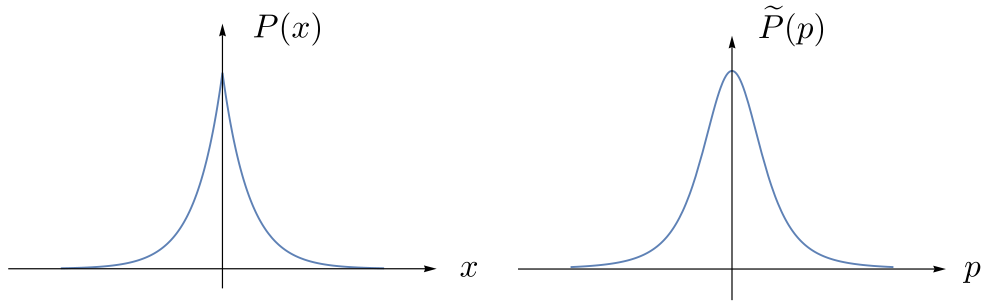
Figure 19.1: The position-space wave probability density for the delta potential bound state, and its momentum-space version.
19.4.2.Example 2: Gaussian wave function
The momentum wave function corresponding to a Gaussian in position-space is again a Gaussian, but now in momentum-space.
Consider the normalised Gaussian wave function
\begin{equation} \psi(x) = Ce^{-x^2/4\Delta^2} \, . \end{equation}
where \(C = 1/(2 \pi \Delta^2)^{1/4}\).
The momentum-space wave function is computed by completing the square in the exponential,
\begin{align} \widetilde\psi(p) & = \frac{C}{\sqrt{2\pi \hbar}} \int^\infty_{-\infty} {\rm d}x \, e^{-x^2/4\Delta^2} e^{-ipx/\hbar} \\ & = \frac{C}{\sqrt{2\pi \hbar}} e^{-p^2 \Delta^2 / \hbar^2} \int^\infty_{-\infty} {\rm d}x \, e^{-(x+2ip\Delta/\hbar)^2/4\Delta^2} \\ \label{e:ycontourint} & =\frac{C}{\sqrt{2\pi \hbar}} e^{-p^2 \Delta^2 / \hbar^2} \int_\gamma \, {\rm d}y \, e^{-y^2/4\Delta^2} \end{align}
where
\begin{equation} y = x + 2ip\Delta^2/\hbar \, . \end{equation}
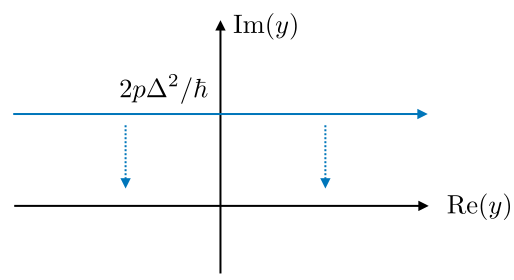
Figure 19.2: The integration over \(y\) in \eqref{e:ycontourint} is a line in the complex plane, which can, however, be shifted to the real line because the integrand does not have any poles in the intermediate region.
In performing the substitution, we are now integrating over a ‘contour’\(\gamma\) in the complex \(y\)-plane that is shifted by an amount \(2ip\Delta^2/\hbar\) in the imaginary direction. However, as there are no poles in the intermediate region we can deform the contour back to the real axis. We then have a standard Gaussian integral,
\begin{align} \widetilde\psi(p) & = \frac{C}{\sqrt{2\pi \hbar}} e^{-p^2 \Delta^2 / \hbar^2} \int^\infty_{-\infty} {\rm d}y e^{-y^2/4\Delta^2} \\ & =\frac{C\sqrt{4\pi \Delta^2}}{\sqrt{2\pi \hbar}} e^{-p^2 \Delta^2 / \hbar^2} \, . \end{align}
Now defining
\begin{equation} \widetilde \Delta := \hbar / 2\Delta \, , \end{equation}
and substituting in the normalisation factor \(C\), this becomes a normalised Gaussian wave function in momentum-space
\begin{equation} \widetilde{\psi}(p) = \frac{1}{(2\pi \widetilde\Delta^2)^{1/4}}e^{-p^2/4\widetilde\Delta^2} \, . \end{equation}
We can therefore immediately determine that \(\langle p \rangle = 0\) and \(\Delta p = \widetilde \Delta\) in complete agreement with what we computed earlier explicitly in position space using \(\Delta p = \sqrt{\langle p^2\rangle - (\langle p\rangle)^2}\).
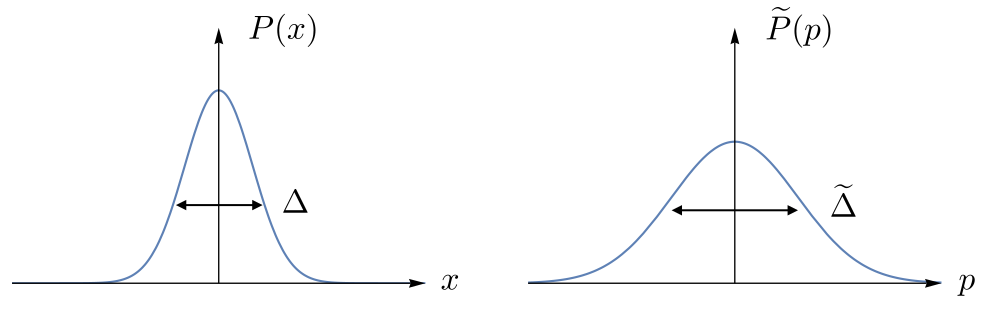
Figure 19.3: The position-space wave probability density for a Gaussian wave function, and its momentum-space version. The momentum-space wave function is again a Gaussian, but with a different width (in momentum-space).
  • This is a very important result: the Fourier transformation of a Gaussian wave function is a Gaussian wave function with uncertainties related by
    \begin{equation} \Delta x \, \Delta p = \frac{\hbar}{2} \, . \end{equation}
19.5.Properties
The Fourier transform preserves the normalisation of the wave function. In addition, a translation in position-space corresponds to a phase factor multiplication in momentum-space, and vice versa.
We conclude by listing a couple of important properties of the Fourier transforms relating position and momentum wave functions.
First, you may have noticed from the Gaussian example that the momentum wave function was automatically normalised. This is generally true: \(\psi(x)\) is normalised if and only if \(\widetilde{\psi}(p)\) is normalised.
Second, the Fourier transformations interchange ‘translations' and `phases’. To be concrete, it is straightforward to check from the definitions that if
\begin{equation} \psi(x) \quad \longleftrightarrow \quad \widetilde\psi(p) \end{equation}
are related by Fourier transform then so are
\begin{align} & \psi(x-x_0) \quad && \longleftrightarrow \quad \widetilde\psi(p)e^{-ipx_0/\hbar} \\ & \psi(x)e^{ip_0x/\hbar} \quad && \longleftrightarrow \quad \widetilde\psi(p-p_0) \end{align}
In words:
This has some important consequences. For example, suppose \(\psi(x) = \phi(x) e^{ip_0x/\hbar}\). Then we should expect the momentum expectation values obey \(\langle p \rangle_\psi = \langle \phi\rangle + p_0\). To see this explicitly using the momentum wave function
\begin{align} \langle p\rangle_\psi & = \int {\rm d}p \, p \, | \widetilde\phi(p-p_0)|^2 \\ & = \int {\rm d}p' \, (p'+p_0) \, | \widetilde\phi(p')|^2 \\ & = \langle p \rangle_{\phi} + p_0 \, , \end{align}
assuming \(\widetilde{\phi}(p)\) is normalised.
19.6.Problems
  1. Gaussian in momentum space
    Consider the normalized Gaussian wave function
    \[ \psi(x) = \frac{1}{(2\pi\Delta^2)^{1/4}} e^{-x^2/4\Delta^2} e^{i p_0 x/\hbar} \]
    1. Compute the momentum expectation values \(\langle p\rangle\), \(\langle p^2\rangle\) and uncertainty \(\Delta p\) using the momentum operator \(\hat p = - i \hbar \partial_x\).
    2. Show that the momentum space wave function has the form
      \[ \widetilde\psi(p) = \frac{1}{(2\pi\widetilde\Delta^2)^{1/4}} e^{-(p-p_0)^2/4\widetilde\Delta^2} \]
      up to a constant phase factor and determine \(\widetilde \Delta\).
    3. Repeat part (a) using the momentum probability density.
  2. Momentum-space wavefunction for a particle in a box
    A particle confined to the region \(-a \lt{} x \lt{} a\) has wave function
    \[ \psi(x) = \begin{cases} \displaystyle C \sin\left(\frac{\pi x}{a}\right) & \text{if} \; -a \lt{} x \lt{} a\\ 0 & \text{otherwise} \end{cases} \, . \]
    1. Find the normalisation \(C\).
    2. Using the momentum operator \(\hat p = - i\hbar \partial_x\) show that \(\langle p\rangle = 0\).
    3. Show that the momentum space wave function is
      \[ \widetilde{\psi}(p) = i \sqrt{\frac{2\pi \hbar^3}{a^3} } \, \frac{\sin(pa/\hbar)}{p^2-(\hbar\pi / a)^2} \, .\]
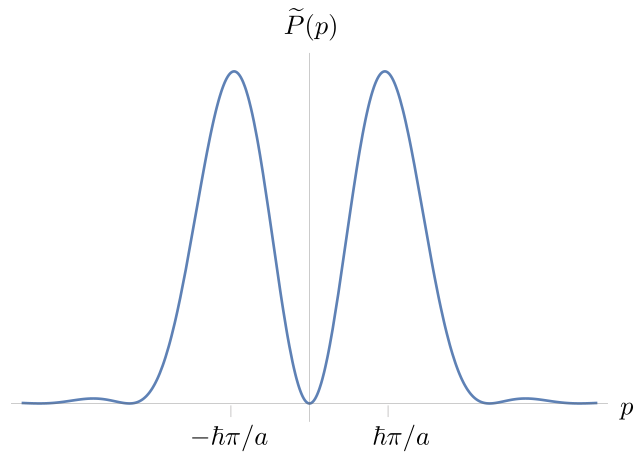
    4. Sketch the momentum probability density \(|\widetilde{\psi}(p)|^2\) and hence explain why
      1. \(\langle p\rangle = 0\), compatible with part (b).
      2. The mostly likely outcomes of a momentum measurement are
      \[ p = \pm \frac{\pi \hbar}{a} \, . \]
    Hints:
    1. Integrate by parts twice or convert the sine to complex exponentials.
    2. If you are having difficulty with the sketch, try Wolfram Alpha!
    Solution:
    1. To determine the normalisation,
      \begin{align}\nonumber 1 & = |C|^2 \int^a_{-a} \sin^2\left( \frac{\pi x}{a}\right) \, dx \\ & = \frac{|C|^2}{2} \int^a_{-a} \left( 1- \cos\left( \frac{2\pi x}{a}\right) \right) \, dx \\ & = |C|^2 a\, , \end{align}
      so we can choose \(C = 1 / \sqrt{a}\).
    2. The momentum expectation value is
      \begin{align}\nonumber \langle p \rangle & = - i \hbar \int^\infty_{-\infty} \overline{\psi(x)} \partial_x \psi(x) \\ & = - i \hbar \frac{\pi}{a^2} \int^a_{-a} \sin\left( \frac{\pi x}{a}\right) \cos\left( \frac{\pi x}{a}\right) \\ & = 0 \end{align}
      because the integrand is odd. Alternatively, the wave function is normalised and real, which implies that \(\langle p\rangle = 0\) by problem 1.3.
    3. The momentum space wave function is
      \begin{align}\nonumber \widetilde{\psi}(p) & = \frac{1}{\sqrt{2\pi \hbar}} \int^\infty_{-\infty} e^{-ipx/\hbar} \psi(x) dx \\ & = \frac{1}{\sqrt{2\pi \hbar a}} \int^a_{-a} e^{-ipx/\hbar} \sin\left(\frac{\pi x}{a}\right) \\ & = \frac{1}{\sqrt{2\pi \hbar a}} \, \frac{1}{2i} \int^a_{-a} \left( e^{-i(p/\hbar-\pi/a)x} - e^{-i(p/\hbar+\pi/a)x}\right) \\ & = \frac{1}{\sqrt{2\pi \hbar a}} \, \frac{1}{2} \left( \frac{e^{ipa/\hbar}-e^{-ipa/\hbar}}{p/\hbar-\pi/a} - \frac{e^{ipa/\hbar}-e^{-ipa/\hbar}}{p/\hbar+\pi/a}\right) \\ & = i \sqrt{\frac{2\pi \hbar^3}{a^3} } \frac{\sin(pa/\hbar)}{p^2-(\hbar\pi / a)^2} \, . \end{align}
      You may also integrate by parts twice to find the same result!
    4. The probability density is
      \[ \widetilde{P}(p) = \frac{2\pi \hbar^3}{a^3} \left( \frac{\sin(pa/\hbar)}{p^2-(\hbar\pi /a)^2 }\right)^2 \, . \]
      1. The momentum probability density is an even function so \(\langle p \rangle = 0\).
      2. The momentum probability density has global maxima at \(p = \pm \hbar\pi / a\).
Enter your question about the highlighted paragraph(s). Use '$...$' to type LaTeX maths.
Your question will be raised anonymously and the answer will appear here at some point.
Long-tap anywhere to ask a question (or see the reply). Right-click anywhere to ask a question (or see the reply).