In classical mechanics, you have learned about two distinct things:
particles and waves. In this chapter we will explore the
`double-slit
experiment'. This shows that the elementary constituents of matter
(electrons, photons, any of the elementary particles) exhibit
characteristics of both particles and waves, known as
`particle-wave
duality'. The experiment also demonstrates that the laws of nature
are fundamentally probabilistic.
Lecture
about the double-slit experiment, going through the main maths that
describes the interference pattern.
First, a quick reminder about the
classical mechanics of particles and waves moving in one dimension.
A particle has a definite position and momentum \((x(t),p(t))\) at each time \(t\). The time evolution of position and momentum is found by solving Hamilton's equations,
where \(H\) is the Hamiltonian function. For a particle of mass \(m\) moving in a potential \(V(x)\) the Hamiltonian is
\begin{equation}
H = \frac{p^2}{2m} +V(x) \, .
\end{equation}
A wave is described by an amplitude \(\psi(x,t)\). This might be the displacement of a string, or a component of the electromagnetic field, as a function of position \(x\) and time \(t\). The amplitude is a solution of a partial differential equation, such as the wave equation
Experiments probing microscopic distances show that the elementary
constituents of matter exhibit characteristics of
both
particles and waves. To see this concretely, we are going to examine
the
`double-slit
experiment'. Although it is very often presented as a thought
experiment, it has actually been performed it in the laboratory, for
instance with electrons. A more extensive account can be found in
Volume III of the Feynman Lectures.
Jim Al-Khalili explaining the double-slit experiment.
For arguments sake, we will imagine performing this experiment with
electrons. We will first explain the outcome of the experiment
according to classical mechanics, assuming that electrons are
particles and then waves. We will then explain how electrons actually
behave in nature.
2.2.Double-Slit : Particles
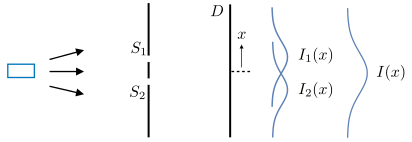
Let us first suppose that electrons are particles. There is a source
emitting these particles at a uniform rate in random directions
towards a screen with two small slits \(S_1\) and \(S_2\). The particles
that pass through one of the slits arrive one at a time at a detector
\(D\) on the other side of the screen.
Figure 2.1: Outcome of the double-slit experiment if the source emits
particles: intensities add up.
By averaging over a long period of time, the detector measures the rate that particles arrive per unit area, as a function of the vertical direction \(x\). We call this the ‘intensity’. Suppose that:
The intensity measured with only \(S_1\) open is \(I_1(x)\).
The intensity measured with only \(S_2\) open is \(I_2(x)\).
The intensity measured with both \(S_1\) and \(S_2\) open is \(I(x)\).
Since particles arrive at the detector one at a time and must pass through either \(S_1\) or \(S_2\), the intensities add up
The result is thus simply the appearance of one or two peaks,
depending on the separation of the slits and the distance to the screen.
2.3.Double-Slit : Waves
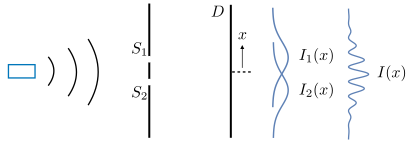
Now suppose instead that electrons are waves with amplitude
\(\psi(x,t)\). There is a source emitting waves uniformly towards a
screen with two small slits \(S_1\) and \(S_2\). The waves pass through
the slits and arrive continuously at a detector \(D\).
Suppose that
The amplitude at the detector with only \(S_1\) open is \(\psi_1(x)\).
The amplitude at the detector with only \(S_2\) open is \(\psi_2(x)\).
The amplitude at the detector with both \(S_1\) and \(S_2\) open is \(\psi(x)\).
Let us assume that the wave amplitude obeys a
linear partial differential equation. Then the principle of superposition means that
Note that we are ignoring the dependence on time \(t\), which is not important in the argument that follows.
Figure 2.2: Outcome of the double-slit experiment if the source emits
waves: there is a characteristic interference pattern.
By averaging over a long period of time, the detector measures the
rate that energy is deposited per unit area, as a function of the
vertical direction \(x\). We again call this the ‘intensity’. The energy
carried by a wave is proportional to the modulus squared of the
amplitude. Ignoring the constant of proportionality,
where \(\delta(x)\) is the relative phase of \(\psi_1(x)\) and
\(\psi_2(x)\). The additional term compared to the result for particles
is known as the ‘interference’ term. It generates the kind of
interference pattern illustrated in the figure above.
Let us compute the interference pattern more explicitly using a series
of approximations. For familiarity, let us suppose that the amplitude
\(\psi(x,t)\) obeys the wave equation with velocity \(v\). We further
assume the slits are very thin, so that we are effectively dealing
with two pointlike sources, producing the two waves
\begin{equation}
\psi_1(x,t) = C \, e^{i ( k r_1 - \omega t)}\,, \quad
\psi_2(x,t) = C \, e^{i ( k r_2 - \omega t)} \, ,
\end{equation}
where
\(C\) is a normalisation constant that is unimportant in what follows,
\(k = \omega / v\) where \(\omega\) is the angular frequency of the wave,
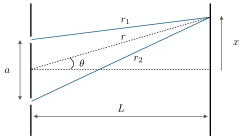
\(r_1\), \(r_2\) are the distances from the slits \(S_1\), \(S_2\) to a point on the detector at height \(x\).
Figure 2.3: Variables used to compute the interference pattern for the
double-slit experiment.
There is constructive interference when \(k(r_1-r_2) = 2 n \pi\) and destructive interference when \(k(r_1-r_2) = (2n+1) \pi\) where \(n\in \mathbb{Z}\), so the intensity will clearly display an interference pattern.
To determine the intensity function \(I(x)\) explicitly is tricky since
the distances \(r_1\), \(r_2\) are complicated functions of \(x\). The two
right-angled triangles give
Taking a square root to obtain \(r_1\) and \(r_2\), we can then subtract
these two expressions to get the phase we have
in \eqref{e:interference}. To get some more insight into that
expression, it is useful to expand \(r_1\) and \(r_2\) for small values
of \(a\), that is, for \(a\ll x\). Using a Taylor expansion we get
and similar for \(r_2\). Subtracting the two and assuming furthermore
that \(x\ll L\), we get the simple expression \(r_2-r_1=a x /L\), and
using this in \eqref{e:interference} thus gives
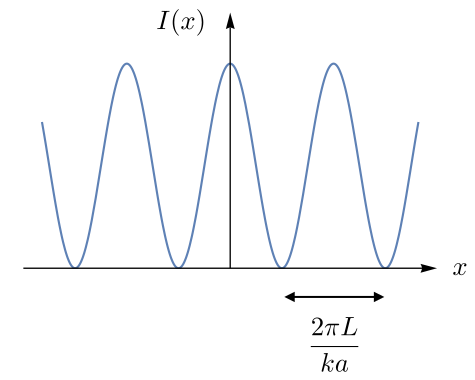
Figure 2.4: Approximate interference pattern computed using the
approximations \(a\ll x\) and \(x \ll L\).
The result is thus quite different from that in the previous section:
waves give a characteristic intensity interference pattern, with an
approximate separation between maxima as given above. To plot the full
pattern, just use \eqref{e:r1r2} directly.
2.4.Double-Slit: the real world
An experiment by Bach et al. reported in 2012 clearly
shows how individual electrons in a double-slit experiment gradually
build up an interference pattern. This movie shows the electron
buildup pattern one electron at a time.
Let us summarise our results for particles and waves and compare to
the experimental result for electrons.
Particles
Particles arrive one at a time.
There is no interference, \(I = I_1+I_2\).
Waves
Waves arrive continuously.
There is interference, \(I = I_1+I_2+ 2\sqrt{I_1 I_2} \cos \delta \).
However, when the experiment is performed with real-world electrons,
the result is neither of these two. Despite the fact that we can set
up the experiment such that we can really register the arrival of
electrons on the screen one-by-one, there
nevertheless is an
interference pattern. So we find that:
Real world electrons
Electrons arrive one at a time.
There is interference, \(I = I_1+I_2+ 2\sqrt{I_1 I_2} \cos \delta \).
So electrons exhibit characteristics of both particles and waves. They
arrive one by one like particles, but the rate that particles arrive
exhibits interference like a wave. This behaviour cannot be explained
in classical mechanics.
In the double-slit experiment, classical particles would
lead to two peaks, and classical waves to an interference
pattern. In the real world, the pattern appears dot-by-dot, but
nevertheless shows interference.
The double experiment is, however, compatible with the following statements:
Electrons arrive at the detector one at a time.
Each of them is described by an amplitude \(\psi(x,t)\).
The modulus squared \(|\psi(x,t)|^2\) is the probability
distribution for the detector to find an electron at position \(x\) at
time \(t\).
The amplitude \(\psi(x,t)\) obeys a linear partial differential
equation to ensure the principle of superposition.
We must abandon the idea that an electron has a definite position
\(x(t)\) at all times. Instead, we may only predict the
probability to measure the position \(x\) in a certain
region. The same conclusion applies to momentum, energy and any other
measurable quantity. The laws of nature are inherently probabilistic!
2.5.Problems
Approximations
We have discussed several approximations to arrive at the wave
interference pattern
There is one hidden assumption which we have not mentioned
explicitly, which is related to the normalisation
constant \(C\). Can you spot it? What would the effect be of
relaxing this assumption?
Solution:
▶
Strictly speaking, the intensity of the wave drops as a function
of the distance from the source, unless you are in one
dimension. In two dimensions, you would have \(C \sim 1/r\). This
means that as you get further away from the axis, and the distance
to the slit gets larger, the intensity drops.
1
Finite-width single slit
Another approximation we have made is that the slits are
infinitesimally thin, which of course in the real world would not
allow for electrons to pass through. We can do better than that.
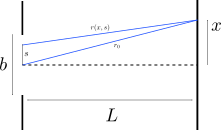
Consider first a single slit of width \(b\) as in the figure
below, centered on the \(x\)-axis.
Figure 2.5: Finite-width single slit experiment, with a slit of
width \(b\).
You can view this as a
superposition of a continuum of sources, so that the wave is
given by
\begin{equation}
\label{e:psicont}
\psi(x,t) = C \int_{s=-b/2}^{b/2} e^{i k r(x,s) - i\omega t} {\rm d}s\,.
\end{equation}
Express \(r(x,s)\) as the sum of \(r_0\) plus a correction, then
perform this integral. Show that the
intensity \(|\psi(x,t)|^2\) takes the form
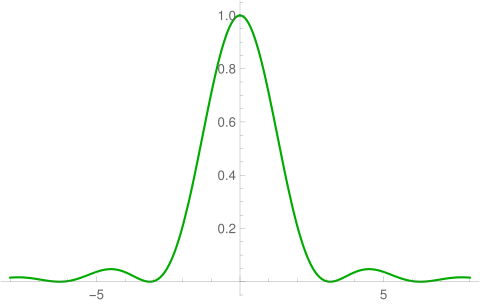
Figure 2.6: Interference pattern for a
single slit, with the size of the slit \(b\) set by \(kb/2L=1\)
(with arbitrary normalisation for \(C\)).
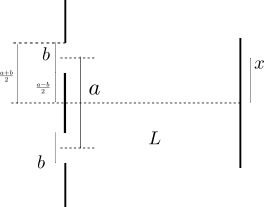
Finite-width double slit
Now consider a situation with finite-width slits, as in the
figure below. Instead of integrating the contributions from
\(-b/2\) to \(b/2\), we should now integrate \eqref{e:psicont} over
\((a-b)/2\) to \((a+b)/2\), and then add the contribution from the
second slit.
Figure 2.7: Finite-width double slit experiment, with slits of
width \(b\) with their midpoints separated by a distance \(a\).
Perform these integrals. Show that the result can be written in
the form of the product of two factors, one which is the
interference pattern of infinitesimally thin double slits
separated by a distance \(a\), and one the interference pattern of
a single slit of finite width \(b\).
Solution:
▶
Instead of doing the integral over \(-b/2 \lt{} s \lt{} b/2\), we now have
two integrals, one ranging over \((a-b)/2 \lt{} s \lt{} (a+b)/2\) and the
other ranging over \(-(a+b)/2 \lt{} s \lt{} -(a-b)/2\). The integrand is the
same. Working out the 4 exponential terms, you get, up to the
factors irrelevant for \(|\psi|^2\),
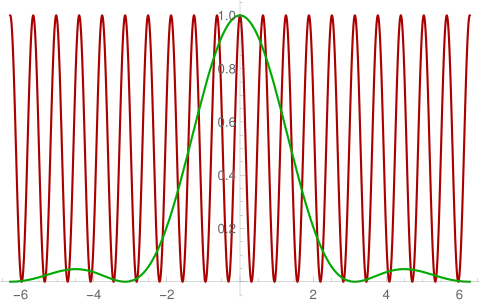
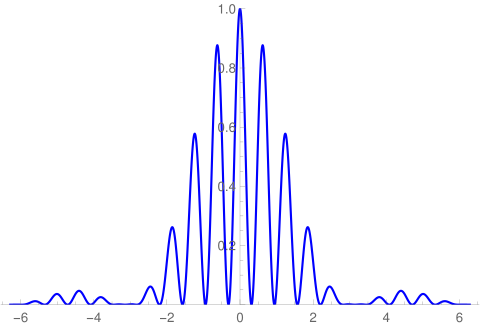
Plots for separation \(a\) equal to \(5\) times the slit size \(b\) are
given below.
Figure 2.8: Interference pattern for a
single slit superposed with the interference pattern of a
double-slit screen with infinitesimally small slits. The
single slit parameter is set to \(kb/2L=1\) and the double-slit
separation parameter is \(ka/2L=5\).
Figure 2.9: Interference pattern for a finite-size double slit,
parameters as above.
Enter your question about the highlighted paragraph(s). Use '$...$' to type LaTeX maths.
Long-tap anywhere to ask a question (or see the reply).Right-click anywhere to ask a question (or see the reply).

 Long-tap anywhere to ask a question (or see the reply).
Right-click anywhere to ask a question (or see the reply).
Long-tap anywhere to ask a question (or see the reply).
Right-click anywhere to ask a question (or see the reply).