In this last lecture, we will explore how the expectation values of
Hermitian operators, such the expectation values of position \(\langle
x\rangle\) and momentum \(\langle p\rangle\), evolve in time. We will
derive an important equation, known as “Ehrenfest's Theorem”[
5], which shows that the classical equations of
motion hold inside expectation values. We will illustrate this theorem
with a number of examples and point out some subtleties.
20.1.A Classical Reminder
In classical mechanics, a particle has definite position and momentum
\((x(t),p(t))\) at each time \(t\) that evolve according to Hamilton's
equations
\begin{align}
\dot x & = + \frac{\partial H}{\partial p} = \{ x,H\} \\
\dot p & = - \frac{\partial H}{\partial x} = \{ p,H\} \, ,
\end{align}
where \(\{ \, , \, \}\) is the Poisson bracket. Furthermore, the evolution of any quantity \(A(x,p)\) constructed from position and momentum is
\begin{equation}
\dot A = \{ A, H\} \, .
\end{equation}
This is the idea we have already exploited that the Hamiltonian
generates time translations. Notice that a quantity \(A\) is constant in
time if and only if its Poisson bracket with the Hamiltonian vanishes,
\begin{equation}
\{H,A\}=0 \, .
\end{equation}
This notion of conserved quantity will carry over naturally to quantum mechanics.
For the standard Hamiltonian
\[
H = \frac{p^2}{2m} + V(x) \,,
\]
we find
\[
\dot x = \frac{p}{m} \qquad
\dot p = -\frac{dV}{dx}
\]
and recover Newton's law
\[
m \ddot x = - \frac{dV}{dx} \, .
\]
20.2.Ehrenfest's Theorem
Ehrenfest's theorem roughly states that the classical
equations of motion hold inside expectation values. It is easily
misinterpreted or misused though.
Let us consider a Hermitian operator \(A\) such as position \(\hat x\), momentum \(\hat p\) or the Hamiltonian operator \(\hat H\).
Recall that the expectation value of \(A\) in a wave function \(\psi(x,t)\) is
\begin{equation}
\langle A \rangle := \langle \psi,A\psi\rangle = \int^\infty_{-\infty} dx \, \overline{\psi(x,t)} \left( A \cdot \psi(x,t) \right) \, .
\end{equation}
We would like to to understand how this expectation value depends on time.
Theorem: For a Hermitian operator \(A\),
\begin{equation}
\displaystyle\frac{d \langle A\rangle }{dt} = \frac{i}{\hbar} \langle [\hat H,A] \rangle \, .
\end{equation}
Proof: We will compute the time derivative of the expectation value using the compact inner product notation. First, using the product rule inside the integral,
\begin{align}
\frac{d \langle A\rangle }{dt} & = \frac{d}{dt} \langle \psi,A\psi\rangle \\[1ex]
& = \langle \partial_t \psi , A \psi \rangle + \langle \psi, A \partial_t \psi \rangle \, .
\end{align}
The partial time derivatives can be replaced by the Hamiltonian operator using Schrödinger's equation,
\begin{equation}
i\hbar \partial_t\psi = \hat H \cdot \psi \, .
\end{equation}
Using properties of the inner product and Hermitian operators, we find
\begin{align}
\label{e:ehrenfest}
\frac{d \langle A\rangle }{d t}
& = \langle -\frac{i}{\hbar} H \psi, A \psi\rangle + \langle \psi, -A \frac{i}{\hbar} H \psi \rangle \\
& = \frac{i}{\hbar} \left( \langle H \psi, A \psi\rangle - \langle \psi, A H \psi \rangle \right) \\
& = \frac{i}{\hbar} \left( \langle \psi, H A \psi\rangle - \langle \psi, A H \psi \rangle \right) \\
& = \frac{i}{\hbar} \langle \psi, [ H, A] \psi \rangle \\
& = \frac{i}{\hbar} \langle [H,A] \rangle
\end{align}
where
\[
[A,B] := AB-BA
\]
is the commutator. This complete the proof.
This result is reminiscent of the classical equations of motion,
\[
\dot A = - \{ H, A\} \, .
\]
To make this precise, recall that commutators in quantum mechanics can be obtained from Poisson brackets in classical mechanics by replacing
\begin{equation}
\{ \, \cdot \, , \, \cdot \, \} \mapsto -\frac{i}{\hbar} [ \, \cdot \, ,\, \cdot \, ] \, .
\end{equation}
For example,
\[
%\{ x , x\} & = 0 \qquad && [ x,x ] = 0 \\
\{ x , p\} = 1 \quad \mapsto \quad [ \hat x, \hat p] = i \hbar \, .
%\{ p,p\} & = 0 \qquad && [p,p] = 0 \, .
\]
gives the canonical commutation relation. Ehrenfest's theorem can
therefore be interpreted as the statement that the classical equations
of motion hold “inside” expectation values.
Let us verify this statement explicitly for the Hamiltonian
\begin{equation}
\label{e:stdH}
H = \frac{p^2}{2m} + V(x)
\end{equation}
where \(V(x)\) is a real analytic function of \(x\).
The commutators of this Hamiltonian with position and momentum were computed in lecture 11,
\begin{equation}
\left[ H , x \right] = -\frac{i\hbar}{m} p \qquad \left[ H , p \right] = i \hbar \frac{d V(x)}{d x} \, .
\end{equation}
From Ehrenfest's theorem,
\begin{equation}
\label{e:stdEhrenfest}
\frac{d \langle x\rangle }{dt} = \frac{\langle p\rangle}{m}\,, \qquad
\frac{d\langle p\rangle }{dt} = -\left\langle \frac{dV}{d x} \right\rangle
\end{equation}
and therefore
\begin{equation}
m \frac{d^2\langle x\rangle}{d t^2} = -\left\langle \frac{\partial V}{\partial x} \right\rangle \, .
\end{equation}
20.3.Conserved Quantities
Conserved quantities correspond to operators which commute
with the Hamiltonian.
In quantum mechanics, a conserved quantity is defined to be a
Hermitian operator \(A\) that commutes with the Hamiltonian: \([H,A] =
0\). This is the natural analogue of the classical statement that
\(\{ A, H\} = 0\). Note that the Hamiltonian itself is always a conserved
quantity!
An immediate consequence of Ehrenfest's theorem is that if \(A\) is
conserved then its expectation value is constant in time,
\begin{equation}
\partial_t \langle A \rangle = 0 \, ,
\end{equation}
justifying the definition of a conserved quantity.
20.4.Example: Free Particle
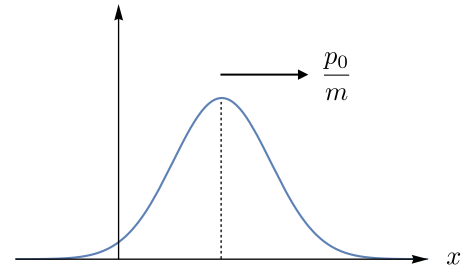
A Gaussian wave packet with momentum \(p_0\) has a centre of
mass moving with velocity \(\langle p\rangle/m\); this follows
directly from Ehrenfest's theorem.
In a previous lecture, we completely solved Schrödinger's equation
for the wave function of a free particle with vanishing potential
\(V(x) = 0\). In particular, we found that an initial Gaussian wave
function remains a Gaussian with expectation values depending on time,
\[
\langle x \rangle = x_0+\frac{p_0}{m} t\,, \qquad \langle p\rangle = p_0 \, .
\]
The important point here is that
\[
\frac{d \langle x\rangle}{d t} = \frac{\langle p\rangle}{m} \qquad \frac{d\langle p\rangle}{dt} = 0 \, ,
\]
so the expectations values solve the classical equations of motion with \(V(x) = 0\): the centre \(\langle x\rangle\) of the Gaussian wave function is moving with a uniform velocity \(\langle p\rangle / m\).
20.5.Example: Infinite Square Well
The expectation value of a function of \(x\) is not the
same as the function of the expectation value of \(x\). Be aware of
this subtlety when using Ehrenfest's theorem.
While Ehrenfest's theorem states the classical equations of motion
hold inside expectation values, this does not necessarily imply that
the expectation values obey the classical equations of motion. That is
to say, while we have seen that
\begin{equation}
m \frac{d^2\langle x\rangle}{d t^2} = -\left\langle \frac{\partial V}{\partial x} \right\rangle \, .
\end{equation}
for a system with Hamiltonian \eqref{e:stdH}, this does not mean that
you can replace the right hand side with
\[
-\frac{\partial V(\langle x\rangle)}{\partial x}\,.
\]
The example in the present section illustrates this
explicitly. Moreover, it shows that sometimes Ehrenfest's theorem
takes a different form, because boundary terms need to be taken into
account.
The example to consider is the infinite square well \(0\lt{}x\lt{}L\), with an initial
wave function that is an equal linear combination of the Hamiltonian
eigenfunctions with the lowest energy,
\begin{equation}
\psi(x,0) = \frac{1}{\sqrt{2}}(\phi_1(x)+\phi_2(x)) \, .
\end{equation}
The solution of Schrödinger's equation at times \(t\gt{}0\) is
\begin{equation}
\psi(x,0) = \frac{1}{\sqrt{2}}(\phi_1(x)e^{-iE_1t/\hbar}+\phi_2(x)e^{-i E_2t/\hbar}) \, .
\end{equation}
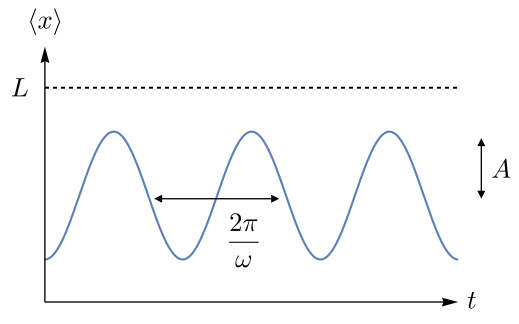
In a tutorial problem in the chapter on stationary states, we have
shown that the position expectation value oscillates in time around
the centre of the box,
\begin{align}
\langle x\rangle & = \frac{L}{2} - A \cos(\omega t) \\
\end{align}
with frequency
\begin{equation}
\omega = \frac{E_2-E_1}{\hbar} \, .
\end{equation}
and amplitude \(A \lt{} \frac{L}{2}\).
This is clearly not a solution of the classical equation of
motion. Since the potential vanishes for \(0\lt{}x\lt{}L\), a classical particle
would feel no force except at the boundaries \(x=0\) and \(x=L\). The
particle would simply bounce backwards and forwards between the two
walls of the infinite potential well with a uniform velocity. So the
expectation value \(\langle x\rangle\) does not satisfy the classical
equation of motion.
Does the classical equations of motion hold inside expectation values,
as Ehrenfest's theorem states? Well, that is rather subtle in this
case. It is straightforward to check that the momentum expectation
value satisfies
\[
\langle p\rangle = A m \omega \sin(\omega t) = m \frac{d\langle x \rangle }{dt}\, .
\]
and thus is in agreement with the first of \eqref{e:stdEhrenfest},
derived from Ehrenfest's theorem. We should also be able to show that
\begin{equation}
\frac{d \langle p\rangle}{dt} = Am\omega^2 \cos(\omega t) = - \left\langle \frac{d V}{dx} \right\rangle \,.
\end{equation}
But computing \(\langle V'(x)\rangle\) is subtle because the potential
jumps at \(x=0\) and \(x=L\) and the derivative of the potential diverges
there.
Sometimes a generalised form of Ehrenfest's theorem is
required, namely when boundary terms ignored in its derivation are
actually non-vanishing.
To treat this problem properly, we need to return to the proof of
Ehrenfest's theorem for momentum, paying more careful attention to the
boundary conditions at \(x=0\) and \(x=L\). The starting point is the
definition of the momentum expectation value,
\[
\langle p \rangle = -i \hbar \int^L_0 dx \, \overline{\psi} (\partial_x \psi) \, .
\]
Using Schrödinger's equation and its complex conjugate,
\begin{equation}
i \hbar \partial_t \psi = -\frac{\hbar^2}{2m} \partial^2_x\psi
\qquad
-i \hbar \partial_t\overline{\psi} = -\frac{\hbar^2}{2m} \partial^2_x\overline{\psi} \,,
\end{equation}
we find
\begin{align}
\frac{d \langle p \rangle}{dt} & = -i \hbar \int^L_0 dx\, \left[ (\partial_t\overline{\psi})(\partial_x \psi) + \overline{\psi} (\partial_x \partial_t \psi)\right] \\
& = - \frac{\hbar^2}{2m} \int^L_0 dx \, \left[( \partial^2_x\bar\psi )( \partial_x \psi )- \overline{\psi} (\partial^3_x\psi ) \right] \\
& = - \frac{\hbar^2}{2m} \int^L_0 dx \, \partial_x \left[ |\partial_x\psi|^2-\overline{\psi} \partial_x^2\psi \right] \\
& = - \frac{\hbar^2}{2m} \left. |\partial_x\psi|^2 \right|^L_0
\end{align}
where in the final step we have used that the wave function vanishes
at \(x=0\) and \(x=L\). As expected, the non-vanishing contribution comes
only from the boundaries \(x= 0\) and \(x = L\), and we did not see these
terms when doing integrations by parts in the derivation of
Ehrenfest's theorem ealier. Be aware of subtleties like these.
Enter your question about the highlighted paragraph(s). Use '$...$' to type LaTeX maths.
 Long-tap anywhere to ask a question (or see the reply).
Right-click anywhere to ask a question (or see the reply).
Long-tap anywhere to ask a question (or see the reply).
Right-click anywhere to ask a question (or see the reply).