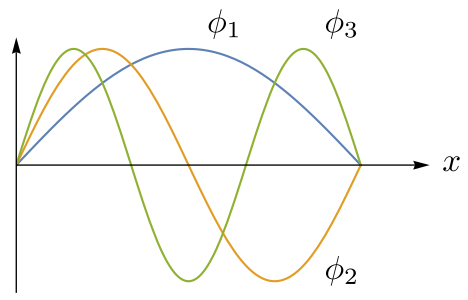
We now begin to develop the mathematical structures underlying quantum mechanics more systematically. In this lecture, we introduce the idea of wave functions as elements of a complex vector space with Hermitian inner product. With a few additional assumptions, this is known as a ‘
Hilbert space’.
6.1.Linear Algebra
Consider a finite-dimensional complex vector space \(V \cong \mathbb{C}^N\). The most important property is that of taking linear combinations: \(a_1v_1 +a_2v_2 \in V\) for any \(v_1,v_2 \in V\) and complex numbers \(a_1,a_2 \in \mathbb{C}\).
A Hermitian inner product on \(V\) is a map
\begin{align}
\langle \, \cdot \, , \, \cdot \, \rangle & : V \times V \to \mathbb{C} \\ \nonumber
& : ( v_1, v_2 ) \mapsto \langle v_1,v_2\rangle
\end{align}
that obeys
\(\langle v,w\rangle = \overline{\langle w,v\rangle}\)
\(\langle v , a_1w_1+a_2 w_2\rangle = a_1 \langle v,w_1\rangle + a_2 \langle v,w_2\rangle\)
\(\langle a_1v_1+a_2 v_2, v\rangle = \bar a_1 \langle v_1,v\rangle + \bar a_2 \langle v_2,v\rangle\)
\(\langle v,v\rangle \geq 0\) with equality iff \(v=0\).
It is often convenient to introduce an orthonormal basis \(\{ e_j\}\) such that
\begin{equation}
\langle e_i,e_j\rangle = \delta_{ij}
\end{equation}
and any vector can be expressed
\begin{equation}
v = \sum_{j=1}^N v_j e_j \, .
\end{equation}
Computing the inner product with \(e_j\), the components of the vector are \(v_j = \langle v,e_j\rangle\). The Hermitian inner product can then be expressed in component form as
\begin{align}
\langle v,w\rangle
%& = \sum_{i,j} \langle v_ie_i , w_je_j \rangle \\ \nonumber
%& = \sum_{i,j} \bar v_i w_j \langle e_i,e_j\rangle \\
%& = \sum_{i,j} \bar v_i w_j \delta_{ij} \\
& = \sum_j \bar v_j w_j \, .
\end{align}
In particular, the squared norm of a vector is \(|v|^2 : = \langle v , v\rangle = \displaystyle\sum_j |v_j|^2\).
6.2.Wave functions Revisited
At a fixed time \(t\), a wave function is a continuous function
\begin{align}
\psi & : \mathbb{R} \to \mathbb{C} \\ \nonumber
& : x \mapsto \psi(x) \, .
\end{align}
In order for the wave function to have a probabilistic interpretation, we require it to be square-normalisable,
\begin{equation}
\int^\infty_{-\infty} |\psi(x)|^2 {\rm d}x \lt{} \infty \, .
\label{eq:sq-int}
\end{equation}
This means that by multiplying by a constant, we can ensure that the probability to find the particle anywhere is \(1\).
The set of continuous square-integrable wave functions forms a complex
vector space. That is to say, for any square-integrable \(\psi_1\),
\(\psi_2\) and complex numbers \(a_1, a_2 \in \mathbb{C}\), the wave
function \(a_1\psi_1+a_2\psi_2\) is square-integrable. This can be shown
as follows. It is immediate that if \(\psi\) is square-integrable then
\(a\psi\) is square integrable for any complex number \(a \in
\mathbb{C}\). We can therefore focus on the sum \(\psi_1+\psi_2\). At
each point \(x \in \mathbb{R}\) we have
\begin{align}
|\psi_1+\psi_2|^2
& = |\psi_1|^2+|\psi_2|^2 + 2 \text{Re} (\bar \psi_1 \psi_2) \\
& \leq |\psi_1|^2+|\psi_2|^2 + 2|\bar \psi_1 \psi_2| \\
& \leq |\psi_1|^2+|\psi_2|^2 + 2| \psi_1 ||\psi_2| \, ,
\end{align}
where we used the properties of complex numbers, \(\text{Re}(z) \leq |z|\) and \(|z_1z_2|=|z_1|z_2|\). We also have the elementary inequality
\begin{align}
2 |\psi_1||\psi_2|
& = |\psi_1|^2+|\psi_2|^2 - ( |\psi_1|-|\psi_2|)^2 \\
& \leq |\psi_1|^2+|\psi_2|^2 \, .
\end{align}
This implies
\begin{equation}
|\psi_1+\psi_2|^2 \leq 2 |\psi_1|^2 + 2 |\psi_2|^2\, .
\end{equation}
and therefore
\begin{equation}
\int^\infty_{-\infty} {\rm d}x \, |\psi_1+\psi_2|^2 \leq 2 \int^\infty_{-\infty} {\rm d}x \, |\psi_1|^2 + 2 \int^\infty_{-\infty} {\rm d}x \, |\psi_2|^2\, .
\end{equation}
This makes it clear that if the wave functions \(\psi_1\) and \(\psi_2\) are square-integrable then the sum \(\psi_1+\psi_2\) is square-integrable.
6.3.Inner Product
Let us define
\begin{equation}
\langle \psi_1,\psi_2\rangle := \int^\infty_{-\infty} {\rm d}x \, \overline{\psi_1(x)} \psi_2(x) \, .
\end{equation}
We claim this is a Hermitian inner product:
\(\langle \psi_1 , \psi_2 \rangle = \overline{ \langle \psi_2, \psi_1\rangle}\)
\(\langle \psi_3,a_1\psi_1+a_2\psi_2 \rangle = a_1 \langle \psi_3 , \psi_1\rangle + a_2 \langle \psi_3,\psi_2\rangle\)
\(\langle a_1\psi_1+a_2\psi_2, \psi_3 \rangle = \bar a_1 \langle \psi_1, \psi_3 \rangle + \bar a_2 \langle \psi_2,\psi_3\rangle\)
\(\langle \psi,\psi \rangle \geq 0\) with equality iff \(\psi(x) = 0\).
The first three properties follow immediately from the definition. To prove the final property, note that
\begin{equation}
\langle \psi,\psi\rangle := \int^\infty_{-\infty} {\rm d}x \, |\psi(x)|^2
\end{equation}
and that the integrand is everywhere non-negative, \(|\psi(x)|^2 \geq 0\). This immediately implies \(\langle \psi , \psi \rangle \geq 0\). Now suppose \(\langle \psi, \psi \rangle = 0\). Then \(|\psi(x)|^2\) vanishes everywhere except a set of measure zero. However, since \(|\psi(x)|^2\) is a continuous function, we must have \(|\psi(x)|^2 = 0\) everywhere and therefore \(\psi(x) = 0\).
The Hermitian inner product obeys another property known as ‘completeness'. We will not need the definition in this course. Including this property, the vector space of wave functions together with the Hermitian inner product form a `
Hilbert space’.
6.4.Orthonormal Bases
It is frequently useful to introduce an orthonormal basis of wave functions. In a later lecture, we will explain that there are natural orthonormal bases that are ‘continuous' or `discrete’ in nature and arise from eigenfunctions of operators associated to observables such as position, momentum and energy.
For now we define an orthonormal basis to be a discrete set of wave functions \(\{ \phi_n(x) \}\) such that
\begin{equation}
\langle \phi_m , \phi_n \rangle = \delta_{mn}
\end{equation}
and any continuous square-integrable wave function can be uniquely expressed
\begin{equation}
\psi(x) = \sum_n c_n \phi_n(x) \, ,
\end{equation}
where
\begin{equation}
c_m = \langle \phi_m , \psi \rangle = \int^\infty_{-\infty} {\rm d}x \, \overline{\phi_m(x)} \, \psi(x) \, .
\end{equation}
The Hermitian inner product can be expressed in terms of the coefficients,
\begin{equation}
\displaystyle \langle \psi_1 , \psi_2 \rangle = \int^\infty_{-\infty} {\rm d}x \, \overline{\psi_1(x)} \psi_2(x) = \sum_n \bar c_{1,n} c_{2,n} \,
\end{equation}
while the the squared norm becomes \(\displaystyle \langle \psi,\psi\rangle = \int^\infty_{-\infty} {\rm d}x \, |\psi(x)|^2 = \displaystyle\sum_n |c_n|^2\).
6.5.Example: Particle in a Box
Let us consider an infinite potential well in the region \(0 \lt{} x \lt{} L\). We therefore restrict to continuous square-integrable wave functions that vanish for \(x \leq 0\) and \(x\geq L\). In this case, we may replace everywhere
\begin{equation}
\int^\infty_{-\infty} {\rm d}x \to \int_0^L {\rm d}x \, .
\end{equation}
Let us define
\begin{equation}
\phi_n(x) = \sqrt{\frac{2}{L}} \sin\left(\frac{n \pi x}{L}\right) \qquad n \in \mathbb{Z}_{\gt{}0} \, .
\end{equation}
These wave functions are orthogonal with respect to the inner product
\begin{align}
\langle \phi_m , \phi_n\rangle & = \int^L_0 \bar \phi_m(x) \phi_n(x) \\ \nonumber
& = \frac{2}{L}\int^L_0 {\rm d}x \sin\left(\frac{m \pi x}{L}\right)\sin\left(\frac{n \pi x}{L}\right) \\
& = \frac{1}{L}\int^L_0 {\rm d}x \left( \cos\left(\frac{(m-n)\pi x}{L}\right) - \cos\left(\frac{(m+n) \pi x}{L}\right) \right) \\
& = \delta_{m,n} - \delta_{m,-n} \\
& = \delta_{m,n}
\end{align}
where in passing to the final line, we dropped the second contribution because \(n+m = 0\) is impossible for \(n,m\in\mathbb{Z}_{\gt{}0}\).
The fact that any continuous square-integrable wave function has a unique expansion of the form
\begin{align}
\psi(x) & = \sum_{n = 0}^\infty c_n \phi_n(x) = \sqrt{\frac{2}{L}} \sum_{n = 1}^\infty c_n \sin\left(\frac{n \pi x}{L}\right) \, ,
\end{align}
is the content of
Fourier's theorem. The Fourier coefficients are found by taking the Hermitian inner product with \(\phi_n(x)\),
\begin{equation}
c_n = \langle \phi_n , \psi \rangle = \sqrt{\frac{2}{L}} \int^L_0{\rm d}x \, \sin\left(\frac{n \pi x}{L}\right)\psi(x) \, .
\end{equation}
The norm squared of the wave function is
\[
\langle \psi,\psi\rangle = \int^L_0 {\rm d}x \, |\psi(x)|^2 = \sum_{n=1}^\infty |c_n|^2 \, ,
\]
which is precisely the statement of
Parseval's theorem.
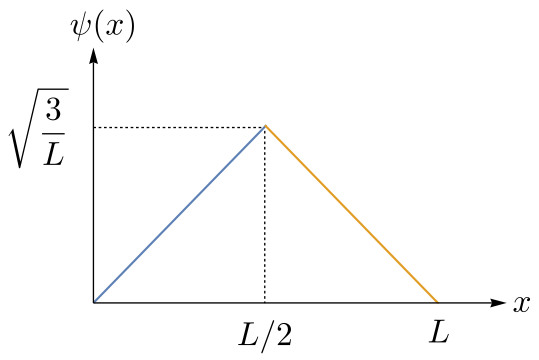
As an example, consider the ‘pyramid’ wave function displayed
above. With the correct normalisation, this wave function is
\begin{equation}
\psi(x) = \sqrt{\frac{12}{L}} \begin{cases}
\; \dfrac{x}{L} & \quad 0 \leq x \leq \dfrac{L}{2} \\[10pt]
\; \dfrac{L-x}{L} & \quad \dfrac{L}{2} \leq x \leq L
\end{cases}
\end{equation}
The Fourier coefficients \(c_n\) are computed as follows,
\begin{align}
c_n & =\sqrt{\frac{2}{L}} \int^L_0 \sin\left(\frac{n \pi x}{L}\right)\psi(x) {\rm d}x \\ \nonumber
& = \sqrt{\frac{24}{L^2}} \left( \int^{L/2}_0 \frac{x}{L} \sin\left(\frac{n \pi x}{L}\right) {\rm d}x+ \int_{L/2}^L \left( 1-\frac{x}{L} \right) \sin\left(\frac{n \pi x}{L}\right) {\rm d}x \right) \\
& = \sqrt{\frac{24}{L^2}}(1-(-1)^n) \int^{L/2}_0\frac{x}{L} \sin\left(\frac{n \pi x}{L}\right) {\rm d}x \\
& = \sqrt{24}(1-(-1)^n) \frac{(-1)^{\frac{n+1}{2}}}{n^2\pi^2} \\
& = \begin{cases}
\displaystyle \frac{\sqrt{96}(-1)^{m+1}}{(2m+1)^2\pi^2} & \text{if} \quad n =2m+1 \\
0 & \text{otherwise}
\end{cases} \, .
\end{align}
In passing to the final line, the summands are non-zero only when \(n\) is odd, so we introduced \(n = 2m+1\).
As a consistency check,
\begin{equation}
\langle \psi,\psi\rangle = \sum_{n=1}^\infty |c_n|^2 = \frac{96}{\pi^4} \sum_{m=0}^\infty \frac{1}{(2m+1)^4} = 1 \, ,
\end{equation}
so the wave function is indeed correctly normalised.

 Long-tap anywhere to ask a question (or see the reply).
Right-click anywhere to ask a question (or see the reply).
Long-tap anywhere to ask a question (or see the reply).
Right-click anywhere to ask a question (or see the reply).