In last term's lectures, you have explored a powerful reformulation of
‘classical mechanics’ using the Lagrangian and Hamiltonian
formalisms. This is perfectly adequate for a complete understanding of
balls, pendulums, springs, and waves, on macroscopic distance scales
familiar to humans.
However, by the early 1900's there was mounting experimental evidence
that the elementary constituents of matter, at microscopic distances
of atoms and molecules, behave in a wholly different manner. The new
theoretical framework that emerged in this period to describe such
phenomena is known as ‘quantum mechanics’. This has had a profound
effect on society: quantum mechanics underpins much of the
technological revolution of the last century.
Ultimately, the framework of quantum mechanics is determined by
experimental facts. However, many features of quantum mechanics are
reminiscent of the Hamiltonian formulation of classical mechanics, and
we will emphasise this connection throughout the course. You should
keep in mind that quantum mechanics is the more fundamental
description of nature, with classical mechanics an approximation valid
at macroscopic distances.
Introductory
lecture, in which the module is introduced and motivation is given
that led to the birth of quantum mechanics.
Quantum mechanics has an extremely rich mathematical framework. In
this course, we will encounter techniques from analysis, probability,
algebra, and representation theory. Moreover, ideas and techniques
from quantum mechanics have inspired many exciting developments in
pure mathematics in the last half century, particularly in geometry
and topology. This continues to be an active area of research today.
In this lecture and the next, we will explore some of the
inconsistencies between classical mechanics and experimental facts
about nature at microscopic distances. This will serve as a guide to
the development of quantum mechanics in subsequent lectures.
1.2.Bound States
Many potentials which lead to a continuum of bound states
in classical mechanics produce, instead, a discrete spectrum in the
real world, which can be ‘explained' by `quantisation conditions’.
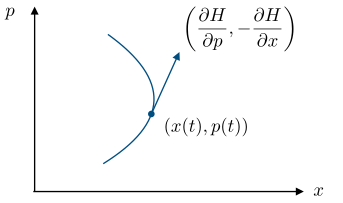
In classical mechanics, a particle has a definite position and
momentum \((x(t), p(t))\) at each time \(t\). We can view this
geometrically as a curve in ‘phase space’ parametrised by time
\(t\). Given some initial conditions, the shape of the curve is
determined by Hamilton's equations,
\begin{equation}
\label{firsteq}
\dot x = \frac{\partial H}{\partial p}\,, \qquad \dot p = - \frac{\partial H}{\partial x} \, ,
\end{equation}
where \(H\) is the Hamiltonian. More precisely, Hamilton's equations
specify the tangent space to the curve at each time \(t\), as shown
below.
Figure 1.1: Phase space dynamics of a classical system, driven by the Hamiltonian.
Example.
A particle of mass \(m\) moving in a potential \(V(x)\) has
\begin{equation}
H = \frac{p^2}{2m} + V(x) \, .
\end{equation}
The Hamiltonian itself is conserved and equal to the total energy \(E\),
given by the sum of kinetic energy and potential energy. In this case,
eliminating the momentum \(p\) from Hamilton's equations leads back to
Newton's law,
\begin{equation}
m \ddot x = - \frac{dV}{dx} \, .
\end{equation}
In classical mechanics, a ‘bound state' is a solution of Hamilton’s
equations that is confined to a finite region of phase space. Bound
states arise from oscillations around a local minimum of the potential
\(V(x)\).
Example 1
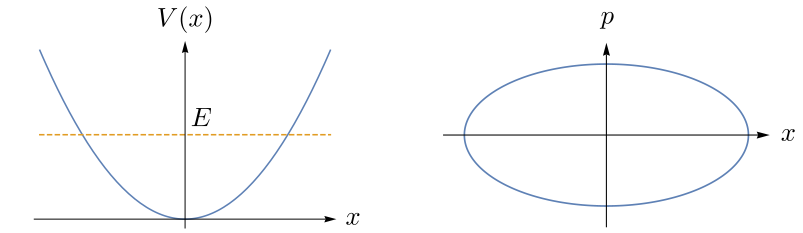
A simple harmonic oscillator has quadratic potential
where the energy \(E \geq 0\) and phase \(\phi\) are determined by the initial conditions.
Figure 1.2: Potential energy and phase space dynamics of the simple
harmonic oscillator.
The particle is confined to the region where \(V(x) \leq E\) and cannot
escape to infinity. The curve \((x(t),p(t))\) forms an ellipse in phase
space, which is confined to a finite region. There is therefore a
continuous spectrum of bound states parametrised by the energy \(E \geq
0\).
Example 2.
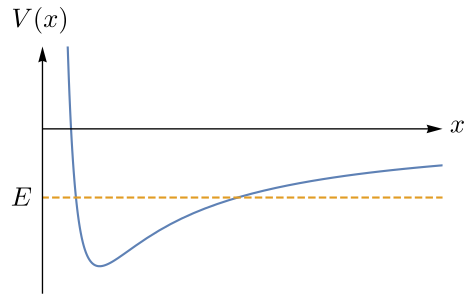
The effective potential for the radial motion of an electron in a hydrogen atom is (in convenient units)
where \(m\), \(e\) are the mass and electric charge of the electron and
\(J^2\) is the conserved square of the angular momentum vector. The
potential has a minimum at \(x_{0} = J^2/me^2\) and asymptotes to \(0\)
from below as \(x \to \infty\). There is a continuous spectrum of bound
states parametrised by \(J^2\) and energy \(V(x_0) \lt{} E \lt{} 0\).
Figure 1.3: Classical potential energy of the hydrogen atom; there is a
classical bound state for every energy \(V(x_0)\lt{}E\lt{}0\).
More generally, any potential \(V(x)\) with a local minimum at some
point \(x_0\) will classically have a
continuous spectrum of
bound states with energy \(V(x_0) \lt{} E \lt{} E_{\mathrm{max}}\) for some
maximum energy \(E_{\mathrm{max}}\).
This classical expectation is in striking contradiction with
experimental tests of microscopic systems, which typically have a
discrete spectrum of bound states. For example, from the study
of atomic spectra it is known that a hydrogen atom has a discrete set
of bound states where angular momentum and energy take particular
values
The quantity \(h\) is a new constant of nature known as the
Planck
constant. This has units of 'energy times time' (just like angular
momentum) and is approximately
These discrete spectra of bound states cannot be explained in the
framework of classical mechanics. Later in the course, we will show
that a discrete spectrum of bound states is, however, a characteristic
feature of quantum mechanics.
In the beginning days of quantum mechanics, people tried to impose
these quantisation rules by hand, for instance by imposing that for
the harmonic oscillator,
\begin{equation}
\label{e:one}
\int_{\text{orbit}} p {\rm d x} = n h\,, \quad n\in{\mathbb Z}\,,
\end{equation}
where the integral is over one entire orbit. For the harmonic
oscillator, we get (see the problems)
\begin{equation}
\int_{\text{orbit}} p {\rm d x} = \frac{2\pi E}{\omega}\,,
\end{equation}
and so with \(\omega = 2\pi\nu\), the `quantisation
condition' \eqref{e:one} produces \(E = \nu h n\). However, such
quantisation prescriptions clearly do not constitute a ‘theory’, and
are difficult to generalise to more complicated systems.
1.3.The Photoelectric Effect
Light irradiated onto a metal behaves as if it is made of
discrete constituents (‘photons’).
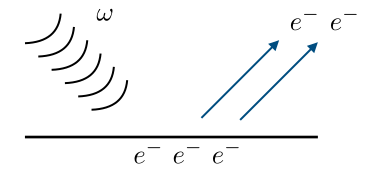
We now consider another important phenomenon that is inconsistent with
classical mechanics. The
`photo-electric
effect' is the emission of electrons from certain metals when
irradiated by light.
Figure 1.4: Schematic depiction of the photo-electric effect: when
light of frequency \(\omega\) is irradiated onto a metal, it
releases electrons.
In classical mechanics, light is a wave. This is a fluctuation in the
electromagnetic field that solves the wave equation
where \(c\) is the speed of light. You can think about the real part of
the amplitude \(\psi(x,t)\) as a component of the electric or magnetic
field. Let us assume the light is monochromatic and accurately
described by a plane wave
with angular frequency \(\omega\). This is related to the wavelength by
\(\lambda = 2\pi / \omega\). The ‘intensity’ of the light is the energy
carried by the electromagnetic field, averaged over time. This is
proportional to the modulus squared of the amplitude, \(I \sim
|\psi(x,t)|^2 = |\psi_0|^2\), and is independent of the angular
frequency \(\omega\).
Let us assume an electron in the metal must absorb a minimum amount of
energy \(E_{\text{min}}\) from the light to be emitted from the
metal. Then the classical description of light as a wave leads to the
following expectation:
The energy of the emitted electrons depends on the intensity \(I\) but is independent of the angular frequency \(\omega\).
Electrons are emitted even in low-intensity light, but there is a time-delay as each electron absorbs the minimum energy \(E_{\text{min}}\).
However, the experimental result is the following:
The energy of emitted electrons is independent of the intensity \(I\) and is linearly proportional to the angular frequency, \(\hbar \omega - E_{\text{min}}\).
Electrons are only emitted if \(\hbar \omega \geq E_{\text{min}} \) and are emitted immediately.
Here \(\hbar\) is the same Planck's constant introduced above. This is shockingly different to the classical expectation!
In 1905, Einstein made a remarkable proposal that resolved this
contradiction: that light arrives in indivisible packets known as
‘quanta' or `photons’. The energy carried by each individual photon is
\begin{equation}
E = \hbar \omega \, ,
\end{equation}
while the intensity is related to the rate that photons are
arriving. Assuming an electron can only absorb one photon at a time,
this means that an electron can only be emitted if \(\hbar \omega \geq
E_{\text{min}}\). Its energy is equal to that of the photon it absorbs
minus the energy needed to escape the metal, \(\hbar \omega -
E_{\text{min}}\).
1.4.These lectures
In these lectures we will restrict to one-dimensional quantum
mechanics in the Schrödinger wave function approach.
We have seen two examples of how the classical mechanics of particles
and waves fails to explain experimental data at microscopic
distances. Furthermore, we have seen hints that light has
characteristics of a wave, but arrives in indivisible packets like a
particle. This is known as
`particle-wave
duality' and is a feature not only of light but also electrons and
all constituents of matter.
In the following chapters, we will explore this idea much more
precisely, starting with the ‘double slit’ experiment, and then
gradually developing a mathematical formalism that can explain the
phenomena discussed above.
Feynman on the difficulty of understanding
quantum mechanics.
As we go along, you will discover that quantum mechanics is a hard
topic. This is not only because it requires you to understand a load
of new mathematical ingredients, but mostly because, as a beginner,
you will be guaranteed to lack an intuition for it. Your classical
experience with the real world out there is of no use when it comes to
understanding the microscopic world governed by quantum mechanics. So
the only way to ‘gain intuition’ is to solve many problems and slowly
get used to the strange miscroscopic world. To make life easier, we
will stick exclusively to one-dimensional systems in these lectures.
Another aspect which does not make it simpler for a newcomer to grasp
the concepts is that there exist three different mathematical
formulations of quantum mechanics, all equivalent in sofar this can be
verified, but radically different in their notation and even
conceptual interpretation. The present notes follow the so-called
Schrödinger wave function approach, which connects most
clearly to classical wave mechanics which was at the root of the
development of quantum mechanics originally.
The first of the other two approaches is the
operator approach,
which formalises much of the wave function approach into the language
of operators acting on infinite-dimensional vector spaces. We will
touch briefly on this towards the end of the module. Finally,
there is the
path integral approach, which is both conceptually
and technically entirely different from the first two. These two other
approaches will be discussed in the Quantum Mechanics III module.
1.5.Recommended literature
Read books! No honestly, read books! There is no
substitute for solving problems yourself, but the next best thing is
to read multiple sources so you get to see things from different
angles.
Three books which these notes to a large extent based on are
Introduction to Quantum Mechanics, David J. Griffiths
A standard textbook. Chapters 1-3 cover the same material as this
course but in a different order. Overall, this is the most appropriate
textbook.
Quantum Physics, S. Gasiorowicz Chapters 3-7 contain
lots of worked examples relevant for this course.
Principles of Quantum Mechanics, R. Shankar A popular
favourite. Chapters 3-7 cover similar material to this course but at
a more advanced level. A good investment for ambitious students who
wish to progress onto Quantum Mechanics III.
There are various other books which do get referred to
frequently, but which are somewhat further away from the present
course, e.g.:
Modern Quantum Mechanics, J. J. Sakurai Another
standard book, with a nice motivation for quantum mechanics at the
beginning. It does, however, use the operator approach almost
exclusively.
Feynman Lectures, Volume III, R.P. Feynmann,
R.B. Leighton, M. Sands
A classic everyone should have read. Covers a lot more than we will
cover in this module, but the first few chapters are worth having a
look at. Available for free online at https://www.feynmanlectures.caltech.edu.
Notes on Quantum Mechanics, D.V. Schroeder
A very new book by an extremely good educator. Has a lot of emphasis
on concrete computations, often using Mathematica. Available for
free online at https://physics.weber.edu/schroeder/quantum/.
1.6.Problems
Hamilton's equations
Write down Hamilton's equations for a particle in a harmonic
potential,
\begin{equation}
V = \frac{1}{2}m \omega^2 x^2\,.
\end{equation}
and show that its solutions are as stated.
Solution:
▶
The Hamiltonian and its derivatives with respect to \(x\) and \(p\)
are
\begin{equation}
\int_{\text{orbit}} p {\rm d x} = 2 E \int_{\text{orbit}} \cos(\omega t + \phi) {\rm d}\left(
\frac{1}{\omega} \sin(\omega t + \phi) \right)\,.
\end{equation}
By applying the chain rule we can rewrite the complicated
differential \({\rm d}(\ldots)\) in terms of \({\rm d}t\). Moreover,
one orbit is given by taking \(t\) from \(0\) to
\(2\pi/\omega\). Together, this gives
\begin{equation}
= 2E \int_{0}^{2\pi/\omega}\!\!\! \cos^2(\omega t + \phi) {\rm d} t
= \frac{2\pi E}{\omega}\,.
\end{equation}
Enter your question about the highlighted paragraph(s). Use '$...$' to type LaTeX maths.
Long-tap anywhere to ask a question (or see the reply).Right-click anywhere to ask a question (or see the reply).

 Long-tap anywhere to ask a question (or see the reply).
Right-click anywhere to ask a question (or see the reply).
Long-tap anywhere to ask a question (or see the reply).
Right-click anywhere to ask a question (or see the reply).