This lecture is an extended example consisting of a ``free particle" moving on a line. This means that the potential \(V(x) = V_0\) is a constant. In this lecture, we assume for simplicity that the potential vanishes \(V_0 = 0\). You might think this is the simplest possible example, but it exhibits a number of important subtleties.
13.1.Step 1: Hamiltonian Eigenfunctions
Once we know the decomposition of an initial Gaussian wave
function in terms of energy eigenfunctions, we can compute its time evolution.
The starting point for understanding is to construct an orthonormal basis of eigenfunctions of the Hamiltonian operator
\[
\hat H = \frac{\hat p^2}{2m} = -\frac{\hbar^2}{2m} \frac{\partial^2}{\partial x^2} \, .
\]
In this case, it is first convenient to first discuss the momentum operator \(\hat p\). This is because an eigenfunction of the momentum operator \(\hat p\) with eigenvalue \(p\) is automatically an eigenfunction of the Hamiltonian operator \(\hat H\) with eigenvalue \(E = p^2/2m\).
The momentum eigenfunctions are solutions to the differential equation
\begin{equation}
-i \hbar \frac{\partial }{\partial x} \phi_p(x) = p \phi_p(x) \, .
\end{equation}
The solutions are
\begin{equation}
\phi_p(x) = \frac{1}{\sqrt{2\pi \hbar}} e^{i p x/\hbar}
\end{equation}
for any \(p \in \mathbb{R}\). The momentum operator therefore has a continuous spectrum and correspondingly the normalisation is chosen so that
\begin{align}
\langle \phi_p , \phi_{p'}\rangle & = \int^\infty_{-\infty} \overline{\phi_p(x)} \phi_{p'}(x) {\rm d}x \\
& = \frac{1}{2\pi \hbar}\int^{\infty}_{-\infty} e^{-i(p-p')x/\hbar} {\rm d}x \\
& = \delta(p-p') \, .
\end{align}
The spectrum of the momentum operator is also non-degenerate: there is a unique eigenfunction \(\phi_p(x)\) for each eigenvalue \(p \in \mathbb{R}\).
The same wave functions are also Hamiltonian eigenfunctions
\[
\hat H \cdot \phi_p(x) = - \frac{\hbar^2}{2m} \frac{\partial^2}{\partial x^2} \phi_p(x) = E_p \phi_p(x)
\]
where
\[
E_p = \frac{p^2}{2m} \, .
\]
However, the spectrum of the Hamiltonian is degenerate since \(\phi_p(x)\) and \(\phi_{-p}(x)\) have the same energy since \(E_p = E_{-p}\). This is a consequence of ``parity" symmetry \(x \mapsto -x\) that sends
\[
\phi_p(x) \mapsto \phi_p(-x) = \phi_{-p}(x) \, ,
\]
while leaving the Hamiltonian operator \(\hat H\) invariant. Nevertheless, the wave functions \(\phi_p(x)\) can be taken as an orthonormal basis of Hamiltonian eigenfunctions.
13.3.Step 3: Time Evolution of Wave function
We now return to the problem at hand: how to determine the solution of Schrödinger's equation \(\psi(x,t)\) given an initial wave function \(\psi(x,0)\).
We expand \(\psi(x,0)\) as a linear combination of the Hamiltonian eigenfunctions. In this case, the spectrum of the Hamiltonian operator is continuous and the expansion becomes an integral
\begin{align}
\psi(x,0) & = \int^\infty_{-\infty} {\rm d}p \, c(p) \, \phi_p(x) \\
& = \frac{1}{\sqrt{2\pi \hbar}}\int^\infty_{-\infty} {\rm d}p \, c(p) \, e^{ipx/\hbar} \, .
\end{align}
The coefficients function \(c(p)\) is computed via the inverse relation,
\begin{equation}
c(p) = \frac{1}{\sqrt{2\pi\hbar}}\int^\infty_{-\infty} {\rm d}x \, \psi(x,0) \, e^{-ipx/\hbar} \, .
\end{equation}
This is of course the Fourier transform between the initial wave function \(\psi(x,0)\) and the initial momentum space wave function, \(c(p) = \widetilde\psi(p,0)\)
To compute the wave function at later times, we promote the Hamiltonian eigenfunctions \(\phi_p(x)\) to stationary wave functions,
\begin{align}
\psi(x,t) & =\int^\infty_{-\infty} {\rm d}p \, c(p) \psi_p(x,t) \\
& = \frac{1}{\sqrt{2\pi\hbar}}\int^\infty_{-\infty} {\rm d}p \, c(p) \, e^{ipx/\hbar} e^{-ip^2t/2m\hbar} \, .
\end{align}
We can express this in terms of the initial wave function \(\psi(x,0)\) by substituting in the inverse Fourier transform for the coefficients \(c(p)\) and interchanging the order of integration,
\begin{align}
\psi(x,t) & = \frac{1}{2\pi\hbar}\int^\infty_{-\infty} {\rm d}p \, \left( \int^\infty_{-\infty} {\rm d}x' \, \psi(x',0) \, e^{-ipx'/\hbar} \right) \, e^{ipx/\hbar} e^{-ip^2t/2m\hbar} \\
& = \frac{1}{2\pi\hbar} \int^\infty_{-\infty} {\rm d}x'\psi(x',0) \int^\infty_{-\infty} {\rm d}p \, e^{ip(x-x')/\hbar}e^{-ip^2t/2m\hbar} \, .
\end{align}
The integral over momentum can now be computed using the standard Gaussian integral formula
\begin{equation}
\int^\infty_{-\infty} \, {\rm d}y \, e^{-\alpha y^2+ \beta y} = \sqrt{\frac{\pi}{\alpha}} \, e^{\beta^2/4\alpha} \, .
\end{equation}
With the substitution
\begin{align}
\alpha = \frac{it}{2m\hbar} \qquad \beta = i\frac{(x-x')}{\hbar} \, ,
\end{align}
we find
\begin{equation}
\int^\infty_{-\infty} {\rm d}p \, e^{ip(x-x')/\hbar}e^{-ip^2t/2m\hbar} =\left(\frac{2\pi \hbar m}{i t}\right)^{1/2}e^{im(x-x')^2 / 2\hbar t} \, .
\end{equation}
The propagator allows us to compute, by doing a single
integral, the wave function at arbitrary times if we know the wave
function at an initial time.
We therefore have
\begin{align}
\psi(x,t) = \left(\frac{m}{2\pi\hbar i t}\right)^{1/2} \int^\infty_{-\infty} {\rm d}x' \, \psi(x',0) \, \exp\left( \frac{im(x-x')^2}{2\hbar t}\right) \, ,
\end{align}
which allows us to compute \(\psi(x,t)\) from the initial wave function
\(\psi(x,0)\). The object
\begin{equation}
G(x,x';t) = \left(\frac{m}{2\pi\hbar i t}\right)^{1/2} \exp\left( \frac{im(x-x')^2}{2\hbar t}\right)
\end{equation}
is sometimes called the “propagator”.
Important Subtlety. The Gaussian integral above converges for \(\mathrm{Re}(\alpha)\gt{}0\) whereas our \(\alpha\) is purely imaginary. A more careful analysis would add a small imaginary time \(t \to t - i \epsilon\) and consider the limit \(\epsilon \to 0\), or deform the contour of integration slightly into the complex \(p\)-plane. This will not be necessary in this course - the above formulae will be correct for all examples we come across. An example is the Gaussian wave function, which we now turn to.
13.4.Example: Time-Evolution of Gaussian
Gaussian wave functions spread in time, but preserve their
Gaussian nature. They also preserve their minimal spread.
Consider an initial Gaussian wave function
\begin{equation}
\psi(x,0) = C e^{ip_0x/\hbar}e^{-x^2/4\Delta^2}
\end{equation}
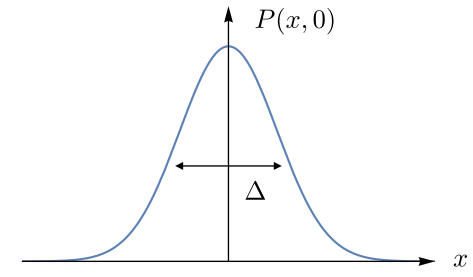
with normalisation \(C = (2\pi\Delta^2)^{-1/4}\). The initial probability distribution is
\begin{align}
P(x,0) & =|\psi(x,0)|^2 \\
& = \frac{1}{\sqrt{2\pi\Delta^2}} e^{-x^2/2\Delta^2}
\end{align}
The initial wave function has the characteristic properties
\begin{align}
\langle x \rangle & = 0 \qquad && \Delta x = \Delta \\
\langle p\rangle & = p_0 \qquad && \Delta p = \frac{\hbar}{2\Delta} \, .
\end{align}
In particular, Heisenberg's uncertainty principle is saturated, \(\Delta x \Delta p = \hbar/2\).
The wave function at later times is
\begin{align}
\psi(x,t)
& = \left(\frac{m}{2\pi\hbar i t}\right)^{1/2} \int^\infty_{-\infty} {\rm d}x' \, \exp\left( \frac{im(x-x')^2}{2\hbar t}\right) \, \psi(x',0) \\
& = C \left(\frac{m}{2\pi\hbar i t}\right)^{1/2} \int^\infty_{-\infty} {\rm d}x' \, \exp\left( \frac{im(x-x')^2}{2\hbar t}\right) \, e^{ip_0x'/\hbar}e^{-x'^2/4\Delta^2} \, .
\end{align}
This can be evaluated by performing another Gaussian integral with parameters
\begin{align}
\alpha & =\frac{m}{2i\hbar t}\left( 1 + \frac{i\hbar t}{2m\Delta^2} \right)\\
\beta & = -\frac{im}{\hbar t}\left( x - \frac{p_0t}{m} \right) \, .
\end{align}
Notice that \(\mathrm{Re}(\alpha)\gt{}0\) so the Gaussian integral converges
and there is no subtlety in computing it. After some simplification,
the final result for the wave function at later times is
\begin{equation}
\psi(x,t) = \left[ 2\pi\Delta^2\left(1+\frac{i\hbar t}{2m\Delta^2}\right) \right]^{1/4} \exp\left[ ip_0\left(x-\frac{p_0t}{2m}\right)\right] \exp\left[ \frac{-(x-p_0t/m)^2}{4\Delta^2(1+i\hbar t / 2m\Delta^2)} \right] \, .
\end{equation}
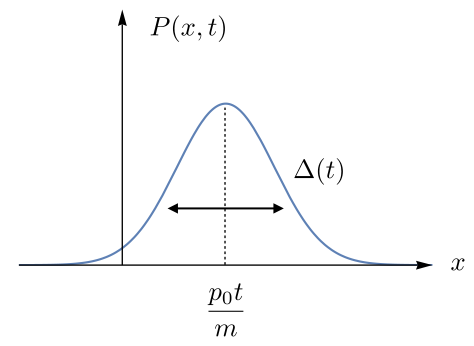
The probability distribution is particularly simple,
\begin{equation}
P(x,t) = \frac{1}{\sqrt{2\pi\Delta(t)^2}} \exp\left[ -\frac{x(t)^2}{4\Delta(t)^2} \right]
\end{equation}
where
\begin{equation}
x(t) = x - \frac{p_0t}{m} \qquad \Delta(t) = \Delta\sqrt{1+\frac{\hbar^2t^2}{4m^2\Delta^4}} \, .
\end{equation}
This is a time-dependent Gaussian characterised by
\begin{align}
\langle x \rangle & = \frac{p_0}{m} t \qquad && \Delta x = \Delta(t) \\
\langle p\rangle & = p_0 \qquad && \Delta p = \frac{\hbar}{2\Delta(t)}
\end{align}
Time-evolution of a free Gaussian wave packet with non-zero momentum
\(\langle x\rangle\), \(\langle p\rangle\) obey the classical
equations of motion: the centre of the wavepacket \(\langle x\rangle\)
is moving with constant velocity \(p_0 /m\). In a later lecture, we
will prove this result in generality.
The position uncertainty \(\Delta(t)\) is increasing in
time. Intuitively, the initial uncertainty in momentum (and
therefore velocity) leads to an increasing uncertainty in position
over time.
Heisenberg's uncertainty principle is saturated \(\Delta x \Delta
p = \frac{\hbar}{2}\) for all \(t\): the wave function remains Gaussian.
For a macroscopic object of mass \(1g = 10^{-3}kg\) with initial
position determined up to uncertainty \(\Delta \sim 10^{-15}m\) equal
to the width of a proton, it would take \(300,000\) years for the
uncertainty in position to grow to \(\Delta\sim 1mm = 10^{-3}m\). It
is therefore reasonable to treat macroscopic objects classically
over long periods of time.


 Long-tap anywhere to ask a question (or see the reply).
Right-click anywhere to ask a question (or see the reply).
Long-tap anywhere to ask a question (or see the reply).
Right-click anywhere to ask a question (or see the reply).