In the last two lectures, we summarised the postulates of quantum
mechanics and revisited what we learnt earlier in the course about
measurements of position and momentum. In this lecture, we will do the
same for measurements of energy and prove a couple of very important
theorems about the spectrum of the Hamiltonian operator.
11.1.Reminder about Energy Measurements
Given the wave function \(\psi(x)\) of a particle moving in some
potential \(V(x)\), the basic question we want to answer is: how can we
determine the possible outcomes of a measurement of energy and their
probabilities?
The starting point is to construct an orthonormal basis of
eigenfunctions of the Hamiltonian operator \(\hat H\). For now, let's
assume the spectrum of the Hamiltonian has the following properties:
Discrete: There is a discrete set of eigenvalues \(\{E_j\}\).
Non-degenerate: There is a unique eigenfunction \(\phi_j(x)\) solving
\begin{equation}
\hat H \cdot \phi_j(x) = E_j \phi_j(x)
\end{equation}
for each eigenvalue \(E_j\).
In this case, we can choose the eigenfunctions to be orthonormal,
\begin{equation}
\langle \psi_i , \psi_j\rangle = \delta_{ij}\, .
\end{equation}
We then expand the wave function
\begin{equation}
\psi(x) = \sum_j c_j \phi_j(x)
\end{equation}
and, provided the wave function is normalised, the probability to
measure energy \(E_j\) is \(P_j = |c_j|^2.\) As a consistency check, it is
straightforward to check that \(\sum_j P_j = 1\).
Finally, we can compute expectation value of energy measurements by
summing the possible outcomes of an energy measurement weighted by
their probabilities, \(\langle H \rangle = \sum_j P_j E_j\).
11.2.Examples with Bound States
Examples of bound states suggest two important properties
of the energy spectrum which hold in a variety of situations (but
not all).
The Hamiltonian could in principle have a continuous spectrum or both
discrete and continuous eigenvalues. It may also be
degenerate
with multiple linearly independent eigenfunctions with the same
eigenvalue. It is therefore important to qualify when the assumptions
made in the previous section are valid.
For concreteness, let us consider a particle of mass \(m\) moving on a line with potential \(V(x)\). The Hamiltonian operator is then
\begin{align}
\hat H & = \frac{\hat p^2}{2m} + V(x) \\
& = -\frac{\hbar^2}{2m} \frac{\partial^2}{\partial x^2} + V(x)
\end{align}
and Hamiltonian eigenfunctions are solutions to the differential equation
\begin{equation}
-\frac{\hbar^2}{2m} \frac{\partial^2\psi(x)}{\partial x^2} + V(x) \psi(x) = E\psi(x)
\end{equation}
that satisfy appropriate boundary conditions as \(x \to \pm \infty\) and at any discontinuities in the potential \(V(x)\).
The Hamiltonian operator typically has a discrete spectrum for
energies \(E\) where the corresponding classical solutions \(x(t)\) would
be bounded in space. For this reason, the corresponding eigenfunctions
are sometimes called ``bound states". This is perhaps best illustrated
with examples.
Infinite square well. Consider the potential
\begin{equation}
V(x) = \begin{cases}
0 & \; 0\lt{}x\lt{}L \\
\infty & \; \text{other}
\end{cases} \, .
\end{equation}
The classical motion is certainly bounded for any energy \(E\gt{}0\): the particle bounces back and forth from the walls of the box. The spectrum of the Hamiltonian is indeed discrete and non-degenerate with eigenvalues
\begin{equation}
E_n = \displaystyle\frac{\hbar^2}{2m}\left( \frac{n\pi}{L} \right)^2 \qquad n\in \mathbb{Z}_{\gt{}0} \, .
\end{equation}
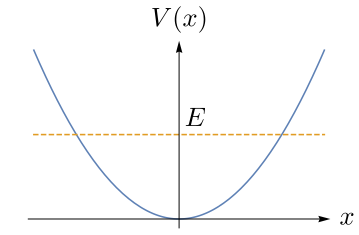
Simple harmonic oscillator. Consider the quadratic potential
\begin{equation}
V(x) = \frac{1}{2}m\omega^2 x^2\, .
\end{equation}
The classical motion is bounded: the particle oscillates with angular frequency \(\omega\) for any finite energy \(E\gt{}0\). Later in the course, we will show that the spectrum is again discrete and non-degenerate with eigenvalues
\begin{equation}
E_n = \hbar \omega\left(n+\frac{1}{2}\right) \qquad n \in \mathbb{Z}_{\geq 0} \, .
\end{equation}
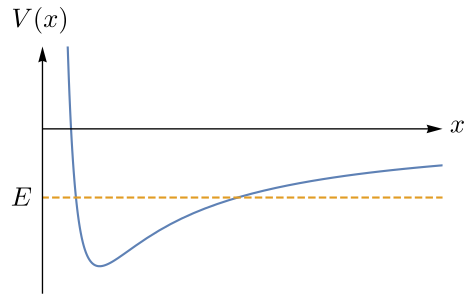
Hydrogen Atom: The effective potential of an electron in a hydrogen atom is
\begin{equation}
V(x) = \frac{J^2}{2mx^2} - \frac{e^2}{x}\, .
\end{equation}
The classical motion is bounded for \(E\lt{}0\) and unbounded for \(E\geq 0\). Correspondingly, there is a discrete set of bound states with energy \(E\lt{}0\), given by
\begin{equation}
E_n = -\frac{me^4}{2\hbar^2n^2} \qquad n \in \mathbb{Z}_{\gt{}0}\, .
\end{equation}
There is also a continuous spectrum of ``scattering states" with \(E\gt{}0\) that will also be studied later in the course.
These examples illustrate some important universal features of a particle moving on a real line:
The Hamiltonian eigenvalues obey \(E \gt{} V_0\) where \(V_0\) is the minimum of the potential \(V(x)\).
The spectrum of the Hamiltonian is non-degenerate.
We prove these properties in the following sections.
11.3.Minimum Energy
In quantum mechanics, the lowest lying energy eigenvalue
is always strictly larger than the minimal value of the
potential. This is called the zero-point energy.
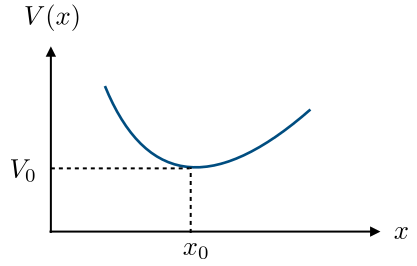
Suppose the potential is bounded below, meaning \(V(x) \geq V_0\) for
all \(x \in \mathbb{R}\). The point \(x_0\) where \(V(x_0) = V_0\) is
typically a local minimum.
In classical mechanics there is a continuum of bound states with energy \(E\geq V_0\) with the minimum energy configuration \(E = V_0\) corresponding to a stationary particle at \(x = x_{0}\). In contrast, in quantum mechanics we must have \(E \gt{} V_0\).
Theorem: If the wave function is normalised, \(\langle H\rangle \gt{} V_{0}\).
Proof: The energy expectation value is
\begin{align}
\langle H\rangle & = \langle \psi,\hat H\psi\rangle \\
& = \frac{1}{2m} \langle \psi, \hat p^2\psi \rangle + \langle \psi,V(x)\psi\rangle \\
& = \frac{1}{2m} \langle \hat p \psi, \hat p\psi \rangle + \langle \psi,V(x)\psi\rangle \, ,
\end{align}
since the momentum operator \(p\) is Hermitian. The first term is necessarily non-negative,
\begin{equation}
\langle \hat p\psi , \hat p\psi\rangle = \int^\infty_{-\infty} | \hat p \psi(x)|^2 \, {\rm d}x = \int^\infty_{-\infty} \left| -i \psi'(x) \right|^2 \, {\rm d}x \geq 0
\end{equation}
and therefore
\begin{equation}
\langle H\rangle \geq \langle \psi,V(x)\psi\rangle = \int^\infty_{-\infty} V(x) |\psi(x)|^2 \, {\rm d}x \geq V_0 \int^\infty_{-\infty} |\psi(x)|^2 \, {\rm d}x = V_0 \, .
\end{equation}
We therefore conclude that \(\langle H\rangle \geq V_0\).
The next step is to rule out equality. A necessary condition for
equality is \(\langle \hat p\psi , \hat p\psi\rangle=0\). From positive
definiteness of the inner product, this would require that \(\hat p\psi
=0\) and therefore
\begin{equation}
-i\hbar\frac{\partial\psi(x)}{\partial x} = 0 \quad \Rightarrow \quad \psi(x) = c\,,
\end{equation}
where \(c \in \mathbb{C}\) is constant. However, square-normalisability
requires \(\psi(x) \to 0\) for \(x \to \pm \infty\) and hence \(c=0\), so
such a wave function would vanish identically. We therefore conclude
that \(\langle H\rangle \gt{} V_0\).
Corollary: If \(\psi(x)\) is a normalized eigenfunction
of \(H\) with eigenvalue \(E\), then \(E \gt{}V_0\).
Proof: This is a
simple consequence of the above theorem: \(\langle H\rangle = \langle
\psi,H\psi\rangle = E\langle \psi,\psi\rangle = E \gt{} 0\).
This means that states with the minimum energy in classical mechanics,
\(E = V_0\), corresponding to a stationary particle, cannot exist in
quantum mechanics. This is compatible with our intuition from
Heisenberg's uncertainty principle. It is a very important result.
The smallest eigenvalue \(E\gt{}V_0\) is sometimes known as the
`
zero-point
energy' in quantum mechanics. This is a characteristic feature of
quantum mechanics that leads ultimately to some of the greatest
mysteries in theoretical physics.
11.4.Non-degeneracy
For a particle on the real line, the energy spectrum is
non-degenerate: there exists only one eigenfunction for each energy
eigenvalue. The proof generalises to some other situations, but not all.
Theorem: The spectrum of the Hamiltonian is non-degenerate.
Proof: Consider a pair of square-normalizable eigenfunctions with the same eigenvalue,
\begin{align}
\hat H \cdot \psi_1(x) & = E \psi_1(x)\\
\hat H \cdot \psi_2(x) & = E\psi_2(x) \, .
\end{align}
We will prove that \(\psi_1(x) \propto \psi_2(x)\), which implies there is a unique normalised eigenfunction for each eigenvalue \(E\).
Expanding out, we have
\begin{align}
-\frac{\hbar}{2m}\partial_x^2 \psi_1(x) + V(x) \psi_1(x) & = E\psi_1(x) \\
-\frac{\hbar}{2m}\partial_x^2 \psi_2(x) + V(x) \psi_2(x) & = E\psi_2(x) \, .
\end{align}
Subtracting the top equation multiplied by \(\psi_2(x)\) from the bottom
equation multiplied by \(\psi_1(x)\), the contributions propotional to
\(V(x)\) and \(E\) vanish and we find
\begin{align}
0 & = \psi_1 \partial_x^2\psi_2 - \psi_2 \partial_x^2\psi_1 \\[1ex]
& = \partial_x( \psi_1 \partial_x\psi_2 - \psi_2 \, \partial_x\psi_1 ) \, .
\end{align}
Therefore,
\begin{equation}
\label{e:c-eq}
\psi_1 \partial_x\psi_2 - \psi_2 \partial_x\psi_1 = c \in \mathbb{C} \, .
\end{equation}
Boundary conditions are crucial in proving non-degeneracy
of the energy spectrum.
But since the wave functions are normalizable, \(\psi_1(x)\),
\(\psi_2(x)\) necessarily vanish at \(x \to \pm\infty\). Evaluating the
equation at infinity, we therefore determine that \(c = 0\). We can then
solve the equation,
\begin{align}
\, & \psi_1 \partial_x\psi_2 - \psi_2 \partial_x\psi_1 = 0 \\[1ex]
\Rightarrow \; & \frac{\partial_x\psi_1}{\psi_1} - \frac{\partial_x\psi_2}{\psi_2} = 0 \\
\Rightarrow \; & \partial_x (\log \psi_1 - \log \psi_2 ) = 0 \\
\Rightarrow \; & \log \frac{\psi_1}{\psi_2} = A \\
\Rightarrow \; & \psi_1 = e^A \psi_2 \,,
\end{align}
for some constant \(A \in \mathbb{C}\). This shows that \(\psi_1(x)\) and
\(\psi_2(x)\) are the same eigenfunction.
11.5.The Evader
We have encountered a potential counterexample to the above theorem: a
free particle moving on a circle of circumference \(L\) with potential
\(V(x) = 0\). There is an orthonormal basis of Hamiltonian
eigenfunctions
\begin{equation}
\phi_{\pm n}(x) = \frac{1}{\sqrt{L}} e^{\pm 2\pi i n x /L} \qquad n \in \mathbb{Z}
\end{equation}
with eigenvalues
\begin{equation}
E_n = \frac{\hbar^2}{2m}\left( \frac{2\pi n}{L} \right)^2 \, .
\end{equation}
The spectrum is degenerate because \(E_n = E_{-n}\). The above proof
fails at the stage where we required the wave function to vanish as \(x
\to \pm \infty\). Here, instead we have imposed periodic boundary
conditions \(\psi(x+L) = \psi(x)\), which is not strong enough to
determine the constant \(c = 0\) in \eqref{e:c-eq}.

 Long-tap anywhere to ask a question (or see the reply).
Right-click anywhere to ask a question (or see the reply).
Long-tap anywhere to ask a question (or see the reply).
Right-click anywhere to ask a question (or see the reply).