4.1.Momentum in Classical Mechanics
For motivation, we first recall the interpretation of momentum in
classical mechanics as the generator of translations in space.
Recall from last term's lectures that functions of position and momentum generate infinitesimal canonical transformations in Hamiltonian mechanics. The infinitesimal canonical transformation with parameter \(\epsilon\) generated by a function \(A(x,p)\) is
\begin{align}
x & \to x' = x+\epsilon \{ x, A\} \\
p & \to p' = p +\epsilon\{ p,A\} \, .
\end{align}
where
\begin{equation}
\{ f , g \} := \frac{\partial f}{\partial x}\frac{\partial g}{\partial p} - \frac{\partial f}{\partial p}\frac{\partial g}{\partial x}
\end{equation}
is the Poisson bracket.
In particular, the canonical transformation generated by the function
\begin{equation}
A(x,p) = p
\end{equation}
is
\begin{align}
x & \to x' = x+\epsilon \{ x,p\} = x + \epsilon \\
p & \to p' = p +\epsilon\{ p,p\} = p \, .
\end{align}
Here we have used that
\begin{equation}
\{ x,p\} = 1 \, .
\end{equation}
The important lesson is that momentum \(p\) generates an infinitesimal translation of \(x\).
4.2.Momentum in Quantum Mechanics
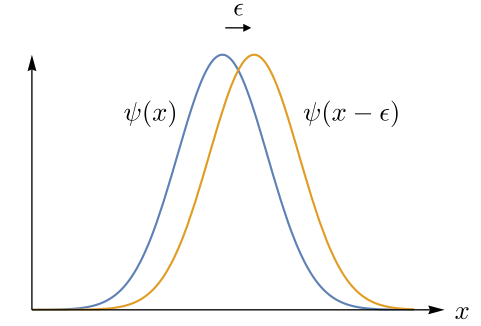
We now use this idea of momentum to understand momentum in quantum mechanics. Let us consider translating a wave function \(\psi(x)\) by a infinitesimal amount \(\epsilon\) in the positive \(x\) direction - as shown below. As in the previous lecture, we work at some fixed moment in time.
The translated wave function is of course \(\psi(x-\epsilon)\). To first order in \(\epsilon\), the change in the wave function is found by Taylor expanding,
\begin{align}
\delta_\epsilon\psi(x) & = \psi(x-\epsilon) - \psi(x) \\
& = - \epsilon \frac{\partial}{\partial x} \psi(x) + {\cal O}(\epsilon^2) \, .
\end{align}
If we want momentum to generate translations, this suggests we should identify momentum \(p\) with the derivative with respect to \(x\).
Let us therefore define a
momentum operator\begin{equation}
\hat p = - i \hbar \frac{\partial}{\partial x} \, ,
\label{eq:mom-op}
\end{equation}
such that
\begin{equation}
\delta_\epsilon \psi(x) = - \epsilon\frac{i}{\hbar} \hat p \, \psi(x) \, ,
\end{equation}
where \(\hbar\) is a constant of proportionality. The additional factors
of \(i\) are introduced for convenience; we will get back to them shortly.
Some comments are in order
Note that while the momentum \(p\) has units of \(MLT^{-1}\),
\(\partial / \partial x\) has units of \(L^{-1}\). This means \(\hbar\)
must have units \(ML^2T^{-1}\), or ‘energy\(\cdot\)time’.
Since the wave function is complex, we could imagine \(\hbar\) is
a complex number. In a moment, we will show that \(\hbar\) must be
real for momentum measurements to yield real results. This is why we
introduced the extra factor of \(-i\) in the definition.
Planck's constant has to be present in quantum mechanics
for dimensional reasons. It has dimension of ‘energy\(\cdot\)time’
or ‘action’.
The constant \(\hbar\) is known as the (reduced)
Planck
constant, and pronounced ‘h-bar’.
Its value cannot be determined by mathematical
arguments. It must be determined by comparing to experimental data,
for example atomic spectra. In our universe,
\begin{equation}
\hbar \approx 1.05 \times 10^{-34} \, \mathrm{kg} \, \mathrm{m}^2 \, \mathrm{s}^{-1} \, .
\end{equation}
The smallness of this number, in units that are natural to humans, is
why we do not observe quantum mechanical effects in everyday life. You
will in the literature also find \(h = 2\pi \hbar\), which is usually
called Planck's constant (without the ‘reduced’ prefix).
4.3.A Quick Commutator
In order have position and momentum on an equal footing, we can introduce a position operator \(\hat x\) that simply multiplies a wave function by \(x\). In summary,
\begin{align}
\hat x & = x \\
\hat p & = - i \hbar \frac{\partial}{\partial x} \, .
\end{align}
The ‘commutator’ of these operators is defined by
\begin{equation}
\left[ \hat x , \hat p \right] : = \hat x \, \hat p - \hat p \, \hat x \, .
\end{equation}
Here the operators should always be understood to act on everything to the right. Acting with this equation on a wave function \(\psi(x)\), we have
\begin{align}
\left[ \hat x , \hat p \right] \, \psi(x)
& = \hat x (\hat p \, \psi(x) ) - \hat p (\hat x \, \psi(x) ) \\
& = x \left(-i \hbar\frac{\partial}{\partial x}\psi(x) \right) + i \hbar \frac{\partial}{\partial x} \left( x \psi(x) \right) \\
& = i \hbar \, \psi(x) \, .
\end{align}
where the final line follows from the product rule. Since this holds for any wave function \(\psi(x)\), we can summarise this result by
\begin{equation}
\left[ \hat x , \hat p \right] = i \hbar \, .
\end{equation}
This is known as the
canonical commutation relation.
The commutator is reminiscent of the Poisson bracket formula \(\{ x , p\} = 1\) from classical mechanics. In fact, the commutator in quantum mechanics is found by replacing
\begin{equation}
\{ \, , \, \} \to -\frac{i}{\hbar}[ \, , \, ] \, .
\end{equation}
This replacement rule is known as ‘canonical quantisation’. We study it further in later lectures after introducing some more mathematical machinery.
4.4.Momentum Expectation Values
Just like position, in quantum mechanics we can only compute the probabilities of the outcomes of momentum measurements. For now, we satisfy ourselves with computing expectation values of functions of momentum.
First, recall from the last lecture that the expectation value \(\langle x\rangle\) can be written
\begin{align}
\langle x\rangle & = \int^\infty_{-\infty} x \, | \psi(x,t) |^2 \, dx \\
& = \int^\infty_{-\infty} \overline{\psi(x,t)} \, \hat x \, \psi(x,t) \, dx \, .
\end{align}
We now propose, similarly, that the expectation value of momentum is
\begin{align}
\langle p \rangle & = \int^\infty_{-\infty} \overline{\psi(x,t)} \, \hat p \, \psi(x,t) \, dx \\
& = - i \hbar \int^\infty_{-\infty} \overline{\psi(x,t)} \, \frac{\partial}{\partial x} \, \psi(x,t) \, dx \, .
\end{align}
As for the position expectation value, we emphasise that \(\langle p\rangle\) is interpreted as the average of momentum measurements on an ensemble of particles with the same wave function \(\psi(x,t)\).
Let us now return to explain why \(\hbar\) must be real. Since the outcomes of momentum measurements are real numbers, we require \(\langle p\rangle \in \mathbb{R}\). Let us imagine for a second that \(\hbar\) is complex and compute the complex conjugate of \(\langle p\rangle\),
\begin{align}
\overline{\langle p \rangle} & = i \bar\hbar \int^\infty_{-\infty} dx \, \psi(x,t) \frac{\partial}{\partial x}\overline{\psi(x,t)} \\
& = -i \bar\hbar \int^\infty_{-\infty} dx \, \frac{\partial}{\partial x}\psi(x,t) \, \overline{\psi(x,t)} + i \hbar \left[ |\psi(x,t)|^2 \right]^\infty_{-\infty} \\
& = - i \bar\hbar \int^\infty_{-\infty} dx \, \overline{\psi(x,t)} \frac{\partial}{\partial x}\psi(x,t) \\
& = \frac{\bar\hbar}{\hbar} \langle p\rangle \, .
\end{align}
In the passing second line, we have integrated by parts. In passing to the third line, we discarded the boundary term because \(|\psi(x,t)|^2\) must vanish as \(x \to \pm \infty\) if the wave function is square normalisable. Therefore, the momentum expectation value is real if and only if \(\hbar\) is real.
In a similar way, we can compute more general expectation values
\begin{align}
\langle f(p) \rangle & = \int^\infty_{-\infty} dx\, \overline{\psi(x,t)} \, f(\hat p) \, \psi(x,t) \\
& = \int^\infty_{-\infty}dx \, \overline{\psi(x,t)} \, f\left(-i\hbar \frac{\partial}{\partial x} \right) \, \psi(x,t) \, .
\end{align}
Of particular importance is the momentum uncertainty
\begin{equation}
\Delta p = \sqrt{\langle p^2\rangle - \langle p \rangle^2} \, ,
\end{equation}
which gives a measure of the spread of momentum measurements around \(\langle p \rangle\) made on an ensemble of particles with identical wave function \(\psi(x,t)\).
4.4.1.Example: Gaussian Wave function
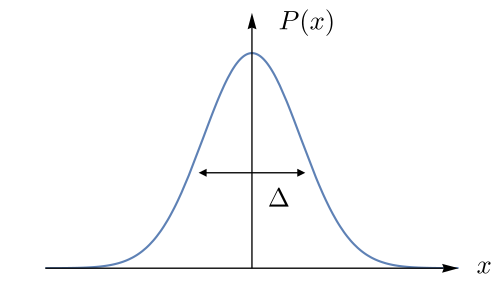
Let us again consider the wave function
\begin{equation}
\psi(x) = C e^{-x^2/4\Delta^2} \, ,
\end{equation}
with normalisation \(C = (2\pi\Delta^2)^{-1/4}\). In the last lecture, we showed that the position expectation values are given by \(\langle x \rangle = 0\) and \(\langle x^2\rangle = \Delta^2\), and therefore the uncertainty in position is \(\Delta x = \Delta\).
The action of the momentum operator on this wave function is
\begin{align}
\hat p \, \psi(x) & = \frac{i\hbar}{2\Delta^2} \, x \, \psi(x) \\
\hat p^2 \, \psi(x) & = \frac{\hbar^2}{2\Delta^2} \, \psi(x) - \frac{\hbar^2}{4\Delta^4} \, x^2 \, \psi(x) \, .
\end{align}
Note that the result is always a polynomial in \(x\) times the original wave function. This means we can recycle our results for position expectation values to compute momentum expectation values. For example,
\begin{equation}
\langle p \rangle = \frac{i \hbar }{2\Delta^2} \int^\infty_{-\infty} x | \psi(x)|^2 = \frac{i \hbar }{2\Delta^2} \langle x \rangle = 0
\end{equation}
and similarly
\begin{align}
\langle p^2 \rangle & = \frac{\hbar^2}{2\Delta^2} \int^\infty_{-\infty} |\psi(x)|^2 -\frac{\hbar^2}{4\Delta^4} \int^\infty_{-\infty} x^2 |\psi(x)|^2 \\
& = \frac{\hbar^2}{2\Delta^2} -\frac{\hbar^2}{4\Delta^4} \langle x^2 \rangle \\
& = \frac{\hbar^2}{4\Delta^2} \, .
\end{align}
The momentum uncertainty is therefore \(\Delta p = \frac{\hbar}{2\Delta}\).
Note that the product of position and momentum uncertainties is independent of \(\Delta\),
\begin{equation}
\Delta x \, \Delta p = \frac{\hbar}{2} \, .
\end{equation}
This means that if we attempt to localise the particle in space by making \(\Delta x\) smaller, the the uncertainly in momentum \(\Delta p\) necessarily increases, and vice verse.
4.5.Heisenberg's Uncertainty Principle
This example illustrates an important result known as Heisenberg's
uncertainty principle. This states that for any normalised wave function,
\begin{equation}
\Delta x \Delta p \geq \frac{\hbar}{2} \, .
\end{equation}
We will prove this result later in the course. It shows that there is a fundamental limit in quantum mechanics on the degree we can simultaneously reduce the uncertainty in position and momentum. The Gaussian wave function saturates this limit: it is a ‘minimal uncertainty’ wave function.
Remember that \(\hbar\) is an extremely small number in human units. So while we cannot arrange for both \(\Delta x\) and \(\Delta p\) to vanish, both uncertainties can be simultaneously small in human units. This goes some way to explaining why in everyday life, objects appear to have a definite position and momentum.

 Long-tap anywhere to ask a question (or see the reply).
Right-click anywhere to ask a question (or see the reply).
Long-tap anywhere to ask a question (or see the reply).
Right-click anywhere to ask a question (or see the reply).